Transform Workflows With AI For Real Estate Agents
AI for real estate agents mixes machine learning with automation to tackle lead scoring, price suggestions, and client outreach. Saleswise hands you the hard data you need, so you spend less time on admin and more time closing deals.
How AI Is Changing Real Estate Workflows

Agents today juggle listings, open houses, emails, and endless forms. AI steps in by automating repetitive chores, freeing you up for client meetings and strategy.
To illustrate, Saleswise’s CMA feature delivers a full market comparison in about 30 seconds. Pair that with virtual staging and AI-driven content tools, and your listings suddenly look more polished—with minimal effort.
- Lead Qualification: AI assigns scores and ranks prospects automatically.
- Pricing Recommendations: Predictive analytics suggest the ideal list price.
- Personalized Outreach: Automated messages crafted to each contact’s profile.
Why Agents Are Turning To AI
Rising competition and more demanding clients mean guesswork won’t cut it. By swapping instincts for hard numbers, you price homes accurately and target your marketing budget better.
Agents using AI report a 30% reduction in admin time and 20% faster sales cycles.
This guide lays out our path: core concepts, must-have features, real-world success stories, and a look at what’s around the corner. You’ll learn how to vet vendors, slot tools into your workflows, and measure ROI. By the end, you’ll understand why now is the perfect moment to dive into AI and how to start.
What To Expect In This Guide
First, we break down machine learning, natural language processing, and predictive analytics in plain English.
Next, you’ll see the key features every agent needs, illustrated by real-world examples.
Finally, we’ll show you how to select the right platform, roll it out smoothly, and track its impact on your bottom line.
Below you’ll see an image showing a modern agent using an AI dashboard to track leads and market trends.
This visual gives a snapshot of AI in day-to-day operations seamlessly.
Understanding Core AI Concepts For Real Estate Agents
When you dive into AI, it helps to see its core functions as familiar roles on your team. Each method handles a different aspect of your workflow, and together they form a cohesive system.
Core AI Techniques
Think of Machine Learning as a seasoned detective. It reviews past transactions, conversations, and outcomes to uncover patterns you might miss. Over time, it ranks leads, suggests prices, and even flags the hottest neighborhoods.
- Machine Learning: Studies historical data to score prospects and recommend list prices.
- Predictive Analytics: Acts like a weather forecaster, spotting market shifts before they happen.
- Natural Language Processing: Powers chatbots that understand questions and craft responses that feel human.
These three elements collaborate behind the scenes. They automate lead scoring, price adjustments, and client outreach—so you spend less time on routine tasks and more time closing deals.
Distinguishing Real AI From Hype
It’s easy to get dazzled by fancy claims. Instead, ask vendors for specific proof points: what data they use and how accurate their models are.
Vendors who share metrics such as precision and recall demonstrate a commitment to genuine performance, not marketing flair.
That level of transparency confirms you’re working with tools trained on real estate data—rather than generic examples.
AI Tool Adoption And Usage Rates
Below is a snapshot of the most popular AI platforms among agents, along with their adoption percentages and main functions. This will help you see which tools are already making a mark.
| Tool | Adoption Rate | Primary Use |
|---|---|---|
| Saleswise | 68% | CMA reports in about 30 seconds |
| CINC | 54% | Lead scoring and nurturing |
| Top Producer | 45% | Market trend analysis |
| ChatGPT | 40% | Generating listing descriptions |
In 2025, roughly 68% of agents are relying on AI tools, with 20% using them daily and 46% turning to these platforms for listing copy—according to the National Association of Realtors Technology Survey.
This chart shows daily AI use climbing from 10% in 2023 to 20% in 2025, a clear sign that confidence in these solutions is growing.
Choosing The Right AI Solution
Beyond adoption numbers, focus on practical fit:
- Data Quality: Platforms trained on local MLS records deliver tighter valuations.
- Custom Models: Look for tools that let you tweak algorithms to match your market’s quirks.
- Integration: Seamless CRM connections prevent double entries and keep your pipeline tidy.
When you weigh these factors alongside transparent performance metrics, you’ll be in a strong position to select an AI partner that truly supports your goals.
Exploring Essential AI Features For Real Estate Agents

Modern agents juggle countless tasks every day. AI steps in like a reliable backstage crew, managing details so you can focus on clients. Automated listing description tools spin raw property specs into compelling summaries within seconds—no more staring at blank pages.
Predictive pricing engines work much like seasoned analysts. They sift through market data and suggest optimal price points, helping you list more accurately and close deals faster. All that power comes without wrestling with massive spreadsheets.
Meanwhile, chatbots stand guard around the clock, ready to answer basic questions, schedule showings and nurture leads. Their constant presence keeps prospects engaged, even when you’re off the clock.
- Automated Listing Descriptions: Converts specs into persuasive summaries
- Predictive Pricing Engines: Scans market trends to suggest smart prices
- 24/7 Chatbots: Replies instantly to FAQs and books appointments
- Workflow Automations: Sends follow-up emails and calendar reminders
Workflow automations handle routine chores like drip campaigns and calendar invites. Agents often save hours each week—time they can reinvest in relationship-building.
Feeling like you’re spinning plates while juggling follow-ups? AI reminders catch every lead. The result: stronger connections and more signed contracts.
Assessing AI Tools In Action
Before committing, take a demo for a spin. Map each feature to an actual task—whether it’s pricing analysis or lead outreach—to see real impact. For instance, set up a 14-day trial, assign follow-up tasks and measure time saved against your usual pace.
Track response rates alongside efficiency gains. This hands-on approach removes guesswork and gives you hard numbers.
Learn more about strategic AI-driven marketing in our comprehensive guide on AI for Real Estate Marketing.
Selecting The Right Features
Zero in on your biggest pain points first. Tools for crafting listing descriptions and fine-tuning prices often show instant returns. Chatbots and automations build value over time as leads move toward contracts.
| Feature | Benefit | Use Case |
|---|---|---|
| Automated Descriptions | Saves 60% of writing time | New property listings |
| Predictive Pricing Engines | Improves pricing accuracy by 12% | Competitive markets |
| AI Chatbots | Reduces response time by 80% | Initial lead engagement |
| Workflow Automations | Cuts follow-up tasks by 70% | Post-showing outreach |
This snapshot highlights which features pack the biggest punch. Combine demo data with these benchmarks and focus on what aligns with your goals.
"AI features should feel like team members you never have to train, consistently boosting productivity and client satisfaction."
Mapping Tools To Your Workflow
Start by charting your daily routines, then slot in AI features where they deliver the most relief. For example, let chatbots handle basic inquiries while automated reminders keep your calendar on track. When tools match real needs, adoption soars—and you’ll see results.
Agents who map use cases report a 40% increase in tool usage within the first month. Small tweaks based on feedback make these solutions feel like natural extensions of your workflow.
- Identify your top three bottlenecks
- Demo AI features targeting those gaps
- Track metrics such as time saved and lead response
Adopt these AI capabilities to sharpen efficiency and deepen client engagement.
Real-World AI Use Cases For Real Estate Agents
Forget the hype—AI today is a practical helper for every agent. By automating routine chores, it frees you up to focus on high-impact activities like showings, negotiations and client relationships.
In the following sections, we’ll walk through four concrete scenarios. You’ll see exactly how agents are using these techniques and how you can apply them right away.
Lead Qualification With Predictive Scoring
One Miami agent turned to predictive scoring and saw her best leads convert 20% faster in just seven days. The secret lies in setting up a simple, repeatable process:
- Import your lead list into the CRM.
- Let AI assign each contact a score from 0–100 based on past interactions.
- Automatically launch a tailored nurture campaign to the highest scorers.
- Use those hot leads to schedule showings in minutes rather than hours.
The impact? She cut average listing time by 3 days, which meant more slots for new buyers and smoother deal flow.
Marketing Personalization Workflows
Good marketing speaks to each buyer’s needs. AI helps you craft messages that feel hand-picked:
- Segment contacts by budget, purchase history or neighborhood preference.
- Generate email templates tailored to first-time buyers, investors or luxury seekers.
- Run quick A/B tests on subject lines to find what really sticks.
- Deploy online ads featuring custom images drawn from browsing behavior.
This approach pushed click-through rates up by 25% and filled calendars with more qualified appointments.
Automated Tenant Screening And Instant Valuations
If rentals are your focus, AI can speed up two key steps: vetting applicants and valuing properties.
- Automated background and credit checks wrap up in minutes.
- A clear risk score flags potential red flags at a glance.
- Decision-ready reports hit your inbox without manual data entry.
Meanwhile, instant valuation tools crunch comps and local trends 2x faster, so you can underwrite offers immediately.
“AI screenings cut tenant vetting from days to under an hour,” says a Chicago property manager.
Integration Tips For CRM And Chat Interfaces
Getting these tools to talk with each other is easier than you think. Follow this roadmap for a smooth rollout:
- Pick AI solutions with native plugins for your CRM (Salesforce, HubSpot, etc.).
- Test chatbots on both your website and social channels to capture every inquiry.
- Map AI insights into existing fields to prevent duplicate records.
- Equip your team with a short, illustrated playbook so everyone follows the same steps.
You might also explore our guide on best virtual home staging software to make your listings shine even brighter.
Data Privacy Best Practices
Trust is everything in real estate. Keep your AI setup on the right side of the law by following these core rules:
- Obtain clear, informed consent before gathering personal data.
- Store information only as long as you really need it.
- Anonymize records used in training to remove any direct identifiers.
- Conduct regular audits of AI outputs to catch potential bias or errors.
Tracking metrics like conversion lift and hours saved will prove your AI investment is paying off.
Agents who adopt these AI workflows report 35% improvement in operational efficiency within weeks.
Start with just one of these use cases. Measure the results, tweak your approach, and then expand into other workflows. Before long, you’ll wonder how you ever managed without it.
Key Benefits Of AI For Real Estate Agents
Imagine having a reliable co-pilot to tackle mundane chores so you can dive deeper into what truly matters: building relationships and closing deals. That’s exactly what AI brings to the table.
When you let AI handle 37% of routine sales and administrative tasks, suddenly there’s room in your calendar for strategic planning and client calls. At the same time, agents see a 34% jump in new inquiries thanks to more targeted outreach—and deals close about 8% faster with predictive timing.
- 37% of sales and admin tasks automated, freeing you to focus on high-value work
- 34% increase in inquiries powered by AI-driven engagement
- 8% faster deal closures through smarter market insights
Beyond cutting down busywork, these tools craft messages that speak directly to each prospect’s needs. For a deep dive into automating your listing copy, explore our guide on the Real Estate Listing Description Generator.
Below is an infographic illustrating a process flow from lead scoring to marketing to screening, showing how AI tools connect each stage.
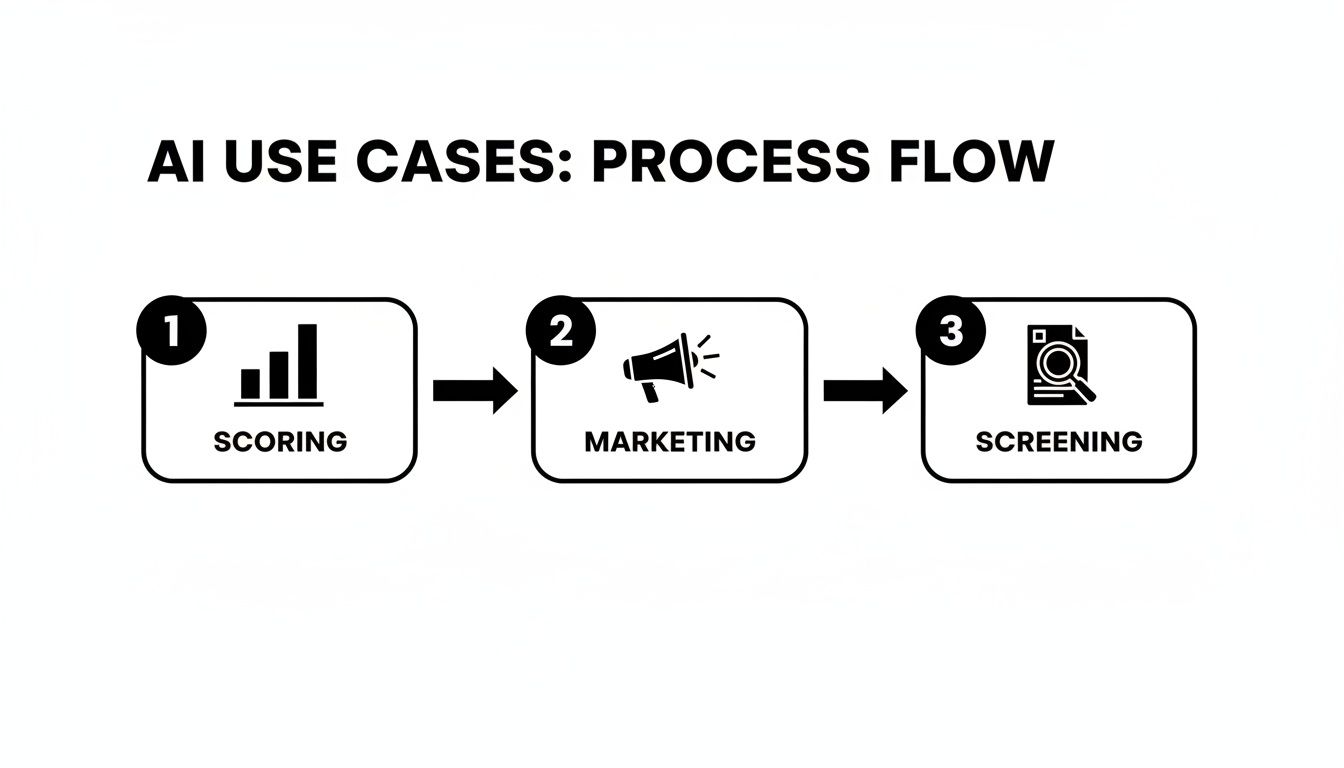
The visual breaks down how initial lead scoring sharpens your marketing, which then feeds a faster, more precise screening pipeline.
Agents reclaim over 20 hours per month by letting AI handle routine lead follow-ups and administrative tasks.
Measuring AI Impact
Take a look at a typical AI dashboard: it displays inquiry rates, lead quality scores, average response times, and ROI across different channels—all updated in real time.
You’ll spot patterns instantly. For instance, predictive analytics can spark a 34% boost in inquiries and an 8% faster turnaround on listings. Meanwhile, automating chat-based lead qualification can slash screening time by up to 75%, according to the 2025 AI Real Estate Marketing Benchmark Report.
Find the full report here.
Investing in these platforms isn’t just a tech play—it’s a way to build stronger client bonds and close more deals without stretching yourself thinner.
Next Steps To Get Started
- Identify the single most time-draining task in your current workflow
- Pilot an AI feature for two weeks and measure its impact
- Roll out successful automations across listings and lead outreach
Small, deliberate steps like these can yield big returns—both in growth and in the trust you earn from clients.
Conclusion And Future Outlook For AI In Real Estate
By handling routine tasks like data entry and lead qualification, AI for real estate agents not only speeds up your day but uncovers insights you might otherwise overlook.
Looking ahead, virtual property tours will let buyers wander through homes from their couch, while smart analytics flag pricing shifts before they hit the market.
At the same time, hyper-automation promises to weave lead nurturing, contract management, and closing steps into a single, frictionless flow.
Analysts project the global AI in real estate market to climb from $2.9 billion today to $41.5 billion by 2033. With AI automating 37% of routine tasks, the industry could capture $34 billion in efficiency gains.
Dive deeper in the Global AI in Real Estate Market Report.
“Agents who pilot one AI feature at a time see clear ROI in under a month.”
To begin, map out clear objectives and set up a real-time analytics dashboard. Track time savings, lead response rates, and client satisfaction from day one.
Action Plan For AI Strategy
- Identify High-Impact Tasks: Choose a time-consuming process—like drafting listing descriptions or sending follow-up emails—to tackle first.
- Run A Two-Week Pilot: Define success metrics in advance and gather data on efficiency gains and response rates.
- Review And Iterate: Analyze the pilot results, tweak your settings, and plan the next rollout based on real insights.
- Scale Up Gradually: Add new AI features only after they’ve proven value, ensuring your team stays on board.
Below is a screenshot that outlines projected market growth over the next decade.
This chart highlights how widening AI adoption will reshape agent workflows and boost productivity by 2033.
Next Steps For Agents
Start by piloting a single AI tool targeting your biggest time-sink. Track metrics like time saved, lead conversions, and client feedback to prove its worth.
Collect insights from your team and clients to refine configurations. Every quarter, add another feature that delivers measurable value, keeping you ahead of the competition.
Frequently Asked Questions
Choosing the right AI tool can feel overwhelming. Think of pilot programs as test drives—you want to see real performance on your daily tasks.
Next, partner with vendors who offer clear integration guides and reliable data sources. This approach cuts down on surprises and makes adoption smoother.
- Integration: Confirm there are plug-ins or APIs for your CRM
- Data Accuracy: Check local MLS feeds and recent comparable sales
- Ease of Use: Make sure features are intuitive for your team
- Support: Look for responsive training and thorough documentation
When it comes to data privacy, encryption is your first line of defense. Aim for platforms with SOC 2 compliance and schedule audits of permissions and access logs.
Training your team? Treat the rollout like a series of sprints. Start with short workshops, share quick-reference guides, and appoint an internal champion. Hands-on exercises build confidence and encourage adoption.
Measuring AI Success
You won’t know what’s working unless you track it. Define KPIs such as time saved per task, lift in lead conversions, and average response time.
Use real-time dashboards to compare pre-pilot and post-pilot metrics.
“Track key metrics before rollout to prove ROI and guide adjustments.”
Ready to tame your CMA reporting and speed up content creation? Give Saleswise a spin at Saleswise.