Automated Real Estate Marketing A Guide to Scaling Your Agency
Let's be honest, most agents didn't get into real estate to spend hours updating a CRM or manually sending follow-up emails. The real work—the stuff that actually closes deals—happens face-to-face with clients. So what if you had a system to handle all those repetitive marketing tasks for you?
That’s exactly what automated real estate marketing is. It's about using smart software to act as your 24/7 digital assistant, one that nurtures leads, posts on social media, and sends follow-ups while you’re out showing properties.
The Modern Blueprint for Real Estate Growth

Does your day feel like a constant scramble between managing social media, chasing down new leads, and actually connecting with clients? You're not alone. So many agents get trapped in the administrative weeds, which pulls them away from the very thing that grows their business: building relationships. This is where automation completely flips the script.
This isn't about adding another complicated piece of tech to your plate. Think of it as hiring the most reliable assistant you’ve ever had. It’s a system that works behind the scenes, managing your entire pipeline from the second a new lead comes in until long after the ink is dry.
Empowering Agents Through Smart Systems
The whole idea is beautifully simple: let technology handle the tedious, repetitive work so you can focus on the irreplaceable human side of real estate. Picture this: a new lead fills out a form on your website. Instantly, they receive a welcome email, their contact info is saved to your CRM, and a series of helpful follow-up messages are scheduled to go out over the next few weeks.
Automation isn't about replacing the agent; it's about amplifying the agent's ability to connect with more people, more effectively. It ensures no opportunity slips through the cracks, even when you're busy with showings or negotiations.
This approach lets you scale your business without having to scale your workload. Agents who really embrace automation can manage a much higher volume of leads with more consistency and a personal touch. To get there, you need a solid strategy for Unlocking Real Estate Marketing potential.
From Lead Capture to Lasting Relationships
The path from a curious browser on your website to a happy, loyal client is built on dozens of small interactions. Automation makes sure every single one of those touchpoints is handled perfectly and on time.
But great automation is more than just collecting a name and email. It’s about nurturing that initial spark of interest with relevant content and consistent communication. If you want to master that critical first step, our guide on how to generate real estate leads is packed with actionable ideas you can build right into your automated workflows.
By putting these systems in place, you’re not just saving time—you’re building a powerful engine for long-term growth. It frees you up to build stronger connections with clients and truly stand out in a crowded market. It’s the modern way to work smarter, not harder.
How Real Estate Automation Actually Works
Think of your entire lead pipeline as a high-tech garden. You could water every single plant by hand, one by one. Or, you could set up an intelligent irrigation system that gives each plant the perfect amount of water, exactly when it needs it. Real estate automation is that smart system for your leads, delivering the right messages at the right time based on what they do.
This isn't just one piece of software. It’s a whole ecosystem of connected tools working together to guide potential clients from casual interest all the way to a closed deal. It runs tirelessly in the background, making sure you never miss an opportunity, whether you're in a meeting or sleeping. At its heart, the process boils down to three key components working in sync.
Capturing Leads Automatically
The journey starts the moment someone shows interest in your business. The first step is to capture their information automatically, without you having to manually type anything into a spreadsheet. This is the part of the system that collects the rainwater for your garden.
This happens through a few different digital tools:
- Website Forms: Simple contact forms, home valuation requests, or newsletter sign-ups on your site instantly grab a visitor's info.
- Landing Pages: Have a specific listing you want to promote? A dedicated landing page can capture details from prospects who are already highly interested.
- Chatbots: A 24/7 digital assistant can chat with website visitors, answer their basic questions, and collect their contact info, even when you’re off the clock.
As soon as this information is captured, it’s instantly fed into the next stage of the system, setting off a chain of pre-planned actions. That immediate handoff is what makes the whole process so powerful.
Nurturing Relationships on Autopilot
Okay, so you have a new lead. Now the nurturing begins. This is where your automated system starts building a relationship with that person on your behalf. If capturing the lead was like collecting water, this is the smart irrigation system that waters the plants thoughtfully over time.
Instead of just blasting out generic emails to everyone, automation uses triggers—specific actions a lead takes—to send communications that are actually relevant. It’s no wonder that businesses using this approach see a 451% increase in qualified leads. It works because you're sending carefully crafted messages that feel personal and timely.
Automation isn't about removing the human touch. It's about using technology to create more chances for real, meaningful conversations when the time is right. It ensures every single lead gets a consistent, high-quality experience from you.
Here’s a real-world example: someone visits a specific property page on your website three times. Your system can spot this, and automatically send them an email with more details on that listing and even suggest a few similar properties. This kind of targeted follow-up keeps you top-of-mind without ever feeling like spam.
Integrating with Your CRM
The final piece of the puzzle is your Customer Relationship Management (CRM) system. Think of your CRM as the central brain of the operation, or the "gardener's logbook," where all the information is organized. Every interaction, every email opened, every property viewed—it all gets tracked and logged there.
This integration is absolutely crucial. It gives you a complete, 360-degree view of each client's journey. It lets you segment your audience with pinpoint accuracy, so first-time homebuyers get different content than seasoned property investors. And this level of organization really pays off; data shows that agents can save up to 10 hours each week by automating tasks like follow-ups and organizing documents. That’s more time to focus on what you do best: talking to clients and closing deals.
By connecting these three components, you create a seamless and incredibly effective engine for growing your real estate business.
Key Automation Strategies to Generate and Nurture Leads

Knowing the theory behind automation is one thing, but actually putting it to work is where you’ll see the clock ticking a little slower and your lead count climbing higher. Let's look at a few high-impact strategies you can put into play right away to start generating and nurturing leads, even while you sleep.
Think of each strategy as a specialized play in your marketing playbook. The big difference? Instead of you having to call every single play manually, you set them up to run on their own based on what a prospect does. This way, you’re always making the right move at the right time, without being chained to your desk.
Automate Your Email Marketing Follow-Ups
Email is still the king of real estate communication, and automating it is probably the single most powerful thing you can do. This isn't about blasting your entire list with the same generic newsletter. We're talking about building smart, triggered campaigns that feel personal because they respond directly to what people are interested in.
Picture this: a potential buyer clicks on the same property page on your website three times this week. An automated system sees this behavior and immediately sends them a personalized email. This email could include more photos, a link to the virtual tour, or even a few similar listings they might have missed. Just like that, you've turned a passive window shopper into a genuinely engaged lead.
It's not just a nice idea; it works. Recent marketing stats show that smart, automated email campaigns can boost lead conversion rates by as much as 30%. If you want to go deeper, check out our complete guide on email marketing for real estate. It’s all about turning your inbox into a finely tuned conversion machine.
Deploy Chatbots for 24/7 Lead Capture
Your website is your digital storefront, and it's open 24/7. But are you always there to greet visitors? A chatbot can be your tireless digital receptionist, ready to engage with potential clients at any hour of the day or night.
This isn’t just a fancy gimmick; it's an incredibly practical lead-capture tool. A well-programmed chatbot can:
- Answer common questions like "What are your business hours?" or "Tell me about the schools in this area."
- Qualify leads on the spot by asking about their budget, timeline, and what they’re looking for.
- Schedule appointments by syncing directly with your calendar, saving you endless back-and-forth emails.
Imagine a seller lands on your site at 3 AM, curious about their home’s value. The chatbot pops up, offers a free home valuation in exchange for their address and contact info, and collects the details. When you wake up, a qualified seller lead is already sitting in your CRM, just waiting for your personal follow-up call.
Schedule Social Media for a Consistent Presence
Staying active and professional on social media is a non-negotiable part of building a brand, but let’s be honest—it can be a massive time suck. This is where automation tools come in, allowing you to schedule your posts weeks or even months ahead of time.
This simple shift in workflow is a game-changer. You can set aside one block of time to create and schedule all your content for the next month. Plan a great mix—new listings, market updates, client testimonials, and community spotlights—and let the system post it automatically across all your channels.
Automation ensures your brand stays active and top-of-mind, even when you're busy with closings and client meetings. It provides the consistency that builds trust and authority in your local market without the daily scramble to find something to post.
This approach frees you from the tyranny of the daily "what should I post?" panic. It lets you focus your energy on what really matters: engaging with comments and messages. That's where the real relationships are built. It's simply a smarter way to handle your social media strategy.
Using AI and Predictive Analytics for Smarter Marketing
Think of old-school automation like a simple sprinkler system. You set it on a timer, and it waters everything on a schedule. It’s a massive improvement over dragging a hose around, but it's not very smart. Now, imagine a system that knows which plants are about to bloom and gives them extra nutrients right when they need it most. That’s the leap from basic automation to intelligent marketing fueled by AI and predictive analytics.
This isn't about setting simple "if this, then that" rules anymore. We're talking about using artificial intelligence to comb through mountains of data, spot subtle patterns in client behavior, and make shockingly accurate predictions about who is getting ready to buy or sell.
The Digital Fortune Teller for Your Leads
Predictive analytics is essentially a 'digital fortune teller' for your real estate business. Instead of giving every new lead the same generic follow-up, AI dives into the data to score each person based on their genuine likelihood to make a move.
This isn't magic; it's data science. The system looks at concrete actions to paint a clear picture of a person's intent.
- Browsing History: Has someone viewed the same listing five times? Are they constantly playing with your mortgage calculator?
- Content Engagement: Did they just download your "Guide to Downsizing" or the "First-Time Homebuyer's Checklist"?
- Demographic Data: Does this person’s profile look a lot like your last ten clients who successfully closed?
By weighing all these factors, AI generates a lead score. This lets you see, at a glance, who your hottest prospects are. You can finally stop throwing spaghetti at the wall and start focusing your valuable time on the people who are closest to the finish line.
From Reactive Follow-Ups to Proactive Marketing
This data-driven approach flips the script from reactive to proactive marketing. You no longer have to wait for a lead to raise their hand with a question. Instead, you can anticipate what they need before they even realize they need it.
AI-powered predictive analytics is a game-changer for automated real estate marketing because it pinpoints high-value leads with incredible precision. In fact, studies have shown these systems can increase lead conversion rates by up to 25% and shorten sales cycles by as much as 30%, all by analyzing online behavior to forecast intent.
The real power of AI in real estate marketing isn't just about saving time—it's about gaining foresight. It allows you to engage the right person with the right message at the exact moment they are most receptive.
This proactive approach builds a ton of trust. It positions you as an insightful advisor, not just another agent clogging up their inbox. It’s the difference between a generic monthly newsletter and a targeted email that says, "I noticed you were looking at three-bedroom homes in the Northwood area. A new one just hit the market that I think you'll love."
Personalizing Property Recommendations at Scale
One of the most impressive uses of this technology is creating personalized property recommendations. We've all been trained by platforms like Netflix and Amazon to expect suggestions tailored to our tastes, and real estate is no different.
AI can look at a client's saved searches, the listings they've viewed, and even the architectural styles they pause on to create a unique preference profile. From there, the system can automatically pull together and send them a list of properties that perfectly align with their unspoken criteria.
This delivers a bespoke, high-touch experience to every single person in your database—a feat that would be completely impossible to manage manually. If you want to dive deeper into how artificial intelligence can reshape your outreach, this A Practical Guide to AI for Small Business Marketing is a great resource.
By weaving AI and predictive analytics into your strategy, your automated real estate marketing becomes smarter, sharper, and dramatically more effective. You can finally stop shouting at the masses and start having meaningful, data-informed conversations with individuals. It transforms your CRM from a simple address book into a powerful engine for closing deals.
How to Choose the Right Automation Tools and CRM
Picking the right technology for your real estate business is a lot like choosing a vehicle for a job. A sleek sports car is fast and flashy, but it's useless if you need to haul lumber. The "best" tool isn't a one-size-fits-all solution; it’s the one that fits your specific needs, team size, and budget.
It’s easy to get overwhelmed by the sheer number of software options out there. Before you get dazzled by fancy features, take a step back and identify the actual problems you're trying to solve. Are you dropping the ball on following up with new leads? Buried under a mountain of administrative paperwork? Or maybe you’re just struggling to keep up with social media. The answers to these questions will be your compass.
Must-Have Features in a Real Estate CRM
Think of your Customer Relationship Management (CRM) system as the central command center for your entire business. It's where every piece of client information lives and connects. While a generic CRM can store names and numbers, a platform built for real estate understands the unique journey of a buyer or seller.
Here are the non-negotiable features you should look for:
- Robust Lead Tracking: You need to see exactly where a lead came from, which properties they’ve clicked on, and what emails they've opened. This intel is gold for a timely and relevant follow-up.
- Seamless Communication Logs: Every single call, text, or email should be automatically logged under the contact's profile. This gives you a complete, at-a-glance history of your entire relationship.
- Essential Integration Capabilities: Your CRM has to play nice with the other tools in your toolbox—your website, email marketing service, and social media scheduler. A truly connected system is where the magic happens.
This map shows how data moves through a modern marketing system, from initial collection all the way to generating a solid lead.
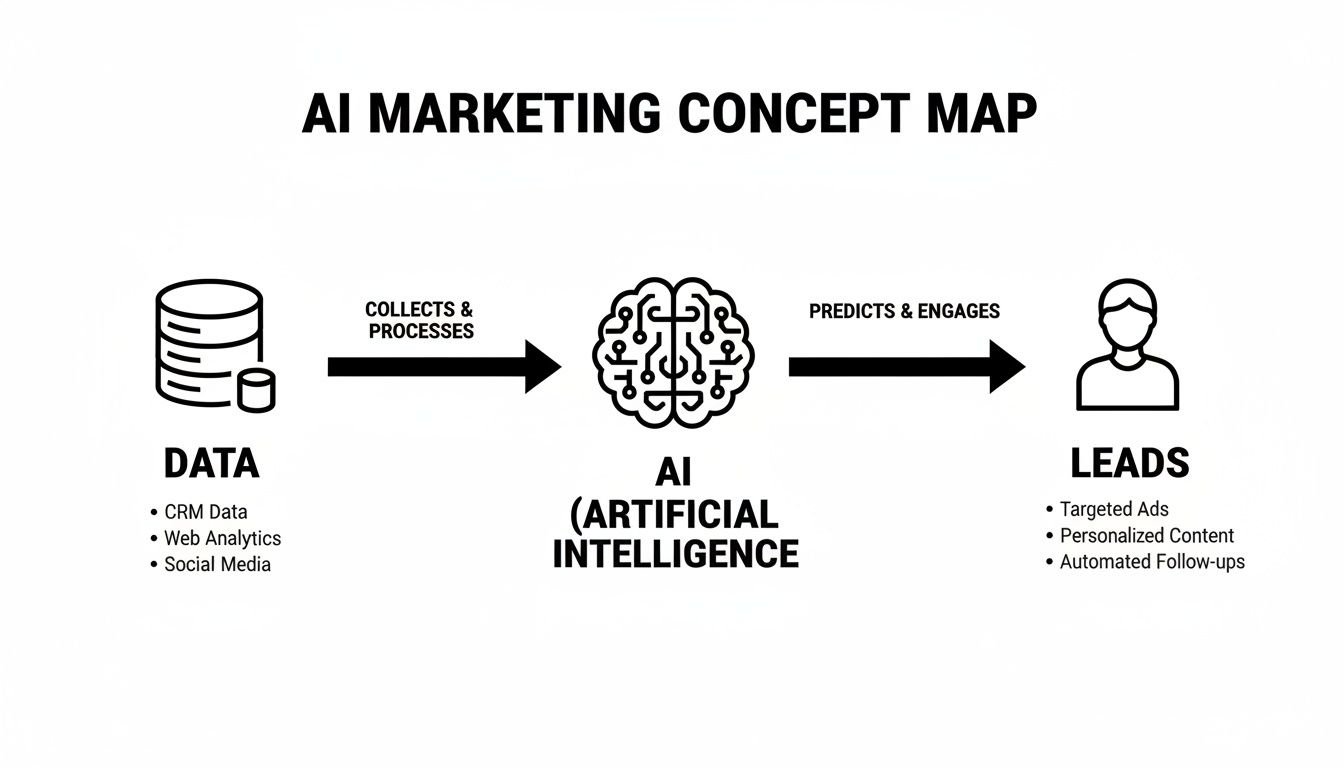
As you can see, a CRM's ability to gather and organize clean data is the critical first step. Without it, even the smartest AI or automation strategy will fall flat.
General vs Industry-Specific Platforms
Agents often get stuck deciding between a general-purpose CRM and one designed specifically for real estate. While you can customize a generic tool, an industry-specific platform like Saleswise comes out of the box with the workflows and features you actually need.
When your CRM is combined with smart data analytics, efficiency skyrockets. In fact, some agents have seen a 41% surge in conversions just by automating follow-ups and personalizing their outreach based on the data their CRM gathers. A platform that already speaks "real estate" makes achieving this much, much easier.
A specialized system anticipates an agent's needs, saving you dozens—if not hundreds—of hours on tedious setup and customization. To get a better handle on what to look for, check out our guide on real estate market analysis software, which dives into the tools that deliver truly deep insights.
A great real estate CRM doesn't just store contacts; it provides a clear, actionable roadmap for every client relationship, from the first click to the five-year home anniversary.
To make the difference crystal clear, here’s a quick comparison of what you can expect from each type of system.
General CRM vs Real Estate Specific CRM (like Saleswise)
| Feature | General CRM | Real Estate Specific CRM (e.g., Saleswise) |
|---|---|---|
| Lead Management | Basic contact fields and manual tagging. | Tracks lead source, property interests, and buyer/seller status automatically. |
| Marketing Workflows | Requires extensive setup from scratch. | Includes pre-built email nurture campaigns for new leads, open houses, and past clients. |
| Industry Integrations | Limited or requires costly custom development. | Offers direct MLS integration for property alerts and transaction management connections. |
| Reporting & Analytics | Standard sales pipeline reports. | Provides reports on commission forecasts, closing rates, and lead source ROI. |
At the end of the day, your choice of tools is the foundation of your entire automation strategy. By choosing a platform that's built with your daily grind in mind, you’re setting yourself up to not just save time, but to build a more efficient, scalable, and profitable real estate business.
Building Your First Automated Marketing Workflow
Theory is great, but there's no substitute for getting your hands dirty. Let's walk through building a simple, yet incredibly effective, automated workflow you can set up today. This example will pull back the curtain on how automation actually works and give you a practical blueprint to follow.
Our mission here is to build a system that instantly connects with new leads from your website. This frees you from the frantic scramble of manual follow-ups and ensures no one ever slips through the cracks. Think of it as your digital receptionist, always on, always ready.
Step 1: Define the Trigger
Every automation has to start somewhere. That starting point is called a trigger—it’s the specific event that kicks everything else into motion.
For this workflow, our trigger is one of the most common ones out there: a potential client fills out the "Contact Us" form on your website. This simple action is the starting gun that tells your system a new person has raised their hand and is interested in what you have to offer. The magic of automated real estate marketing is that your system is listening for this signal 24/7, even when you’re not.
Step 2: Automate the Initial Actions
As soon as that form is submitted, a few things should happen instantly, without you lifting a finger. These first actions are all about organization and making a killer first impression. You’ll want your system to:
- Add to CRM: Automatically add the person's name, email, and phone number directly into your CRM.
- Apply a Tag: Tag the new contact as a "New Website Lead" so you can easily find and segment them later.
Doing this keeps your database tidy and organized right from the start. No more messy spreadsheets or forgotten sticky notes.
An immediate, automated response can be the difference between a warm lead and a lost cause. In fact, research shows that businesses responding within five minutes are 100 times more likely to actually connect with that lead.
Step 3: Launch the Nurture Sequence
Okay, the lead is captured and organized. Now it’s time to start building that relationship. This is where your pre-planned nurture sequence takes over. The system will automatically:
- Send an Instant Confirmation Email: A personalized email fires off immediately, thanking them for reaching out and setting the expectation that you'll be in touch soon.
- Start a Drip Campaign: A 3-part email series you've already written begins sending over the next couple of weeks. This is your chance to provide real value with things like a local neighborhood guide, a homebuyer's checklist, or testimonials from happy clients.
This entire process—from the moment they hit "submit" to that final nurture email—runs completely on its own. It ensures every single lead gets a consistent, professional, and timely experience. By the time you step in to make a personal call, they’re already warmed up and ready to talk. You’ve just built a powerful engine for turning clicks into clients.
Got Questions About Real Estate Automation? We've Got Answers.
Jumping into the world of marketing automation can feel like a big step. You’ve probably got a few questions running through your mind, from "Can I even afford this?" to "Will I sound like a robot?" These are completely normal concerns.
Let's break down some of the most common questions agents have. We'll give you straight, no-nonsense answers to help you see how automation can work for you, whether you're a one-person show or running a growing team.
Is Marketing Automation Too Expensive for a Solo Agent?
This is probably the biggest myth out there. While some massive, enterprise-level systems can cost a fortune, many of the best tools today are built specifically for solo agents and small teams. They offer flexible, budget-friendly plans that grow with you.
The trick is to stop thinking of it as a cost and start seeing it as an investment. Imagine all the hours you spend every week on manual follow-ups or trying to keep up with social media. Automation gives you that time back so you can focus on what actually makes you money—talking to clients and closing deals.
Your return on investment isn't just about the money you save. It's about the time you reclaim. When a tool lets you handle more clients without working yourself to the bone, it pays for itself almost instantly.
How Much Time Does It Really Take to Set Up?
The initial setup is faster than most people think. You'll want to block out a few solid hours to get comfortable with the system and build your first couple of essential workflows, like a sequence for new leads.
But here's the magic of automation: you do the work upfront, just once. You build the system, and it works for you around the clock, day in and day out, for months or even years. That initial time commitment is tiny compared to the hundreds of hours you'll save down the road.
Will My Marketing Feel Robotic and Impersonal?
It's a fair question. Nobody wants to sound like a machine. But good automation does the exact opposite—it makes your marketing more personal by freeing you up to connect when it matters most. The system takes care of the routine check-ins so you can jump in for the meaningful conversations.
The best automated marketing is built on smart personalization. This is done through:
- Smart Segmentation: You can group contacts based on what they're looking for, like first-time buyers or empty-nesters looking to downsize.
- Behavioral Triggers: The system can send a message automatically when someone takes a specific action, like viewing the same property on your website three times.
- Personalization Tokens: Simple fields automatically pull in a contact's name, a property they were interested in, or other key details to make every message feel like it was written just for them.
What Is the Single Best Automation to Start With?
If you're going to start with just one thing, make it a new lead welcome sequence. It's simple to build and delivers a huge impact right away.
Here’s what it does: a new lead fills out a form on your site, and the system automatically kicks into gear.
- It adds the contact to your CRM and tags them as a "New Lead."
- It sends an instant confirmation email, so they know you got their message.
- It then starts a short email series over the next week to introduce you, share helpful info, and build trust.
This one automation guarantees that no lead ever gets missed. You make a great first impression every single time, without lifting a finger. It's the perfect place to start.
Ready to build powerful, client-ready marketing materials in seconds? Saleswise uses AI to generate everything from lightning-fast CMAs and listing descriptions to social posts and follow-up emails, all grounded in live market data. Start your $1 seven-day trial and see how easy it is to automate your growth.