email marketing to realtors: Boost Leads & Close More Deals
When you’re building a real estate business, you're constantly fighting for attention. Social media is great, but you're always at the mercy of the next algorithm change. That's why email marketing isn't just another tool in your kit—it's the foundation for building a truly predictable sales pipeline.
It’s about creating direct, meaningful relationships with your contacts, turning a list of names into a community of clients who trust you. In a crowded market, being the agent people remember and rely on is everything.
Why Email Marketing Is Still a Realtor's Best Bet
Let’s be real. Social media platforms like Instagram and Facebook are fantastic for getting your name out there. But you're essentially building your business on rented land. One algorithm update, and your reach can plummet overnight, cutting you off from the very audience you spent months, or even years, cultivating.
Email is fundamentally different. Your list is your asset. You own it. This gives you a direct, unfiltered line to your sphere of influence—past clients, current leads, and future prospects. It lets you nurture those relationships on your own schedule, building a reliable business instead of just chasing the next hot lead.

The Unmatched Return on Investment
Beyond just owning your audience, the numbers speak for themselves. The financial case for putting email at the center of your marketing strategy is incredibly strong. While social media is important for brand awareness, email is where the real business gets done.
Agents who get serious about email marketing typically see an ROI of $36 to $40 for every $1 spent. That’s a return of 3,600% to 4,200%. Think about that for a second. It's a level of profitability that other channels just can't touch. In fact, for real estate professionals, social media converts 40% less effectively than email. You can dive deeper into the latest real estate email marketing trends to see the data for yourself.
The bottom line is clear: For every dollar you invest in a well-crafted email strategy, you're positioned to get back nearly forty times that amount. No other marketing activity offers that kind of leverage for your business.
To put it in perspective, let's look at how email stacks up against other common marketing channels you're likely using.
Realtor Marketing Channels at a Glance
This quick comparison shows why email holds a unique and powerful position in a realtor's marketing mix.
| Channel | Key Advantage for Realtors | Typical ROI | Audience Control |
|---|---|---|---|
| Email Marketing | Direct, owned communication channel for nurturing relationships and driving conversions. | 3,600% - 4,200% | Total Control |
| Social Media | Excellent for top-of-funnel brand awareness and community building. | Varies Widely | Low (Algorithm-Dependent) |
| Direct Mail | Tangible and effective for hyper-local farming and high-value targets. | 15% - 17% | High (List-Based) |
| Zillow/Realtor.com | Access to active, high-intent buyers and sellers in real-time. | Varies (Lead Quality) | None (Platform-Owned) |
While a great strategy uses a mix of these, email provides the control and ROI that can truly anchor your entire marketing ecosystem.
Building Trust at Scale
At the end of the day, real estate is a relationship business. People work with agents they know, like, and trust. Email is the perfect medium for building that trust consistently and at scale, without losing the personal touch.
By sending out valuable content—whether it's a monthly market report, tips for sellers, or a guide to the best local parks—you’re not just an agent. You become a trusted advisor. That's how you stay top-of-mind, ensuring you’re the first person they call when they, or someone they know, is ready to make a move. This guide will give you the playbook to do just that.
Building an Email List That Actually Converts
Let's be real: your email campaigns are only as good as the list you're sending them to. The old playbook of buying lists or slapping a generic "sign up here" form on your website just doesn't cut it anymore. If you want to succeed, you have to build a quality, engaged audience of people who actually want to hear from you.
Think of your list as your single most valuable business asset. Seriously. I'd take a curated list of 500 genuinely interested contacts over a list of 5,000 random names any day of the week. The goal isn't just to collect emails; it's to start building trust from the very first handshake, click, or conversation.
Transform Every Interaction into an Opportunity
Every time you connect with a potential client, it's a chance to grow your list—the right way. Instead of just trying to get their information, you need to offer a compelling reason for them to opt-in. This is where permission-based marketing works its magic.
Here are a few proven ways to capture leads who are truly interested:
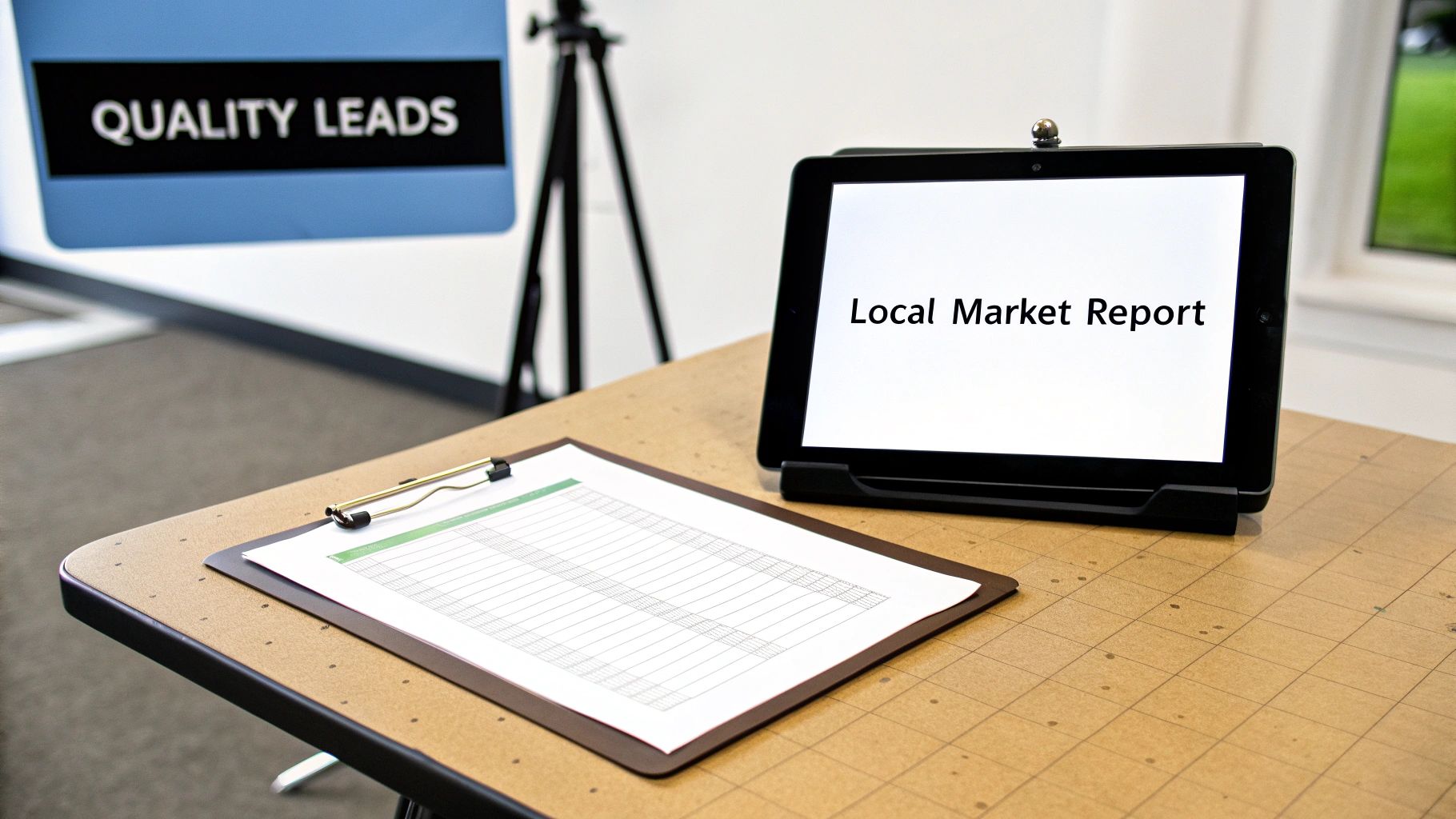
- Modernize Your Open House Sign-Ins: Ditch the clipboard and pen. Use a tablet with a digital sign-in form that feeds directly into your email list. You can instantly offer to email attendees a detailed property feature sheet or a neighborhood guide as a thank-you. It's professional and effective.
- Run Smart Social Media Ads: Target ads on Facebook or Instagram with a high-value download, like a "First-Time Homebuyer's Checklist" or an analysis of recent sales in a hot zip code. The key is offering something valuable they can't just Google.
- Work Your Networking Events: When you meet someone at a local event, don't just swap business cards. Offer to send them a helpful resource, like your latest market update, and ask for their email right then and there. It's a natural, value-driven way to connect.
Create Lead Magnets They Can't Resist
A "lead magnet" is just a fancy term for a free resource you offer in exchange for an email address. But it's the cornerstone of building a killer list. The best ones solve a specific problem or answer a burning question for your ideal client.
Try creating a few of these to attract different types of leads:
- Seller's Staging Guide: A simple PDF checklist with high-impact, low-cost tips for prepping a home for sale.
- Hyper-Local Market Report: A deep dive into a specific neighborhood's real estate trends, updated monthly or quarterly.
- Buyer's Guide to [Your City]: An insider's look at different communities, complete with school ratings, local hangouts, and amenities.
A powerful lead magnet does more than just capture an email; it immediately positions you as a knowledgeable local expert. It’s the first step in proving your value before you ever ask for their business.
To get even more ideas, check out this guide on how to build email lists that actually grow your business. One of the most effective lead magnets a realtor can offer is a CMA, and you can explore our own guide on creating a free comparative market analysis for your clients.
Organize Your Leads for Success
As your list grows, just having a collection of emails isn't enough. This is where a good CRM system becomes non-negotiable. It allows you to manage your campaigns efficiently and see what's actually working. In fact, research shows that by 2025, realtors using a CRM report a 41% higher lead conversion rate than those who don't.
Getting your leads organized from day one is critical. This foundational step sets the stage for the powerful segmentation strategies we’ll cover next, which is how you turn those contacts into closed deals.
Segmenting Your Audience for Maximum Impact
If you’re sending the same “Just Listed” blast to every single person in your database, you’re leaving money on the table. It’s a surefire way to get ignored, deleted, and eventually, unsubscribed.
Think about it: a past client who sold their home with you two years ago has completely different concerns than a new lead who just started hunting for their first condo. This is where smart segmentation comes in. It’s how you turn a generic broadcast into a genuine conversation.

Effective segmentation is all about dividing your audience into smaller, more relevant groups. You group people based on their actual needs, where they are in their journey, and their history with you. This simple act lets you send content that feels like it was written just for them, which is exactly what grabs attention, earns clicks, and brings in better leads.
Moving Beyond Buyers and Sellers
Your first instinct might be to just split your list into "buyers" and "sellers." It's a start, but it's way too broad to make a real difference. A luxury home seller has vastly different motivations than someone selling a starter home. A first-time buyer is overwhelmed and needs guidance, while a seasoned investor just wants the numbers.
The real magic happens when you create nuanced segments that mirror the diversity of your actual client base. By doing this, your messaging, your timing, and your calls-to-action will actually line up with what each group cares about. That’s what separates the pros from the amateurs in email marketing.
Here are a few powerful segments you can build right away:
- First-Time Homebuyers: They're often anxious and crave educational content that simplifies the entire process. They need a guide, and that guide should be you.
- Luxury Property Seekers: This crowd expects a premium experience. They value exclusivity, hard data, and a high-touch approach. Generic emails are an instant turn-off.
- Past Clients (for Referrals): These are your brand ambassadors. The goal isn't to sell them another house; it's to stay top-of-mind so they become a source of new business.
- Local Real Estate Investors: This segment is all about the bottom line. They’re looking for ROI, cash flow opportunities, and off-market deals. Get straight to the point.
Tailoring Your Content to Each Segment
Once you’ve defined your segments, the real work begins: creating content that speaks directly to each group. Sending the right message to the right person is the absolute core of successful email marketing to realtors.
Let's walk through what this looks like in the real world.
For First-Time Homebuyers:
Your tone should be educational, supportive, and reassuring. You’re their expert navigator in uncharted territory.
- Content Idea: Create an email series called "Your 5-Step Roadmap to Homeownership." Break down confusing topics like pre-approval, making an offer, and what actually happens at closing.
- Saleswise Integration: Use the Saleswise AI content generator to quickly write a simple, jargon-free email that explains what a CMA is and why it's critical for making a smart offer.
For Past Clients (Referral Focus):
The key here is to provide ongoing value and gently remind them of your expertise without being salesy.
- Content Idea: Send a quarterly "Home Equity Check-In" email. It can be a simple, friendly message offering to run an updated CMA to show them how much their investment has grown.
- Saleswise Integration: With Saleswise, you can generate a professional, data-rich CMA in under a minute. Attaching it as a high-value PDF gives them a powerful, tangible reason to remember you.
A brilliant tactic I’ve seen work wonders: send past clients a fresh CMA on the "anniversary" of their home purchase each year. It reinforces the value you provided and keeps you as their go-to real estate expert for life.
For Local Real Estate Investors:
This group is busy and speaks the language of numbers. They need concise, actionable info that helps them make better financial decisions.
- Content Idea: Start a monthly "Investor's Brief." You could highlight properties with strong rental potential, share recent multi-family sales data, or cover zoning changes in up-and-coming areas.
- Saleswise Integration: Use the virtual staging tool to show a dated property’s potential as a modern, high-rent unit. Including striking before-and-after visuals in your email can generate serious interest from investors looking for a project.
When you stop blasting and start segmenting, you transform from just another agent in their inbox into an indispensable advisor. This strategic approach is how you build lasting relationships and a business that thrives on referrals.
Writing Emails People Actually Want to Read
Once you’ve sliced your list into smart segments, the real work begins: writing an email that someone actually wants to open. Let's be honest, inboxes are crowded. A great email doesn't just sell; it connects, solves a problem, and solidifies your reputation as the go-to expert in your market. It's about shifting from generic sales pitches to delivering real, tangible value with every single send.
The formula for an email that gets results is surprisingly simple. It starts with a subject line that's too good to ignore, flows into content that answers a question or sparks curiosity, and finishes with a clear, direct call-to-action that tells the reader exactly what to do next. If you can nail this, you’ll see your engagement rates climb.
The Anatomy of a High-Converting Email
Before we jump into specific campaign ideas, let's break down the core components that make an email click. Each piece plays a critical role in moving a prospect from their inbox to a real conversation with you.
- The Subject Line: This is your digital handshake. A good one is personal, intriguing, and hints at a benefit. Ditch the spammy, all-caps nonsense and focus on sparking a little curiosity. Instead of "New Listing Alert," how about "Your Neighbor's Home Just Sold for How Much?" See the difference?
- The Hook: The very first sentence has one job: deliver on the promise of your subject line. Get straight to the point and give them the most important piece of information immediately.
- Valuable Body Content: This is your chance to educate, inform, or even entertain. Share a quick market insight, offer a genuinely helpful tip, or tell a compelling story about a recent sale. Use short paragraphs, bold text, and images to make it easy to scan.
- A Clear Call-to-Action (CTA): Every email must have a purpose. What do you want them to do? "See the Full Photo Gallery," "Get Your Free Home Valuation," or "Book a 15-Minute Chat"—make it a single, unmissable directive.
The best emails feel less like marketing and more like a personal note from a trusted advisor. Always ask yourself: "If I got this email, would I find it useful, or would I hit delete?" Be honest. That’s your best filter.
Your Essential Real Estate Email Campaign Planner
To give you a clearer picture of how these campaigns fit together, here's a quick planner. Think of this as your strategic roadmap for nurturing different segments of your audience with the right message at the right time.
| Campaign Type | Target Audience Segment | Primary Goal | Recommended Frequency |
|---|---|---|---|
| New Lead Nurture | Fresh leads (buyers & sellers) | Build trust & prompt a response | 4-5 emails over 2 weeks |
| Just Listed/Sold | Buyer segments, local homeowners | Drive listing traffic, showcase activity | Per listing/sale |
| Local Market Update | Entire database (by neighborhood) | Provide value, generate seller leads | Monthly or Quarterly |
| Open House Follow-Up | Recent open house attendees | Re-engage & secure an appointment | 2-3 emails over 1 week |
Mapping out your campaigns like this ensures you have a consistent, purposeful communication strategy that nurtures relationships and drives business forward, instead of just sending emails randomly.
Proven Email Campaigns for Every Realtor's Playbook
A solid email strategy is so much more than a monthly newsletter. You need a mix of automated sequences and timely broadcasts that meet your contacts where they are. To really boost your open rates and engagement, having a library of effective email templates can be a massive time-saver.
Here are four essential campaigns every agent should have running.
1. The New Lead Nurture Sequence
Think of this as your automated welcome wagon. A new lead signs up on your website, Zillow, or an open house sheet, and this sequence immediately kicks in to start building that relationship.
- Target Audience: Fresh leads (buyers and sellers).
- Goal: Establish trust, demonstrate your expertise, and get them to reply.
- Frequency: 4-5 emails over two weeks.
- Email 1 (Immediate): "Thanks for reaching out! Here's that [Resource] I promised."
- Email 2 (Day 3): "3 common mistakes first-time homebuyers make in [Your City]."
- Email 3 (Day 7): "Case Study: How we helped a family find their dream home in 30 days."
2. The "Just Listed" Announcement
This email is all about creating a sense of urgency and showing off your listings. But it's also a backdoor way of showing potential sellers on your list that you're active and getting results in their neighborhood.
- Target Audience: Buyer segments, local homeowners.
- Goal: Drive traffic to your listing page and get people scheduling showings.
- Frequency: As new properties hit the market.
- Pro Tip: This is where visuals are everything. High-quality photos are non-negotiable. But with a tool like Saleswise, you can take it a step further and embed AI-powered virtual staging images right in the email. Showing an empty room's full potential can dramatically increase buyer interest.
3. The Hyper-Local Market Update
This might just be the most valuable email you can send. It positions you as the undisputed local expert and keeps you top-of-mind with everyone—past clients, cold leads, and everyone in between.
- Target Audience: Your entire database, ideally segmented by neighborhood.
- Goal: Deliver real market intelligence and generate seller leads.
- Frequency: Monthly or quarterly.
- Content Idea: Include key stats like average sale price and days on market, and maybe feature a "Sale of the Month." You can also easily repurpose this content for your social channels. For more on that, check out our guide to creating compelling real estate social media content.
4. The Open House Follow-Up
Don't let that sign-in sheet collect dust. A simple, automated sequence can turn a casual visitor into a warm lead by continuing the conversation after they've gone home.
- Target Audience: Open house attendees.
- Goal: Re-engage visitors, offer more info, and lock in an appointment.
- Frequency: 2-3 emails over one week.
- Email 1 (Same Day): "Thanks for stopping by 123 Main Street! Here's the digital feature sheet."
- Email 2 (Day 2): "Did you see the backyard? Here are a few similar homes you might like."
- Email 3 (Day 5): "The market is moving fast. Are you free for a quick chat about your search this week?"
Putting Your Lead Nurturing on Autopilot
Imagine being able to nurture every single lead around the clock without lifting a finger. This isn't just a dream; it's what smart email automation makes possible. By setting up some straightforward, automated workflows, you can make sure every prospect gets a timely, relevant message from you, keeping your name top-of-mind from the second they express interest.
This is your secret weapon for scaling your business. Automation takes care of all the repetitive follow-up, freeing you up for the stuff that actually makes you money—like showing properties and closing deals. The whole point is to build relationships at scale, and a well-thought-out automation sequence does exactly that.
Setting Up Your First Workflow
Getting started with automation is way easier than most people think. You don't need some crazy, 20-step sequence with a dozen different paths to make a real impact. A simple follow-up for new leads from your website or Zillow can be a total game-changer.
Think about a common scenario: a potential buyer fills out a form on your site at 10 PM on a Tuesday. With an automated workflow, they can get an instant welcome email. It confirms you got their request and maybe even offers a free buyer's guide. That immediate touchpoint shows you're on the ball, even when you're off the clock.
This flowchart breaks down the simple but powerful anatomy of every email you'll send in your automated sequences.
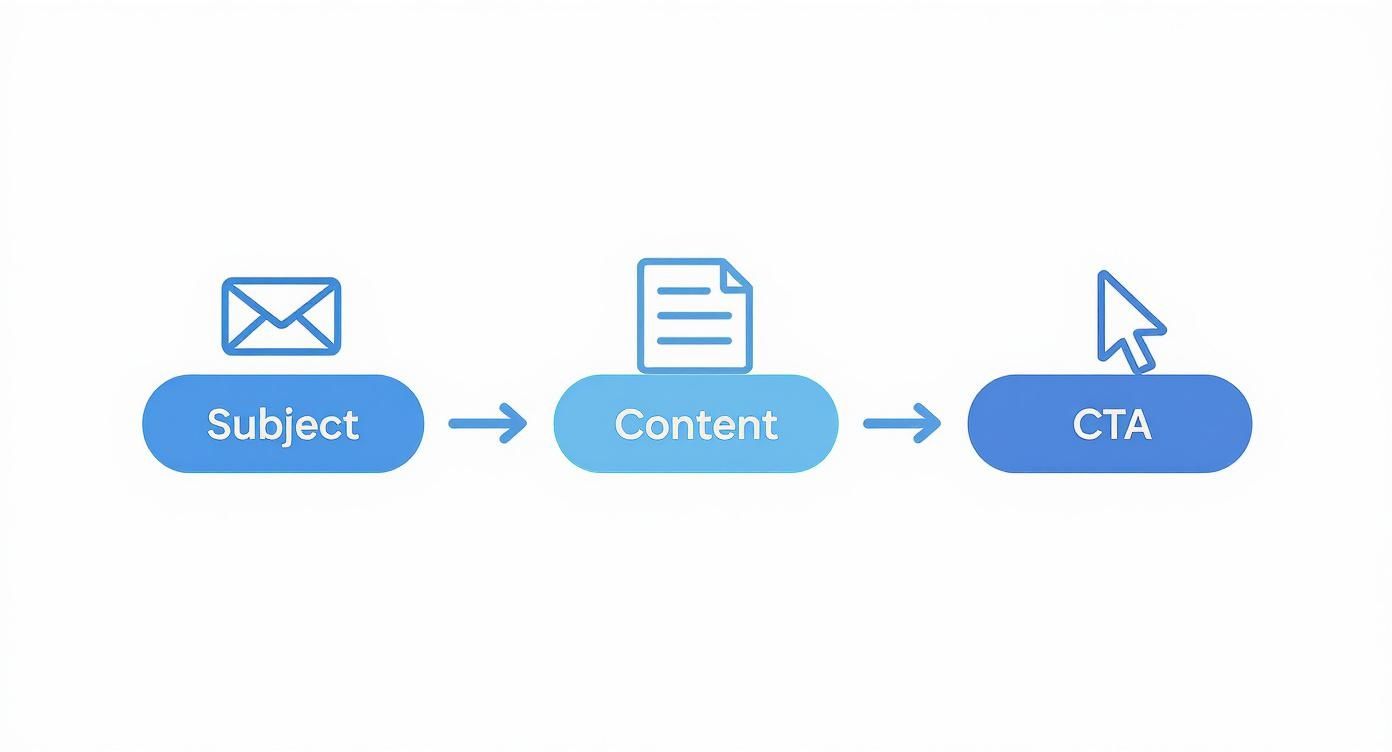
Nailing these three things—a subject that grabs attention, content that delivers value, and a clear call-to-action—is the bedrock of any email campaign that actually works.
Key Deliverability Best Practices
Writing great automated emails is only half the job. You have to make sure they actually land in the inbox. Email deliverability—the art and science of staying out of the spam folder—is absolutely critical. Internet Service Providers (ISPs) like Gmail and Yahoo are always on the lookout for spammers.
To keep your sender reputation strong, you need to stick to a few core practices:
- Authenticate Your Domain: This sounds technical, but it’s a non-negotiable step. Setting up records like SPF and DKIM is like showing your ID to the email providers. It proves you are who you say you are, which dramatically cuts the chances of your emails being flagged as spam.
- Maintain a Consistent Schedule: Sending emails on a regular, predictable basis helps ISPs see you as a legitimate sender. Don't go silent for three months and then blast your entire list at once.
- Keep Your List Clean: Every so often, you have to prune your list. Remove inactive subscribers who never open your emails. A high bounce rate is a major red flag for ISPs and will tank your deliverability across the board.
Deliverability isn't a "set it and forget it" task. It's ongoing maintenance. Think of it like your car—regular tune-ups like cleaning your list and checking your stats ensure you don't break down on the side of the road.
Building Trust Through Consistency
At the end of the day, automation is all about consistency. When a lead gets a series of helpful, well-timed emails, you start building trust and credibility long before you ever meet them face-to-face. This process warms up those colder leads, making them way more receptive when you finally do pick up the phone.
Automation also gives your communication a reliable structure. If you need more inspiration for what to send, check out our guide to essential real estate agent marketing materials you can easily work into your emails. A systematic approach means no lead ever falls through the cracks, effectively turning your email list into an automated pipeline for new business.
Realtor Email Marketing FAQs
Getting started with email marketing always brings up a ton of questions. As you put these strategies into play, you'll naturally wonder about things like how often to send, what numbers actually matter, and what to do with that old list of contacts collecting dust.
This section tackles the most common questions I hear from agents. Think of it as a quick reference guide to help you troubleshoot and fine-tune your approach, so you can move from just knowing what to do to confidently doing it.
How Often Should I Email My Real Estate Contacts?
Here's the golden rule: consistency trumps frequency. Blasting your list every single day is a surefire way to burn it out. For most of your database, a high-value weekly or bi-weekly newsletter is the sweet spot. It keeps you top-of-mind without becoming background noise.
Now, for those hot leads—say, someone who just signed up on your website—you can be a bit more aggressive. You might hit them with an email every 2-4 days at the beginning to build some real momentum, then ease up as the conversation develops.
The real answer, though, is in your data. Keep a close eye on your open rates, and even more importantly, your unsubscribe rates. Those numbers are the most honest feedback you'll ever get from your audience.
It's always better to send one fantastic, valuable email a month than four generic ones a week. Quality over quantity, every time.
What Are the Most Important Email Metrics to Track?
It’s easy to get buried in data and suffer from "analysis paralysis." To avoid that, just laser-focus on a few key performance indicators (KPIs) that tell you the real story. These three will give you a clear snapshot of your campaign's health.
- Open Rate: This is your first test. It tells you if your subject lines are strong enough to cut through the clutter of a busy inbox. If your open rate is low, your subject lines need work. Simple as that.
- Click-Through Rate (CTR): This number shows if your content is actually hitting the mark. If people open the email but don't click anything inside, it's a huge red flag that your message or call-to-action isn't connecting.
- Unsubscribe Rate: This is the most direct criticism you can receive. A sudden spike in people opting out means your content is off, you're emailing too often, or you're talking to the wrong people.
Once you have a handle on these, you can get more advanced and start tracking conversions, like how many people who clicked on a listing then requested a showing. But start with these three to build a solid foundation.
Should I Buy an Email List to Start Faster?
Let me be crystal clear: no. Buying an email list is the single fastest way to kill your email marketing before it even gets off the ground. It's a tempting shortcut that leads straight to a dead end.
For starters, it often violates anti-spam laws like CAN-SPAM, which can land you in hot water with some serious penalties. More than that, these lists are packed with cold contacts who never asked to hear from you. That’s a recipe for terrible open rates and sky-high complaint rates.
But here’s the real kicker: it completely destroys your sender reputation. Email providers like Gmail and Outlook watch how people interact with your emails. When they see your messages getting ignored or flagged as spam, they start sending all your emails—even the ones to your actual clients—straight to the junk folder. The only way to win is to build your list organically with people who genuinely want to hear from you.
What Is the Best Way to Re-Engage a Cold List?
We all have them—that list of contacts who've gone radio silent. Before you hit delete, it’s absolutely worth running a dedicated "win-back" campaign to see if you can spark a connection. The trick is to be direct and offer something they can't ignore.
Try sending an email with a personal-sounding subject line, something like "Quick question for you" or "Still interested in the [Your City] market?". In the email, just be honest and acknowledge it's been a while.
Then, offer up something of real value. Maybe it's your latest annual market report or a free, no-strings-attached home equity check-in. You want to give them a clear choice: a button to confirm they want to stay on your list and another one to easily opt out. If someone doesn't bite after a couple of tries, it's time to let them go. Culling your list is healthy; it keeps your engagement high and your deliverability strong.
Ready to create stunning CMAs and powerful email content in seconds? Saleswise gives you the AI-powered tools you need to impress clients and automate your marketing. Start your $1 trial and see the difference today.