Finding the Best AI for Real Estate Agents A Complete Comparison

For agents at the top of their game, the best AI for real estate isn't a generic tool—it's a specialized platform that deeply integrates live MLS data with smart marketing automation. Tools built specifically for the industry, like Saleswise, are miles ahead of general-purpose AI like ChatGPT because they understand the nuances of real estate. They deliver instant Comparative Market Analysis (CMA) reports, AI-powered virtual staging, and content created for the specific workflows agents use every day.
This targeted approach gives you a level of accuracy and speed that a general AI simply can't match.
How AI Is Reshaping the Real Estate Industry

Artificial intelligence is no longer some far-off idea; it's become a must-have tool for real estate professionals. Agents are turning to AI to solve old problems in new ways, from pulling together data-rich CMAs in minutes to writing captivating listing descriptions without staring at a blank screen. It’s no longer about just working harder. It’s about working smarter with tech that gets the unique pressures of the property market.
This shift is creating a real gap between agents who are leaning into AI to be more efficient and those who are sticking with the old, time-intensive methods.
The Driving Force Behind AI Adoption
The incredible growth in AI adoption is backed by some serious market momentum. The global AI in real estate market is jumping from $222.65 billion in 2024 to an estimated $303.06 billion in 2025. That's a staggering 36.1% compound annual growth rate.
This isn't just hype; it shows how AI is fundamentally changing everything from property valuations to marketing, giving agents who use it a critical edge. You can discover more about how AI is changing the real estate industry in 2025 on scrumlaunch.com.
At its core, AI for real estate is about one thing: getting your time back. It automates the tedious, data-heavy tasks that eat up your day, freeing you up to focus on what actually moves the needle—negotiating deals and building client relationships.
Key Benefits for Modern Agents
Bringing the right AI platform into your business delivers results you can see and feel almost immediately. It’s not just about doing things faster; it's about elevating the quality of your work and the experience you provide your clients.
- Dramatic Efficiency Gains: Think about generating CMAs, property descriptions, and social media posts in minutes, not hours.
- Data-Driven Decision Making: Tap into live market data to price your listings with laser precision and advise clients with unshakable confidence.
- Superior Client Experience: Deliver beautiful virtual staging, personalized follow-ups, and professional reports that truly impress both buyers and sellers.
- Competitive Advantage: Stay ahead of the competition by reacting to market shifts faster and showcasing properties in a way that makes them stand out.
How to Judge the Best AI Tools for Real Estate
Picking the right AI platform can feel overwhelming, but it's a crucial decision. Not all tools are built the same, especially when it comes to the day-to-day grind of a real estate agent. To cut through the noise, you need a solid framework for evaluating what actually works in the real world.
First and foremost, it all comes down to data accuracy. Does the tool have a live, direct pipeline to your local MLS? If a platform is pulling from stale, generic databases, you're going to get inaccurate CMAs and market insights that could seriously damage your reputation with clients.
Generalist vs. Specialist AI: What’s the Real Difference?
This is a huge fork in the road. You can go with a generalist AI like ChatGPT, which is powerful in its own right, or a specialist platform built from the ground up for real estate. Generalist tools are impressive conversationalists, but they simply don't have the specialized training or direct data access needed for complex real estate tasks.
You can't ask a generalist AI to pull active comps or truly grasp the subtle dynamics of a specific neighborhood without spoon-feeding it every piece of information.
A purpose-built AI has been trained on real estate workflows, industry-specific data, and even the language of top-producing agents. That specialization is the secret sauce—it’s what delivers relevant, actionable, and compliant results you can trust.
This distinction shows up in the quality of the work. A specialized tool can write a property description that hits on the exact features buyers in your market are looking for. A generalist tool, on the other hand, is likely to spit out something generic and uninspired. You can see this difference in action in our guide to the top real estate market analysis software.
Speed and a Great User Experience are Non-Negotiable
Finally, let's talk about the practical side of things. Your time is your most valuable asset. The best AI tool should feel like a natural part of your workflow, not another clunky piece of tech you have to wrestle with.
Here are the questions you should be asking:
- How fast is it? Can the tool generate a comprehensive, client-ready CMA in under a minute? If you're waiting around for several minutes, it's defeating the whole purpose of using an efficiency tool.
- Is it easy to use? A cluttered, confusing interface is a dealbreaker. You're a busy professional, and the platform needs to be intuitive from the get-go, or you simply won't use it.
- Does it integrate with your workflow? A great platform lets you jump from market analysis to creating marketing content without having to switch between a half-dozen different tabs and tools.
At the end of the day, you're looking for a tool that delivers reliable data, genuinely understands the real estate world, and moves at the speed of your business.
Comparing The Top AI Platforms For Real Estate Agents
Deciding on the right AI tool isn't just about ticking off features on a list—it's about how that tool performs in the real world, on the tasks that make or break an agent's business. You need to look past the marketing hype and see how these platforms actually handle the day-to-day grind.
Broadly speaking, you're looking at two different animals: generalist AI models like ChatGPT and specialized platforms built from the ground up for real estate. While a general tool is handy for brainstorming a quick email, it just doesn't have the live data or industry-specific training to produce professional-grade work consistently.
Comparing Core Functions Head-to-Head
When you put these two types of AI side-by-side on essential agent tasks, the difference in quality and speed becomes obvious almost immediately.
Take a Comparative Market Analysis (CMA), for example. This is a cornerstone of an agent's work, and the gap between a specialized and general tool is massive. A purpose-built AI like Saleswise taps directly into live MLS data, generating a polished, client-ready report in about 30 seconds. Trying to do the same with a general AI means you're stuck manually hunting down comps, then copying and pasting every last detail—a slow, tedious process that’s wide open to human error.
This flowchart can help you decide which path makes more sense for what you're trying to accomplish.
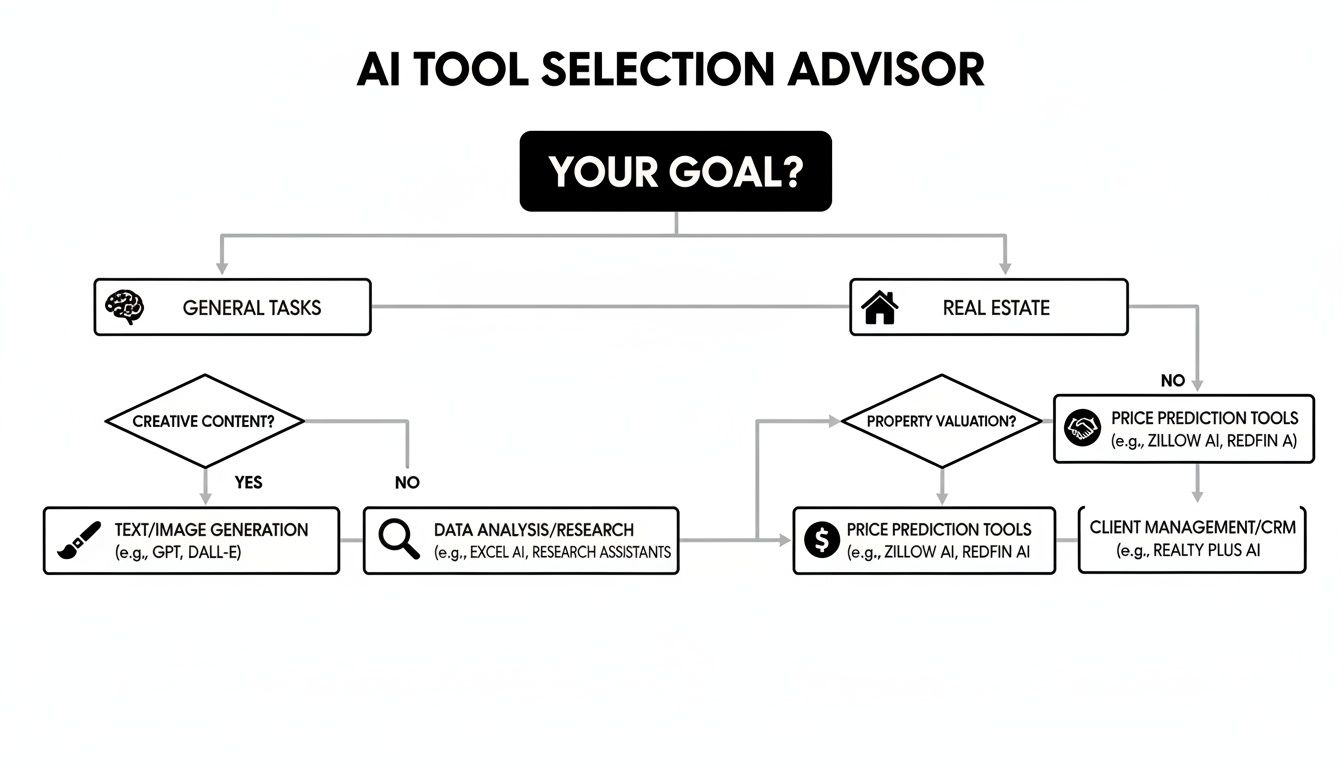
As you can see, for specific, data-driven real estate work, a specialized platform is simply the most direct and effective route.
Marketing Content: The Nuance of Specialization
The same logic holds true for creating marketing content. Top agents are already all-in on AI, with a staggering 73% using it daily or weekly. This shift has cut content production time by an incredible 78% for things like emails, social media posts, and property descriptions.
A specialized AI is trained on the language and strategies of top-producing agents. It understands how to highlight features that resonate with local buyers, resulting in content that feels authentic and persuasive, not generic.
A generalist AI can certainly write a listing description, but it will probably feel flat. It lacks the local flavor and market-aware phrasing that a specialized tool delivers. For instance, a real estate-focused AI knows to highlight "a chef's kitchen with quartz countertops" in an upscale neighborhood or "a low-maintenance yard perfect for busy professionals" when marketing a starter home. It's that level of detail that connects with buyers.
Visual Marketing and Property Showcasing
Great visuals are non-negotiable for a listing, and this is another area where specialized AI really pulls ahead. General AI image generators are fun to play with, but they aren't built to meet the specific demands of property marketing.
Specialized platforms come loaded with features like instant virtual staging and AI-powered room remodels. These tools empower agents to turn an empty room or a dated kitchen into an aspirational space for buyers, and they can do it in seconds. When you're weighing your options, it's worth exploring guides on the best virtual home staging software for real estate to see what’s possible.
Feature Comparison of Leading Real Estate AI Tools
To put it all in perspective, here’s a side-by-side look at how a specialized tool like Saleswise stacks up against a generalist AI like ChatGPT (even with plugins) and other competitors for core real estate tasks.
| Feature | Saleswise | ChatGPT (with plugins) | Other Competitor |
|---|---|---|---|
| CMA Generation | Generates instant, accurate CMAs using live MLS data. | Requires manual data entry and lacks direct MLS integration. | Often relies on third-party integrations that can be slow or outdated. |
| Listing Descriptions | Writes compelling, market-specific copy trained on top agent language. | Produces generic text that needs significant editing for local appeal. | Varies; some offer templates but lack deep market context. |
| Virtual Staging | Offers built-in, one-click AI virtual staging and room remodeling. | Not a native feature; requires separate, often complex tools. | Typically an add-on service or requires another subscription. |
| Client Communication | Creates personalized follow-up emails and market updates. | Can draft emails, but lacks context on specific client interactions or properties. | May offer basic email templates without personalization. |
| Data Source | Live, hyper-local MLS and market data for real-time insights. | Limited to publicly available data up to its last training date. | Dependent on their data partners, which may not be real-time. |
Ultimately, the choice comes down to efficiency and expertise. While a general AI is a jack-of-all-trades, a specialized real estate AI is a master of one, delivering the speed, accuracy, and industry-specific insights that help you close more deals.
Putting AI to Work in Real-World Scenarios

Features on a spec sheet are nice, but the real test for any AI tool is how it actually performs on a busy Tuesday afternoon. The true value comes when these tools turn time-consuming, tedious tasks into something you can knock out in minutes.
Let's look at a few day-in-the-life scenarios to see how AI is changing the game for different roles in a real estate business. It's all about trading hours of manual grunt work for minutes of focused, high-impact action.
The Listing Agent: From Client Call to Appointment Ready
Picture this: a listing agent hangs up the phone with a potential seller. The mission is clear—secure that listing appointment and show up so prepared that signing with you is a no-brainer.
Before AI: The agent would block off the next two to three hours. That time would be spent digging through the MLS for comps, wrangling a spreadsheet to build a CMA, carefully drafting a follow-up email, and trying to find a compelling listing description for a similar home to get some inspiration.
After AI: With the right platform, the agent generates a complete, data-heavy CMA in less than 60 seconds. Then, they jump over to an AI content generator to whip up a personalized follow-up email and a polished, persuasive listing description. For an extra touch, they use an AI virtual staging tool to show the seller how that empty spare room could become a beautiful home office. The whole prep process is done in under 10 minutes.
This isn't just about being faster; it's about being better. The agent walks into that meeting with professional, data-backed materials and creative visuals. That level of preparation instantly builds trust and positions them as the expert.
The Buyer's Agent: Crafting Personalized Client Experiences
A good buyer's agent knows that keeping clients engaged and informed is everything, especially when the market is hot. Personalization is what makes a buyer feel like you truly get what they're looking for.
After a long day of showings, for instance, an agent can use AI to create unique summary emails for each client. Just feed the tool a few notes about the properties and the client's gut reactions, and the AI drafts a follow-up that speaks directly to them. It highlights the features they loved and downplays the ones they didn't, making your communication feel incredibly thoughtful and relevant.
To see more about the visual tools that can really wow buyers, take a look at our guide on the best virtual home staging software.
The Team Leader: Standardizing Excellence and Saving Time
For team leaders, the real magic of AI is creating consistency and efficiency across the entire group. It ensures every agent, from the rookie to the 20-year veteran, is putting out high-quality marketing materials that reflect the team's brand.
Instead of every agent fumbling to write their own social media posts, the team can use an AI tool that’s been trained on the language of top producers. This not only creates a powerful, unified brand voice but also saves dozens of collective hours every single week. Some agents are already using a dedicated AI tool specifically designed for real estate agents to create LinkedIn posts to maintain a steady, professional online presence.
This frees up the team leader to focus on what really matters—coaching agents and growing the business, not proofreading marketing copy.
Integrating AI into Your Business Workflow

Jumping into new technology can feel like a huge commitment, but it doesn't have to be. The best way to bring the right AI for real estate agents into your daily grind is to start small and be strategic. The goal is to get a quick win that builds confidence, not to overhaul your entire business overnight.
Most platforms offer a trial period, so take advantage of it. It’s a no-risk way to get a feel for the tools. Don't try to learn everything at once. Just focus on one thing—one core task that eats up your time right now.
Start with a Single High-Impact Task
For most agents, that one task is generating Comparative Market Analysis reports. It’s a huge time-sink. So, make it your first mission to master instant CMAs. Run a few for your current listings, some past sales, or even your own house. Getting comfortable with the process and the results is the first step.
Once you nail this, you’ll immediately feel the impact of the hours you get back. That early win gives you the motivation to see what else the tool can do. From there, you can start exploring other features at your own pace.
The agents who successfully adopt AI don't try to boil the ocean. They find one nagging problem, solve it exceptionally well with the tool, and let it become a natural part of their workflow before moving on to the next thing.
Overcoming Common Hurdles
Look, there’s always a learning curve. That’s normal. But AI platforms built specifically for real estate are designed to be pretty intuitive. Just block out a little time each week to play around with other functions, like AI-powered virtual staging or writing social media posts.
Concerns about data privacy are also completely fair. Any reputable, industry-specific AI platform is built with data security as a top priority, keeping your client and MLS information locked down.
A recent industry analysis found that while 90% of real estate companies are testing out AI, a mere 5% actually hit their goals. Why? Because the tools are often too complicated to implement. This just shows how important it is to pick user-friendly, specialized software. You can read the full real estate AI reality check on prnewswire.com.
At the end of the day, the small monthly cost is a no-brainer when you measure it against the value you get. Think about the hours you'll reclaim every week. That’s time you can put directly into what matters: building relationships and closing deals. To get a better sense of the possibilities, take a look at our guide on using AI for real estate agents.
Answering Your Questions About AI in Real Estate
Diving into AI can feel like a big step, and naturally, you've probably got some questions. Let's tackle the most common ones we hear from agents just like you, so you can see exactly how these tools fit into a modern real estate business.
Will AI Replace Real Estate Agents?
Not a chance. The real goal here is to make great agents even better, not to push them out. Think of the best AI for real estate agents as a high-powered assistant that handles the tedious, repetitive work—like pulling market data or drafting that first round of marketing copy.
This isn't about replacing your expertise; it's about amplifying it. When the busywork is automated, you get more time back for the things that actually close deals: building relationships with clients, negotiating tough contracts, and offering the kind of nuanced advice a machine never could.
Is My Client and Property Data Secure?
This is a huge deal, and it should be a top priority when you're looking at any AI platform. Always take a few minutes to check out the privacy policies and security protocols of any tool you're considering.
Professional-grade tools built for real estate are designed from the ground up to protect confidential information, from MLS data to your clients' personal details. They use robust security to ensure your business data stays your business data. This is one of the biggest reasons to stick with industry-specific tools over general, consumer-facing apps.
The core difference between a specialized real estate AI and a generalist tool like ChatGPT comes down to two things: live data access and industry-specific training. This is what separates a helpful assistant from a true business partner.
How Is a Specialized Real Estate AI Different from ChatGPT?
While ChatGPT is impressive for general tasks, it hits a wall when it comes to the specific needs of a real estate agent. It's working off a static, outdated library of information and has zero connection to your local MLS. That means it can't find active comps or generate a CMA that's accurate for today's market.
A purpose-built AI is a completely different beast. It's trained on real estate data, connected to live market feeds, and even learns the language and strategies of top-producing agents. This specialized focus means you get hyper-relevant, accurate results—from property descriptions that speak to local buyers to market analyses that reflect what's happening right now.
Is the Investment in AI Worth It for an Agent?
For most agents, the math works out pretty clearly. A specialized AI subscription often costs less per month than a single marketing spend, like a round of mailers or a paid social media campaign.
The easiest way to see the value is by looking at your time. What's an hour of your time worth? If an AI tool saves you just a few hours a week on tasks like writing listing descriptions or building CMAs, that's time you can pour directly into dollar-productive activities. More time for lead follow-up and client meetings means the subscription doesn't just pay for itself—it becomes a profit center.
Ready to see how a specialized AI can transform your workflow? Saleswise gives you the power to create instant CMAs, stunning virtual staging, and expert-level marketing content in minutes.