Explore cma comparative market analysis to win listings

So, what exactly is a Comparative Market Analysis, or CMA? Forget the textbook definition for a second. At its heart, a CMA is an agent's deep dive into a property's market value, grounded in real-world data from the neighborhood. It’s how you figure out what a home is truly worth right now by comparing it to similar homes that have recently sold nearby.
This isn't just about pulling numbers; it's about crafting a compelling, evidence-backed story that helps sellers price their homes competitively and buyers make smart, confident offers.
What a CMA Is and Why It Wins Listings
A masterfully crafted CMA is arguably the most powerful tool in an agent's arsenal. It’s what separates the pros from the pack, turning guesswork into a concrete strategy that builds client trust and closes deals.
For a seller, it’s a reality check that prevents the all-too-common mistake of overpricing, which can cause a property to sit on the market for months. For a buyer, it provides the validation they need to put forward a strong, defensible offer that won't get dismissed out of hand.

Ultimately, your ability to create and explain a CMA directly impacts your client's bottom line—and your own reputation.
The Strategic Advantage of a Data-Backed Price
A well-researched CMA isn't just a pricing suggestion; it’s a strategic anchor for the entire transaction. In a massive global real estate market, getting the price right from day one is everything. Research actually shows that homes priced within 5% of their accurate CMA value sell a whopping 23% faster than overpriced listings. They spend an average of just 32 days on the market, compared to 41 for their less-accurately-priced counterparts. You can explore more global real estate market insights on Statista.com.
That speed isn't just for convenience. It almost always leads to a better financial outcome by avoiding the dreaded price cuts that can make a seller look desperate to buyers.
A CMA is the bridge between a homeowner's emotional attachment to their property and the market's objective valuation. Your job is to build that bridge with solid data, clear explanations, and unwavering confidence.
To build that bridge, you need to analyze a strategic mix of comparable homes, or "comps." Each type tells a different part of the story:
- Recently Sold Homes: This is the bedrock of any CMA. These comps show what buyers have actually paid for similar properties, providing a proven benchmark for value.
- Active Listings: This is your client's direct competition. Looking at active listings helps you understand the current landscape and position the property to stand out.
- Pending Sales: These are the most current snapshot of the market in action. They show you what's attracting offers right now, giving you a real-time pulse on buyer demand.
A CMA plays a unique and vital role for everyone involved in the deal. This table breaks down its core functions.
The Core Functions of a CMA
| Function | For the Seller | For the Buyer | For the Agent |
|---|---|---|---|
| Pricing Strategy | Sets a competitive and realistic list price to attract serious offers. | Validates an offer price, ensuring it's fair and supported by market data. | Establishes credibility and justifies the recommended pricing strategy. |
| Expectation Management | Aligns their perceived value with the current market reality. | Provides confidence that they aren't overpaying for a property. | Manages client expectations from the start, preventing future conflicts. |
| Negotiation Power | Provides leverage by backing up the asking price with hard evidence. | Justifies a lower offer or a firm stance during counter-offers. | Arms both sides with objective data to facilitate smoother negotiations. |
| Decision-Making Tool | Helps decide if it's the right time to sell based on market conditions. | Informs the decision to move forward with a purchase or walk away. | Guides the overall transaction strategy, from marketing to closing. |
By mastering the CMA, you’re not just crunching numbers; you’re giving your clients the clarity and confidence they need to navigate one of the biggest financial decisions of their lives.
What Goes Into a Winning CMA Report?
A truly persuasive CMA is much more than a simple printout of nearby properties. It’s a story—a carefully built case that uses hard data to show a home's true market value. To tell this story effectively, you need to bring together a few key pieces, each one playing a crucial role in building a clear and convincing pricing argument.
Think of yourself as a market detective building a case. You need a solid starting point, undeniable evidence, and a deep understanding of the current scene. A well-built CMA gives you all three, elevating you from a salesperson to an indispensable market advisor.
Start with a Detailed Profile of the Subject Property
Before you can compare a single home, you have to know the subject property inside and out. This is your benchmark, the central character in the story you're about to tell, and a quick once-over just won’t do.
A rock-solid profile goes way beyond the basics like square footage or the number of beds and baths. You need to document every little detail that adds or subtracts from its value.
- Key Specs: Get specific. Note the year it was built, the exact lot size, its architectural style, and any HOA fees.
- Condition & Upgrades: Has the kitchen been redone in the last five years? Is the roof brand new? Are the windows old and drafty or new and energy-efficient? Every upgrade needs to be on your list.
- Unique Selling Points: Does it have a pool, a workshop in the three-car garage, a finished basement, or a killer view? These are the features that drive value and set it apart.
This detailed profile is the lens you'll use to view every other property. Without this level of detail, your comparisons will feel flimsy and your final price recommendation will be much harder to defend.
The Three Pillars of Comparable Properties
Once you have a crystal-clear picture of the subject property, it's time to gather your evidence. This comes from analyzing three distinct categories of comparable properties, or "comps." Each category gives you a different—but equally vital—piece of the market puzzle.
- Recently Sold Properties: This is your foundation. Sold comps are historical fact—they show what real buyers were actually willing to pay for similar homes in the very recent past. They offer the most concrete proof of market value and form the backbone of any credible CMA.
- Active Listings: These homes are your client's direct competition, right now. Looking at active listings tells you what other sellers are asking and helps you position the property to grab buyers' attention. It answers the critical question: "What are our other options?"
- Pending & Expired Listings: Pending sales give you a real-time pulse on market momentum, showing you what's hot and getting offers. Expired and withdrawn listings are just as important—they're cautionary tales that show you exactly what happens when you price a home too high.
A killer CMA comparative market analysis uses these three pillars to build an airtight case for value. At its heart, it compares a subject property—say, a 2,500 sq ft, 4-bed, 3-bath home built in 2015 on a 0.25-acre lot—to 3-5 nearly identical comps. In competitive markets, homes priced with this kind of detailed guidance fetched 98% of their list price on average, a stark contrast to the 92% for homes priced without such a rigorous analysis. Discover more insights about CMA strategies at Kapre.com.
A persuasive CMA doesn't just list data; it interprets it. By weaving together the stories of sold, active, and pending properties, you create a compelling market narrative that leads your client to the logical conclusion: the right price.
Each pillar offers a unique vantage point. Sold properties provide proof from the past, active listings size up the present competition, and pending sales hint at the immediate future. Together, they create a 360-degree view of the market, letting you build a pricing strategy that isn't just accurate, but strategic and defensible. This is what turns a standard report into a tool that wins listings.
How To Select and Adjust Comparable Properties
This is where the rubber meets the road. Creating an accurate cma comparative market analysis is less about theory and more about practice—a blend of your street-smart intuition as an agent and hard data. Choosing the right comparable properties, or "comps," is hands-down the most critical step. Get this right, and you build a pricing argument that’s logical, defensible, and ultimately, convincing.
Think of it as finding the subject property's identical twin—or at least its closest relative. You wouldn't compare the price of a Granny Smith apple from last season to a Honeycrisp that just came off the truck. In the same way, your comps must mirror the subject property in location, timing, and features to give a true picture of its value.
The whole process rests on three pillars: sold, active, and pending properties. Each one tells a different part of the story.
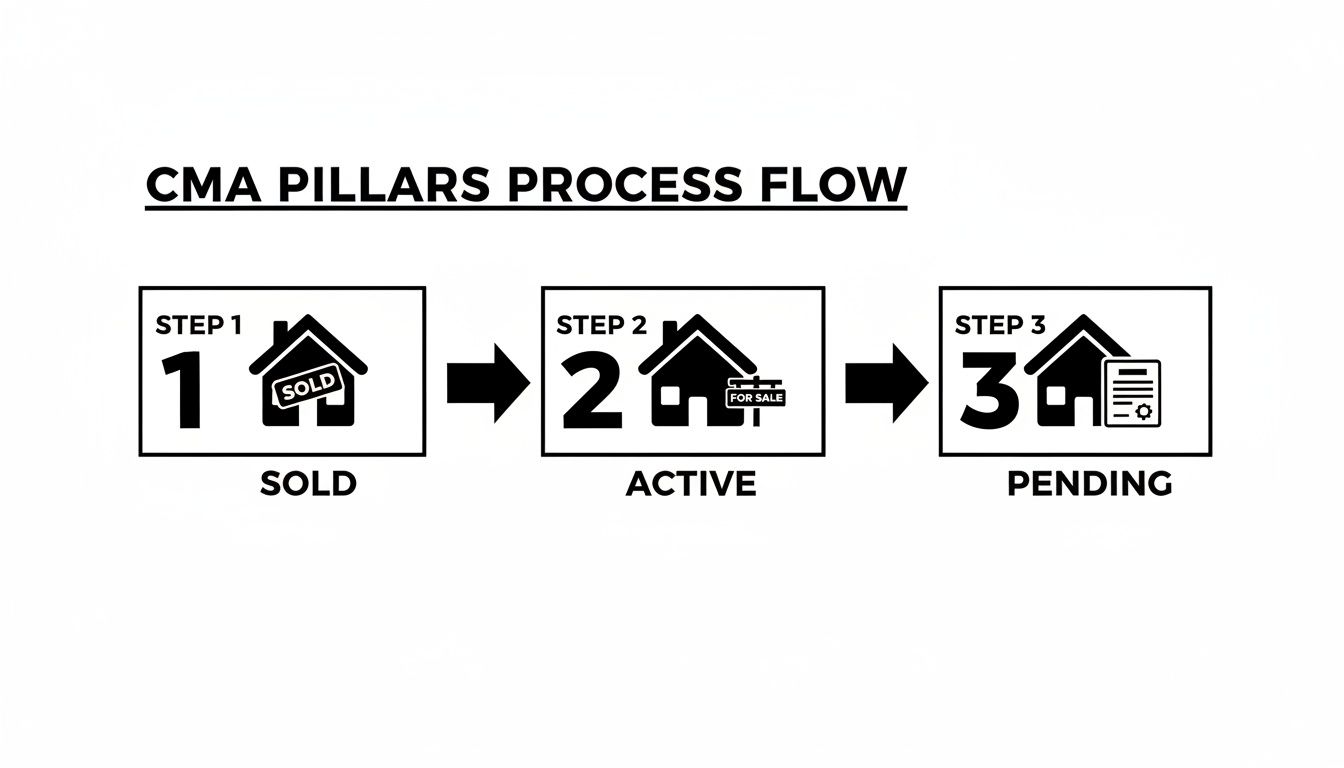
Sold properties give you a historical baseline of what buyers have actually paid. Active listings show you the current competition. And pending sales? They're the crystal ball, revealing where the market is headed right now.
The Non-Negotiable Rules of Comp Selection
To keep your analysis credible, every comp you pick needs to pass a strict test. Following these rules ensures your final price isn't just a guess; it's an evidence-backed conclusion. This is what separates a professional CMA from a generic online estimate.
Here are the filters every pro uses:
- Proximity: Closer is always better. Stick to the same subdivision or neighborhood if you can. For rural properties, you might have to stretch it to a few miles, but the goal is to tap into the same hyper-local market forces.
- Recency of Sale: Markets change fast. Always prioritize homes sold within the last 90 days. You can push it to six months if you absolutely have to, but any sale older than that is practically ancient history and much less reliable.
- Similarity of Features: The details make all the difference here. Look for homes with a similar architectural style, age, lot size, bedroom/bathroom count, and square footage (stay within 10-15%). A two-story colonial is not a good comp for a single-story ranch, period.
The Art and Science of Making Adjustments
Let's be real: no two houses are exactly alike. This is where the "art" of the CMA comes into play—assigning a real dollar value to the differences between your subject property and the comps. This process, called making adjustments, has to be objective and clear so your client can follow your logic and trust the outcome.
You're essentially leveling the playing field, tweaking each comp so it becomes an "apples-to-apples" match with the subject property.
Think of adjustments like a financial balancing act. If a comp has a superior feature the subject property lacks (like a swimming pool), you subtract its value from the comp's sale price. If the subject property has the better feature (like a brand-new kitchen), you add its value to the comp's price.
This takes a deep understanding of what local buyers are actually willing to pay for. Some adjustments are easy, but others are more nuanced. For example, when you're comparing homes, you also have to consider their presentation. Knowing how to improve curb appeal helps you understand why two otherwise similar homes might sell for different prices.
Quantifying Key Property Differences
So, how do you put a number on these differences? Experienced agents rely on a few defensible methods to make sure adjustments are based on market data, not just a gut feeling. (The formal methodology behind all this is the sales comparison approach, which is worth a deeper dive).
Here’s how you can tackle common adjustments:
- Cost-Based Method: What would it cost to add the feature today? For instance, if a comp has a deck and your subject property doesn't, you can adjust based on what a local contractor would charge to build a similar one.
- Paired Sales Analysis: This is the gold standard for accuracy. You find two comps that are nearly identical except for one key feature (e.g., one has a finished basement, the other doesn't). The difference in what they sold for is a powerful indicator of that feature's market value.
- Depreciated Value: For features that wear out, like a roof or an HVAC system, you can calculate a depreciated value based on their age and expected lifespan to make a fair adjustment.
By carefully selecting your comps and making logical, data-backed adjustments, you turn a simple list of houses into a powerful tool that clearly and convincingly demonstrates a home's true market value.
Presenting Your CMA for Maximum Impact
Putting together a rock-solid cma comparative market analysis is just the first step. The real magic happens when you present it. This is where you transform all that data into a story that builds trust, sets realistic expectations, and motivates your client to move forward.
Think of yourself less as an analyst and more as a market storyteller. Your role is to walk the client through the evidence, connect the dots for them, and guide them to the only logical conclusion: the perfect price for their home. A clumsy presentation can make even the best CMA feel overwhelming, but a great one can bring clarity to even the most complex market.
Set the Stage for Success
Don't just dive headfirst into the numbers. Before you even open the report, take a moment to frame the conversation. Kick things off with a quick, high-level overview of what's happening in their specific neighborhood and the broader city.
Is it a buyer's or a seller's market right now? Are prices climbing or cooling off? How long are homes like theirs sitting on the market? Giving them this context first is crucial—it helps them understand the big picture their home's value fits into. This simple shift positions you not as a salesperson, but as their trusted market advisor.
Once you’ve painted the macro picture, you can seamlessly zoom in on the micro-level: their property. This structure helps clients see that your final price recommendation isn't just a number pulled from thin air, but a conclusion rooted in a thorough analysis of the entire market.
Tell a Visual Story with Your Comps
Let's face it, people are visual. A spreadsheet filled with addresses and prices is just noise. To make your data hit home, you have to bring it to life.
Start with a map showing their home in relation to all the comps. This instantly grounds the analysis in a physical space they know intimately—their own neighborhood. Then, as you go through each comparable property, show them good, clear photos.
- For Sold Comps: You can point out the similarities and, more importantly, the differences. "See this one over on Maple Avenue? It sold last month for $550,000. It has the same square footage, but it doesn't have your brand-new kitchen. That's a key reason we're adjusting the value up."
- For Active Listings: These are the direct competition. "Okay, this is what buyers are going to see when they tour your home this weekend. They're asking $575,000, but notice their yard backs up to that busy street, unlike yours."
This approach makes your adjustments feel real and tangible. Instead of looking at abstract numbers, the client can see precisely why their home is worth more or less than another. It makes the entire cma comparative market analysis process feel intuitive and far easier for them to get on board with.
Your goal isn't to lecture; it's to collaborate. Treat the CMA as a shared document you're walking through together. This interactive approach naturally invites questions and makes the client feel like a partner in the pricing decision, not just someone being told what to do.
Navigate Objections with Confidence
Even with a flawless presentation, expect questions and objections. It's totally normal. Selling a home is a massive financial and emotional decision. The key is to anticipate these moments and respond with empathy backed by solid data.
When a client says, "But my neighbor down the street sold for $600,000!" don't get defensive. Be prepared. Pull up that specific property and gently walk them through the facts. Maybe it had a finished basement, or maybe it sold three months ago when the market was hotter.
The most powerful way to handle any objection is to circle back to the evidence you’ve already prepared. By guiding them back to the facts in a calm, consultative way, you reinforce your expertise and keep the conversation productive. Mastering this dialogue is a huge part of delivering an effective cma comparative market analysis and a fantastic client experience.
For more on structuring these crucial client meetings, check out our guide to building a winning listing presentation template. When you learn to turn data into a compelling story and objections into opportunities for education, you’ll secure the listing at the right price, every time.
Common CMA Mistakes That Undermine Your Credibility

Even a carefully prepared cma comparative market analysis can be instantly discredited by a few common, yet critical, mistakes. These slip-ups don’t just lead to a bad price—they can completely erode the trust you’ve worked so hard to build with your client. Think of this as your pre-flight checklist, helping you spot and fix issues before your analysis ever takes off.
Dodging these pitfalls is what separates a good agent from a truly great one. It shows a dedication to precision that clients notice, respect, and remember long after the deal is done. Ultimately, a rock-solid CMA is a direct reflection of your expertise.
Relying on Outdated or Irrelevant Comps
One of the quickest ways to ruin a CMA is by using comparable properties that are either too old or too far away. Real estate markets are incredibly local and can turn on a dime. A sale from six months ago might as well be from another lifetime, especially if inventory levels or interest rates have shifted.
The same goes for geography. Pulling a comp from a different school district or a neighborhood with a completely different vibe can invalidate your entire report. The goal is to mirror the subject property's specific market, not some vague, regional average. Always, always prioritize comps that are recent (ideally within 90 days) and as close as possible.
Ignoring Current Market Conditions
A CMA doesn't exist in a bubble; it has to reflect the real-time pulse of the market. If you only look at sold data without considering the bigger picture, you're setting yourself up to misprice the home. A sharp agent always looks beyond the sold comps and asks the right questions:
- Is it a buyer's or seller's market? This fundamental question shapes your entire pricing strategy and negotiating power.
- What is the average Days on Market (DOM)? A low DOM signals a hot market where you can price more confidently.
- Is inventory rising or falling? This tells you about supply and demand, which directly impacts a property's value.
If you fail to weave these market indicators into your analysis, you're only telling half the story.
A CMA is more than a historical record of past sales; it's a strategic forecast based on current conditions. Overlooking active competition and pending sales is like driving while only looking in the rearview mirror.
Making Indefensible or Emotional Adjustments
Adjustments are where the science of a CMA meets the art of valuation, but they can't be based on guesswork. Slapping a random value on a finished basement or a new roof without any data to back it up will make your client (and the other agent) question your entire report.
Every single adjustment needs a "why." You have to be ready to explain your logic, whether it's based on a cost-to-build approach or, even better, a paired sales analysis from the market. This transparency is what builds your credibility and helps your client understand how you got to the final number. It’s also crucial to avoid letting your own—or your client's—emotional attachment to certain features cloud your judgment. The market, not personal preference, is the ultimate judge of value.
Common CMA Pitfalls and Solutions
To help you stay on track, we've put together a quick reference table. Think of this as your cheat sheet for spotting and fixing the most frequent errors that can derail an otherwise solid analysis.
| Common Mistake | Why It's a Problem | How to Avoid It |
|---|---|---|
| Using Stale Comps | Markets change fast. A 6-month-old sale may no longer reflect current values, leading to an inaccurate price. | Prioritize sales from the last 90 days. Only go further back if absolutely necessary, and always explain why. |
| Ignoring Market Trends | A CMA based only on sold properties misses the live action. It fails to account for supply, demand, and momentum. | Analyze active listings, pending sales, and key indicators like DOM and list-to-sale price ratio. |
| Poor Comp Selection | Choosing homes that aren't truly comparable (different style, school district, etc.) skews the final value. | Stick to the "apples to apples" rule. Match location, size, age, condition, and amenities as closely as possible. |
| Making Arbitrary Adjustments | Pulling adjustment values out of thin air undermines your credibility and makes your CMA easy to challenge. | Justify every adjustment with market data, paired sales analysis, or verifiable cost estimates. Be prepared to show your work. |
| Overlooking Property Condition | Failing to account for major differences in condition (e.g., a fixer-upper vs. a turnkey home) is a massive oversight. | Always view the comps online or in person if possible. Make realistic, defensible adjustments for condition differences. |
By keeping these points in mind, you're not just creating a report; you're building a foundation of trust.
A precise and defensible cma comparative market analysis is the cornerstone of your professional reputation. By sidestepping these common errors, you deliver a report that is not only accurate but also a powerful tool for building lasting client relationships and securing listings at the right price.
How AI Can Make Your CMAs Smarter and Faster
In a market where every minute counts, the old-school way of putting together a cma comparative market analysis can feel like a real drag. Manually digging through the MLS, hand-picking comps, and then trying to format it all into a decent-looking report can eat up hours. That's valuable time you could be spending face-to-face with clients. This is exactly where modern AI tools are stepping in and completely changing the game.
AI platforms built for real estate aren't just about shaving off time; they’re about bringing a whole new level of precision to your pricing. These systems can process millions of data points in the blink of an eye, pinpointing the most relevant comps with a kind of data-backed objectivity that's tough to match manually. They catch subtle market shifts and weigh property features with algorithms, leading to a much more accurate and defensible pricing recommendation.
The Real-World Benefits of AI-Powered CMAs
The most obvious win here is a massive boost in efficiency. Think about it: instead of blocking out your morning for research and report building, you can generate a detailed, professional, and client-ready CMA in less than a minute. The technology takes the tedious data work off your plate so you can get back to what you do best.
- Lightning-Fast Generation: Go from request to report in seconds, not hours.
- Data-Driven Accuracy: Let algorithms sift through vast datasets to find the best comps, which cuts down on human error and unconscious bias.
- Professional Presentations: Get reports that are automatically formatted into polished, easy-to-read documents that will definitely impress your clients.
This shift lets you respond to new leads and client questions almost instantly, making you look like the responsive, tech-savvy agent you are. For those who want to get even more advanced with data, learning how to scrape leads with AI can give you another serious leg up on the competition.
By automating the most time-consuming parts of the CMA, AI doesn’t replace your expertise—it supercharges it. The tech handles the number crunching, freeing you up to focus on strategy, negotiation, and building those crucial client relationships.
At the end of the day, bringing this kind of technology into your workflow means you can offer more value to your clients. You're giving them more accurate pricing advice, backed by solid data, and you're doing it faster than anyone else. For a closer look at the tools making this possible, check out our guide to real estate CMA software and see how it's shaping the industry.
Frequently Asked Questions About CMAs
Even after you've got the basics down, certain questions always seem to pop up when you're in the trenches creating or presenting a CMA. Let's tackle some of the most common ones I hear from agents and their clients. Think of this as a quick-reference guide to handle those tricky situations and build unshakeable confidence with your clients.
These are the details that often separate a good CMA from a great one.
How Is a CMA Different from a Professional Appraisal?
This is a big one, and it's crucial to get it right. Simply put, a Comparative Market Analysis (CMA) is our tool, as agents, to figure out a smart listing price or offer price. It’s all about market positioning and strategy. An appraisal, on the other hand, is a formal, legally-recognized valuation done by a licensed appraiser, usually for a bank's mortgage decision.
While we both look at property data, a CMA is more fluid and forward-looking—we're paying close attention to the active competition and what’s happening in the market right now. An appraiser has to follow much stricter rules and leans heavily on historical sold data to arrive at a formal value for lending purposes.
How Many Comps Should I Use in My CMA?
The sweet spot is usually between three and five really solid comparables. Remember, the goal here is always quality over quantity. If you use too few, you might not be telling the whole story. But if you throw in too many, you'll just muddy the waters and confuse your client.
Stick to the three to five most similar, most recent, and closest properties you can find. A focused selection like this builds the strongest, most defensible case for the price you're recommending.
What Should I Do If There Are No Good Comps Available?
We've all been there. You've got a one-of-a-kind property or a home in a rural area, and finding a perfect match feels impossible. When this happens, you have to get a bit creative, but you also have to be completely open about it with your client.
- Go Back in Time: Start by pushing your search from the usual 90 days to 180 days.
- Broaden the Map: If that doesn't yield anything, carefully expand your geographic search radius. Don't go crazy, but a little more distance might be necessary.
- Adjust Heavily: You might have to use properties that aren't a great match and make significant, well-documented adjustments for all the differences.
The most important thing is to walk your client through the challenge. Explain why good comps are scarce, show them the properties you ultimately chose, and justify every adjustment you made. This turns a tough situation into a moment where you can really showcase your expertise.
How Often Should a CMA Be Updated?
A CMA is a snapshot of a moving target. Its value can diminish quickly, especially when the market is hot or cooling off fast. What was accurate a month ago might be totally off today.
As a rule of thumb, if a property hasn't sold within 30-45 days, it’s time for a refresh. You should also update your CMA immediately if something big happens in the market—a new, important comp sells, a major competing listing expires, or interest rates take a sudden turn. Keeping your pricing strategy sharp means keeping it aligned with today's reality, not last month's.
Ready to create lightning-fast, data-driven CMAs that win listings? Saleswise generates professional, client-ready reports in seconds, giving you more time to focus on your clients. Start your $1 trial and see the difference at https://www.saleswise.ai.