Mastering the CMA for Realtors A Guide to Winning Listings

A Comparative Market Analysis, or CMA, isn't just another report we print out for clients. Think of it as your data-driven pricing strategy—the bedrock of trust and realistic expectations. It’s how we show our work, comparing a seller's home to similar properties that have recently sold, are still on the market, or even those that didn't sell. This isn't just about finding a number; it's about building a clear, defensible case for the home's true market value.
Honestly, a solid CMA is one of the most fundamental tools you have for winning a listing and making sure it sells in a timely manner.
Why a Great CMA Is Your Most Powerful Listing Tool

Let's be real: the pricing conversation is where you either win or lose a client's trust. A meticulously prepared CMA is what separates the pros from the pack. It shifts the entire discussion from "I think..." to "Here's what the data shows..." From that first meeting, you’re not just another agent with a guess—you’re the market expert.
Picture this scenario: two agents are up for the same listing. The first one shows up with a generic, one-page printout they pulled from the MLS in five minutes. The second agent walks in with a thoughtful analysis, guiding the seller through carefully chosen comps, explaining how they adjusted for that renovated kitchen, and telling a clear story about what’s happening in their specific neighborhood.
Who do you think gets the listing? The second agent doesn't just give a price; they deliver confidence.
Turning Data Into Client Confidence
A truly effective CMA isn't just about landing on a final number. It’s about the journey you take the client on to reach that number. By grounding your pricing recommendation in hard evidence, you set the entire process on a foundation of reality. This is your best defense against the dreaded "but Zillow said..." or the seller who's fixated on what their neighbor’s totally different house sold for six months ago.
A well-crafted CMA does more than suggest a price; it educates the seller. When they understand the 'why' behind the number, they become a partner in the pricing strategy, not an obstacle to it.
This educational approach is everything. When sellers feel like they're part of the process and understand the market forces at play, they're far more likely to agree on the right price from the very beginning. And that single decision can make or break the entire sale.
The Real-World Impact of an Accurate CMA
The difference between a data-backed price and a hopeful guess is stark. The table below illustrates just how much is on the line when it comes to pricing a home correctly from day one.
The Impact of CMA Accuracy on Listing Performance
| Metric | Accurate CMA (Data-Driven Pricing) | Inaccurate CMA (Guesswork Pricing) |
|---|---|---|
| Time on Market | Sells 57% faster on average. | Lingers on the market, risking stigma. |
| Final Sale Price | Achieves closer to list price, often with multiple offers. | Often requires multiple price drops, selling below market value. |
| Seller Experience | Smooth, predictable process with less stress. | Frustrating, with carrying costs and uncertainty piling up. |
| Agent Reputation | Builds trust and generates referrals. | Damages credibility and leads to difficult conversations. |
As you can see, the ripple effects of that initial pricing decision are huge. An accurate CMA sets everyone up for a win, while a poor one creates a cascade of problems.
The numbers back this up. Properties priced correctly from the start sell 57% faster than homes that are overpriced. This isn't a small edge; it's a game-changer that impacts everything from the seller's carrying costs to their final net profit. Agents who make the CMA a cornerstone of their listing presentation win 15% more deals than those who wing it. When the median time on market can easily be 29 days or more, accurate pricing is the difference between a quick, successful sale and months of frustrating price reductions.
Mastering the CMA for realtors is a non-negotiable, foundational skill. It's the tool that proves your value long before the "For Sale" sign ever goes in the yard and directly impacts your ability to get a real estate listing and deliver the results your clients deserve.
Finding Comps That Tell the Real Story
A powerful CMA all starts with the right ingredients. The quality of your entire analysis hinges on the quality of your data, and for that, the MLS is your single source of truth. But just pulling a list of recently sold homes won't cut it. That's only part of the story.
Think of yourself as a market detective. You need to gather different types of evidence to build a compelling case for a home's value. Focusing only on sold properties gives you a snapshot of where the market was, but it misses the critical context of where it is right now and where it's headed.
Look Beyond Just the "Solds"
To build a complete and convincing market picture, you have to look at properties from four distinct categories. Each one gives you a unique piece of the puzzle, and when you put them all together, they paint a vivid, defensible picture for your client.
These categories are:
- Active Listings: This is your subject property's direct, live competition. It shows sellers exactly what their home is up against in the eyes of today's buyers.
- Pending Sales: This is the freshest data you can get on market value. These are homes under contract but not yet closed, revealing what buyers are willing to pay right now.
- Sold Listings: The gold standard for proven value. These closed sales from the last three to six months are your hard evidence of what similar homes have actually sold for.
- Expired/Withdrawn Listings: These are powerful cautionary tales. They show the market's pricing ceiling and are a perfect example of what happens when a property is over-priced.
When you present all four, you're not just throwing a number at your client. You're giving them a full market education that answers their questions before they even ask them. That's how you build trust.
Nail Down Your Core Search Criteria
Before you even log into the MLS, you need a clear set of search criteria. This is what keeps your analysis tight and ensures you’re comparing apples to apples. While every neighborhood is a little different, your initial search should always be narrow and focused.
Think of it as a checklist of non-negotiables that helps you filter out the noise and zero in on the most relevant properties.
Your starting search parameters should always include:
- Location: Start in the same subdivision or within a half-mile radius. Don't cross major roads or school district lines unless you absolutely have to.
- Property Type: Stick to the same style. A two-story colonial is not comparable to a ranch, even if the square footage is identical.
- Square Footage: Aim for properties within 15-20% of your subject property's size.
- Age: Look for homes built within 5-10 years of the subject property. This usually keeps construction quality and design features consistent.
- Bedrooms & Bathrooms: Match the bed and bath count as closely as you possibly can. A significant difference here will require big adjustments later.
The goal isn't to find the most comps; it's to find the best comps. A CMA with three killer comparables is infinitely more persuasive than one with ten mediocre ones.
Read Between the Data Lines
Once you've pulled a pool of potential comps, the real work begins. The raw data in the MLS tells a story, but you have to know how to interpret it. Look for clues that reveal the narrative behind each number.
For instance, a home that went under contract in three days for over the asking price almost certainly had multiple offers. That tells you something powerful about demand. On the flip side, a property that sat for 90 days and had two price cuts before selling below the original list price tells a clear story about being overpriced from the start.
Knowing how to effectively find and interpret this data is crucial. Even when you're laser-focused on sourcing real estate comps, the core principles of finding truly similar properties and understanding their history don't change. These details add the context that explains not just what a home sold for, but why. This is the insight that separates a basic report from a professional analysis that wins you the listing.
How to Select and Adjust Comps Like an Appraiser
You've pulled a list of potential comps from the MLS. That’s the easy part. The real work—the part that showcases your expertise—is sifting through that raw data to find the handful of properties that tell an accurate and compelling pricing story. This is where your analytical skill transforms a data dump into a persuasive, appraiser-level analysis.
It’s not just about matching square footage and bed/bath counts. You have to get inside the mind of a buyer and an appraiser, looking at the nuances that influence value. This critical thinking is what separates a generic report from a winning CMA.
This process involves looking at the full spectrum of market activity.
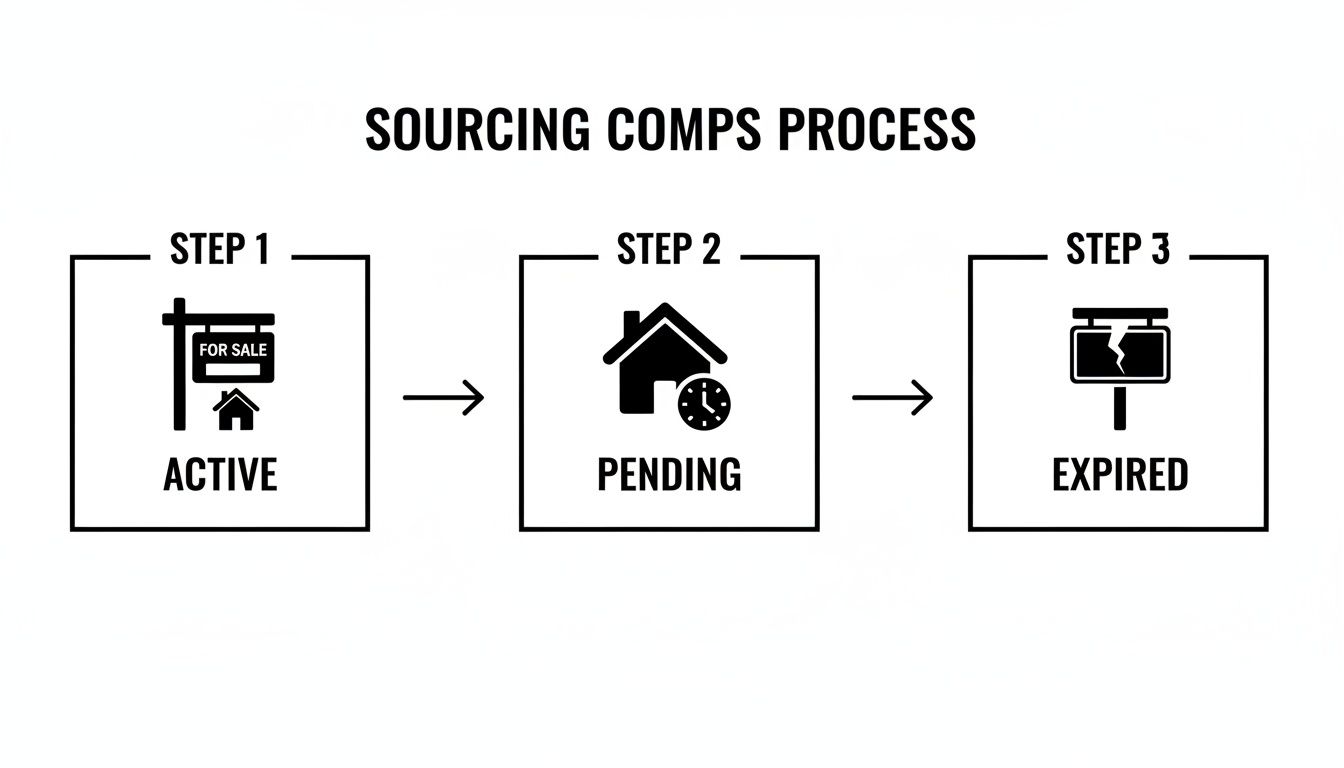
Looking at what’s active, pending, and expired gives you a 360-degree view. You see not just what sold, but what buyers are choosing right now and, just as importantly, which prices the market has already rejected.
The Art of Selecting the Best Comps
Your initial search might spit out a dozen possibilities. Your job is to narrow that list down to the best three to five properties. But how do you choose? It often comes down to weighing difficult trade-offs.
Here’s a classic dilemma: do you pick the older, un-renovated house next door or the newer, fully updated home a half-mile away? There’s no single right answer. It depends entirely on what buyers in that specific market value more. In a highly walkable downtown neighborhood, that primo location might trump everything. But in a newer suburban development, the modern, updated home is likely the better indicator of value.
A great CMA tells a story. Think of each comp as a character. You're choosing each one deliberately to illustrate a specific point about the subject property's location, condition, or place in the current market.
Making Defensible Value Adjustments
Once you’ve hand-picked your comps, it's time to make adjustments. This is easily the most technical part of building a CMA, and it's where a lot of agents get nervous. The secret is to be consistent, logical, and ready to explain the "why" behind every single number.
Adjustments are all about leveling the playing field. If your client's house has a three-car garage but your best comp only has two, you have to add value to the comparable to make it equivalent. On the flip side, if a comp has a stunning new kitchen and your client’s is from 1995, you have to subtract value from the comp’s sale price.
Here are a few common adjustment scenarios and some typical value ranges to consider:
- Extra Bathroom: A full bath adds real value. An adjustment of $20,000–$30,000 is often justifiable, though this will scale with the home's overall price point.
- Finished Basement: If your subject property has one and the comp doesn’t, you need to account for that extra living space. Remember to adjust it at a lower price per square foot than the above-grade square footage.
- Updated Kitchen: This is a huge selling point. Adjustments can easily range from $15,000 to $50,000+, depending on the quality of the finishes and appliances.
- Premium Lot: Does the property back up to a park, have a golf course view, or sit on a quiet cul-de-sac? This demands a positive adjustment that can vary dramatically from one neighborhood to the next.
These numbers aren't pulled out of thin air. The best way to justify an adjustment is to find "paired sales"—two otherwise identical sold homes where one has the feature and one doesn't. The difference in their sale prices is what the market was willing to pay. This is a core principle of the sales comparison approach that professional appraisers use every day.
Putting It All Together for a Rock-Solid Price
Your final goal is a tight, logical analysis. Most experienced agents use 3 to 5 comps to create an accurate CMA, blending sold properties with a look at the active and expired listings to get a feel for the market's pulse. This methodical approach is proven to slash pricing errors by 25%—a massive advantage when you consider that 41% of sellers initially want to overprice their homes.
When you carefully select your comps and make logical, evidence-backed adjustments, you create a CMA that stands up to scrutiny from even the most analytical client. You aren't just giving them a price; you're presenting a well-reasoned conclusion. This is how you turn a home's features into tangible value and cement your status as the go-to market expert.
Presenting the CMA to Win Your Next Listing

You can have the most brilliant analysis in the world, but it’s worthless without a compelling delivery. All that meticulous research and those careful adjustments mean nothing if you can’t tell the story behind the numbers. Your listing presentation is the stage, and the CMA is your script.
Your real job here is to translate a bunch of complex data into a clear, understandable narrative about the market. You aren't just dropping a price on the table; you're guiding the seller on a logical journey that makes your recommended price the obvious conclusion. This is where you prove your worth and win their business.
Setting the Stage for Success
Before you even flip to the first page of the report, you need to frame the conversation. Kick things off by reminding the seller of your shared goal: to get their home sold for the highest possible price in the shortest amount of time. This simple shift positions you as a partner, not just a messenger with a number they might not like.
Explain that the CMA is a tool you’ll use together to understand what's happening in the market right now. That one small step can transform a potentially tense pricing talk into a collaborative problem-solving session.
Telling the Story with Your Comps
Don’t just rattle off addresses and prices. Tell the story of each comparable property. Walk the seller through them one by one, using photos and maps to make the data feel real. A visual journey is always more persuasive than a spreadsheet.
- The Hero Comp: Start with the most similar sold property. "Take a look at this one on Elm Street. It’s almost a mirror image of your home and it sold just three weeks ago for $525,000. This is our strongest clue for what a buyer is willing to pay today."
- The Competitor: Next, show them an active listing. "Now, this is what we're up against. The house on Maple Avenue has been sitting for 32 days at $550,000. Buyers looking at your home will absolutely be looking at this one, too."
- The Cautionary Tale: Use an expired or withdrawn listing to show the real danger of overpricing. "The owners on Oak Drive started at $575,000 and ended up chasing the market down with price cuts before giving up. We can learn a valuable lesson from their mistake."
This narrative approach makes the data easy to digest and your pricing conclusion feel inevitable.
The best CMA presentation doesn't feel like a presentation at all. It feels like a strategic conversation between two experts—the seller, who knows their home inside and out, and you, the expert on the market.
Handling Common Seller Objections
Objections aren't roadblocks; they're your chance to shine and reinforce your expertise. You know the classics are coming, so have your data-backed responses ready.
"But Zillow says my home is worth more!"
"I get it, those online estimates are everywhere. They're a decent starting point, but their algorithm can't see the new quartz countertops you installed or factor in the nuances of our specific block. My analysis is based on verified sales of homes a real-life buyer would actually compare to yours."
"My neighbor sold for a higher price six months ago."
"That's a great point, and I definitely looked at that sale. The market has shifted since then—interest rates have ticked up and we're seeing more homes for sale. Our pricing strategy has to be based on today's conditions, not yesterday's."
A poorly executed CMA has serious consequences. Overpriced homes often need multiple price reductions, with data showing they make up 20% of listings that get a price cut early on. Underpricing is just as bad, potentially leaving 10-15% of a seller's equity on the table. As you present, you’re preventing your client from becoming one of the 11% of listings that expire nationally. You can see more data on how a great CMA helps win 22% more listings at Highnote.io.
Presenting your analysis with confidence and clarity is what sets you apart. Many agents find that dedicated tools can turn hours of CMA prep into just a few minutes. If you're looking to speed things up, you can explore some great options in our guide to real estate CMA software. In the end, this presentation is where you build trust, demonstrate your true value, and walk away with your next listing.
Building CMAs in Minutes, Not Hours, With the Right Tech
Let's be honest: blocking off half your morning to build a single CMA is a thing of the past. If you're still manually digging through the MLS, fighting with clunky spreadsheets, and designing reports from scratch, you’re leaving money on the table. The modern agent's toolkit has some seriously powerful tech, and AI-powered platforms are completely changing the game.
This is about more than just speed; it’s about working smarter. The old-school workflow was a major time-sink, keeping you chained to your desk instead of out in the field with clients. That painstaking process has cost agents business because a competitor simply delivered a polished, accurate report faster.
The Old Way vs. The New Way
Let's break down the two approaches. The traditional method was a gauntlet of admin tasks that had very little to do with your actual market expertise. It was a grind that could easily eat up hours and was full of opportunities for human error.
The new way lets technology do the heavy lifting, freeing you up to focus on what you do best: strategy and client relationships.
The Traditional CMA Workflow (Hours):
- Log into the MLS and run multiple, separate searches for active, pending, and sold listings.
- painstakingly copy and paste data—square footage, sale dates, tax records—into a spreadsheet.
- Spend time double-checking for data entry errors, which are almost guaranteed when bouncing between systems.
- Try to apply your own formulas for adjustments, hoping they stay consistent from one report to the next.
- Jump into another program to design and format a decent-looking report, manually adding photos and property descriptions.
The AI-Powered CMA Workflow (Minutes):
- Type a single property address into your platform of choice.
- The AI instantly pulls and organizes data from the MLS, public records, and other key sources.
- Smart algorithms pinpoint the best comps and suggest logical adjustments based on thousands of data points.
- A professionally designed, client-ready report is generated automatically, complete with your branding, charts, and photos.
This isn't just a small improvement. A workflow that used to chew up your most productive hours now takes less time than it takes to make a cup of coffee. It's a fundamental change in how you can operate your business.
To really see the difference, let's compare the tasks side-by-side. The contrast in time and effort is stark, highlighting how much of the old process was pure administrative drag.
Traditional CMA vs AI-Powered CMA Workflow
| CMA Task | Traditional Method (Time/Effort) | AI-Powered Platform (Time/Effort) |
|---|---|---|
| Data Gathering | 30-60 mins of manual MLS searches and data export. | <1 min of automated data aggregation. |
| Comparable Selection | 20-40 mins of sifting through properties and maps. | <1 min as AI suggests top comps instantly. |
| Data Entry & Cleanup | 15-30 mins of copy-pasting into spreadsheets. | 0 mins. Data is structured automatically. |
| Value Adjustments | 20-45 mins of manual calculations and guesswork. | 2-5 mins of reviewing and tweaking AI suggestions. |
| Report Creation | 30-60 mins of design, formatting, and proofreading. | 1-2 mins to generate a branded, client-ready PDF. |
| Total Time | 1.5 - 3.5 Hours | ~5-10 Minutes |
As you can see, the time savings are massive. This isn't just about efficiency; it's about reallocating your most valuable asset—your time—toward activities that actually grow your business.
Real-World Benefits for Your Business
Adopting this kind of tech does way more than just save you a few hours. It gives you a powerful competitive edge that you can see in your bottom line and your professional reputation.
First off, you get back a huge chunk of your week. Research has shown that agents can spend over a third of their time on data collection and report building. Automating this frees you up for what really matters: prospecting, lead follow-up, and face-to-face client meetings.
Second, you deliver a much higher level of accuracy. AI models process hundreds of variables at once, from subtle neighborhood price trends to the specific financial impact of a new kitchen. This gets rid of the guesswork and spreadsheet errors, leading to pricing recommendations you can stand behind. That kind of consistency builds a reputation for being the go-to expert who gets it right.
Finally, you show up looking like a pro every single time. Modern CMA tools generate beautiful, easy-to-read reports that instantly position you as a tech-savvy agent who's on top of their game. Once you have your CMA presentation nailed, you can take your listing visuals to the next level by exploring virtual staging solutions specifically designed for realtors to make your presentations even more compelling. By embracing technology, you're not just creating a CMA; you’re delivering a superior client experience from that very first meeting.
Tackling Tricky Questions When Building a CMA
Even the best agents get tripped up from time to time when putting together a CMA. You're dealing with a living, breathing market and sometimes the data just doesn't want to cooperate. Let's walk through a few of the most common curveballs you'll face and how to handle them like a pro.
Think of this as your field guide for those "what do I do now?" moments. The aim here is to build on what you already know and give you the confidence to tackle any property, no matter how unusual.
How Far Back Should My Comps Go?
The old rule of thumb says to look back six months for sold comps. For a lot of neighborhoods, that’s a pretty good starting point. It gives you enough data to work with, but it's not so old that you're looking at a completely different market.
But here's the thing: markets don't follow rules.
- In a hot market: If prices are jumping month-over-month, six months is ancient history. You need to shrink that window down to 90 days, or you risk leaving serious money on the table for your seller.
- In a slow or rural market: Sometimes you have to take what you can get. If there are only a handful of sales in the past year, you may have to stretch your search to 12 months. If you do this, just be ready to make some clear, justifiable adjustments for time.
Your best evidence is always the most recent, most similar sale. Always. Recency tells you what a buyer is willing to pay right now, and that’s the number that matters most.
What If There Are No Good Comps?
We've all been there. You're trying to price a one-of-a-kind historic home surrounded by new construction, or a rural property with more acreage than its neighbors. When the obvious comps aren't there, you have to think more like a detective.
First, widen your search area, but don't just blindly expand the radius. Instead, look for other neighborhoods that have a similar vibe, the same school district, or a comparable price point. An appraiser will do this, and so should you.
You'll also need to get comfortable making bigger adjustments. This might mean comparing a three-bedroom to a four-bedroom or a home with a pool to one without. The secret is having a consistent, data-backed method for your adjustment values so you can stand behind your final number and explain the "why" to your client.
How Do I Value a Home with Unique Issues?
What about that house with the unpermitted garage conversion? Or the one with foundation problems? For these properties, a standard CMA just won't cut it. The comps show what a typical home is worth, not one with specific, costly flaws.
Start by digging through the MLS for properties that had similar issues. Use keywords like "as-is," "fixer-upper," or even "unpermitted" in your search notes to see how the market reacted and what kind of discount those homes ultimately sold for.
If you come up empty, you’ll have to make a significant adjustment based on condition. That unpermitted addition, for example, absolutely cannot be valued at the same price per square foot as the rest of the house. You have to discount it—sometimes heavily—because the next owner is inheriting the cost, headache, and risk of dealing with it. This is where a frank, honest conversation with your seller is non-negotiable. Your CMA needs to reflect the reality of the situation, and a clear, well-supported analysis is the only way to set the right expectations from the start.
Ready to build accurate, client-winning CMAs in seconds instead of hours? Saleswise uses AI to pull the best comps, make smart adjustments, and generate professional reports instantly. Try it now and see how much time you can save on your next listing. You can learn more and start your $1 trial.