The High-Converting Cold Calling Script Real Estate Agents Need
Let's be honest: a successful cold calling script for real estate agents today isn't really a "script" at all. It’s more of a flexible framework, a guide for a real, human conversation. The days of sounding like a robot reading a monologue are long gone. Today, it’s all about sparking curiosity, offering something genuinely valuable, and positioning yourself as a local market expert—not just another person trying to sell something.
Why Your Cold Calling Script Needs a Human Touch
Cold calling in real estate is far from dead, but those one-size-fits-all scripts? They definitely are. Homeowners are savvy and they guard their time fiercely. Launching into a generic pitch is the quickest way to get hung up on. That’s why the top-producing agents I know have completely changed their approach, moving away from a hard sell and toward a value-driven conversation.
This modern strategy is built on a simple foundation: prioritize making a connection over forcing a conversion on the very first call. The goal is to stop sounding like a salesperson and start acting like the trusted market advisor you are.
The Modern Script Framework
Instead of a rigid, word-for-word document, think of your script as a conversation with three key checkpoints.
- A Hook That Builds Curiosity: You’ve got about seven seconds to make an impression. Ditch tired lines like, "Are you thinking of selling?" Instead, lead with a compelling, hyper-local piece of information. Mentioning a specific, recent sale on their street works wonders.
- A Value Proposition That Actually Helps: The core of your call needs to offer something tangible. This isn't the time for a sales pitch. It’s for a quick, no-strings-attached market analysis or an insight into how many qualified buyers are actively searching for a home just like theirs.
- A Clear, Low-Friction Next Step: Don't go for the listing appointment right out of the gate. That's a huge ask. Aim for a smaller, easier "yes," like getting permission to email them a detailed report or to check back in next week.
"Effective cold calling objection-handling isn’t about pushing harder; it’s about listening, understanding, and reframing the conversation. When done right, it helps you uncover the seller’s real motivation."
From Intrusive to Consultative
This human-centric approach is all about changing the dynamic of the call from an unwanted interruption to a genuinely helpful, consultative chat. The secret? Listen more than you talk. Sharpening your active listening skills is non-negotiable here, as it's the only way to truly understand what the person on the other end of the line needs or is worried about.
When you adapt your conversation based on what they're telling you, you build rapport almost instantly. This is where having the right data in your back pocket makes all the difference. Imagine being able to generate a full CMA with a tool like Saleswise in just 30 seconds before you even dial. You’re no longer just calling; you're armed with the exact insights needed to sound like the neighborhood pro, turning a cold call into a warm, relevant conversation.
The Anatomy of a Winning Real Estate Cold Call
Ever listen to a top-producing agent on a cold call? It sounds so natural, so effortless. But that’s not raw talent you're hearing—it’s a finely-tuned process. Every great call follows a predictable structure designed to build rapport, show your value, and lock in the next step, often in just a few minutes.
Think of this framework as your roadmap. It keeps you in the driver's seat, guiding the conversation exactly where you need it to go, even when a homeowner tries to take a detour. Mastering these components turns what could be an awkward interruption into a welcome, professional conversation.
The Opener: You’ve Got Seven Seconds
That’s it. You have a tiny window to grab their attention and earn the right to keep talking. Cliché openers like, "Are you thinking of selling?" are a dead end. They immediately trigger a "no" response.
Your opening needs to be direct, confident, and, most importantly, relevant to them.
- Introduce yourself clearly: "Hi, this is [Your Name] from [Your Brokerage]."
- Give immediate context: "I'm calling about your property at [Their Address]."
- Lead with a powerful local insight: "We just sold a home down the street at [Neighbor's Address] for well over asking, and I wanted to give you a quick heads-up on what that means for your home's value."
This approach immediately frames you as a neighborhood expert with valuable intel, not just another agent chasing a commission.
Discovery: Uncover Their Motivation
Once you have their attention, it's time to shift gears and understand their story. This isn't an interrogation; it's a genuine discovery process. The goal is to ask thoughtful, open-ended questions that get them talking about their plans, timelines, and any potential frustrations.
Ditch the yes/no questions. Instead of "Do you want to move?" try something like these:
- "If you did decide to move, have you ever thought about what that next chapter might look like for you?"
- "Realistically, what would need to fall into place for you to consider a move in the next year or two?"
- "When was the last time you saw a really clear picture of your home's current market value?"
These questions gently probe for motivation without being pushy. The answers you get are gold—they give you everything you need for the next phase of the call.
This simple flowchart breaks down the modern cold calling flow into its three most essential actions.
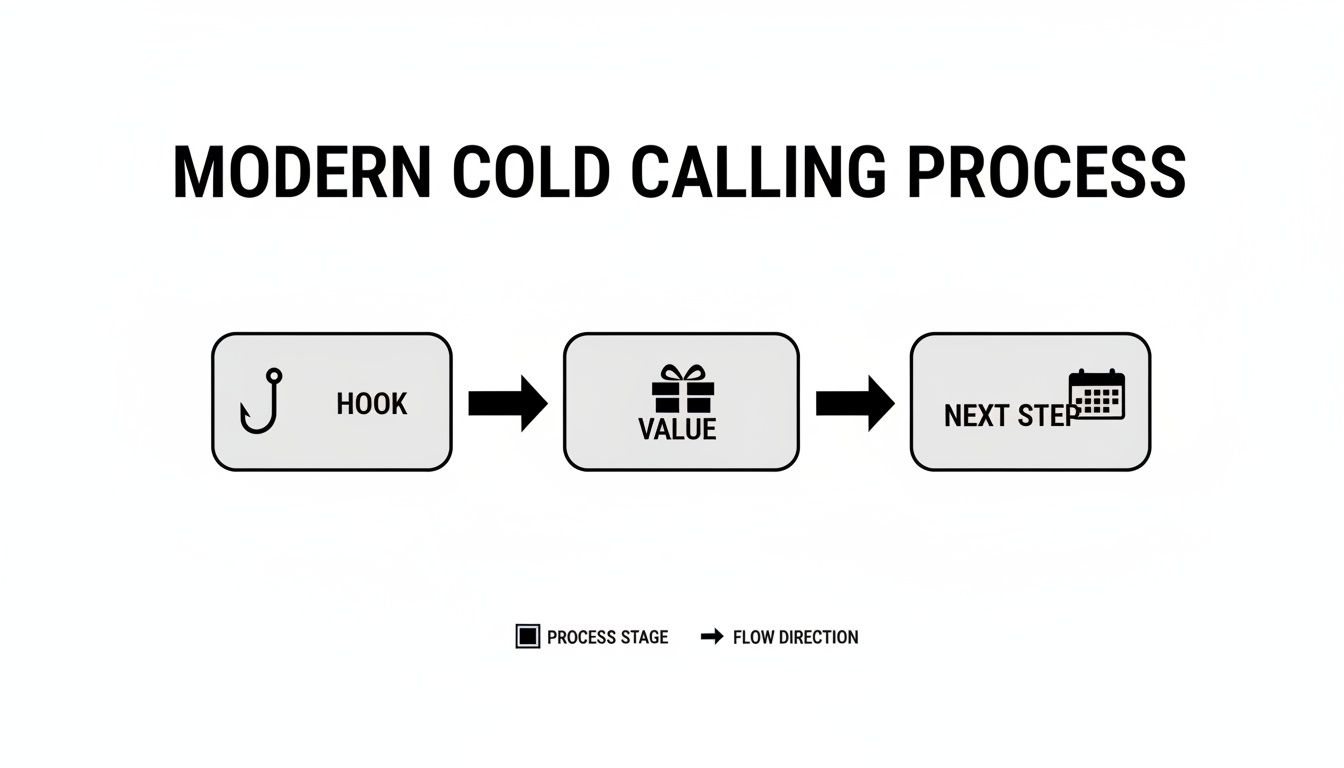
As you can see, a successful call isn't about a long, drawn-out pitch. It’s about hooking their interest, offering something of real value, and then clearly defining what happens next.
The Value Prop: Give Them Something Tangible
Now you pivot from asking questions to providing immediate value. Based on what you just learned, you can offer a specific solution or piece of information that demonstrates your expertise and helps them out.
For example, if they express even a little curiosity about their home's value, you can jump in with: "Based on that recent sale and the buyer activity we're seeing, I can put together a detailed equity report for you in about 30 seconds. Would you mind if I emailed that over?"
It's a low-pressure, high-value offer that’s hard to say no to.
At its core, a modern real estate cold call is a value exchange. You’re trading your expert market knowledge for a few minutes of their time and the chance to build a real relationship.
The Close: Lock In the Next Step
This is the moment of truth. A call is only a success if it ends with a clear, agreed-upon next action. Vague promises to "stay in touch" won't cut it. And remember, the goal isn't always to book a listing appointment on the very first call.
A small commitment is a massive win. Focus on getting a firm "yes" to one of these:
- Scheduling a specific time for a follow-up call.
- Getting their permission to send a detailed CMA from a tool like Saleswise.
- Adding them to your monthly newsletter with local market updates.
Securing that next step is what officially turns a cold contact into a warm lead in your pipeline. You've successfully started the conversation, and now you have a reason to continue it.
Field-Tested Scripts for Different Seller Types
Theory is one thing, but having a powerful cold calling script real estate agents can actually use in the trenches is what makes the difference. Let's be honest, your approach has to be nimble. You can't talk to a frustrated homeowner with an expired listing the same way you’d talk to a confident For Sale By Owner (FSBO).
Here are three solid frameworks I've seen work time and again for the most common leads you'll dial. Don't think of these as rigid scripts to be read word-for-word. They're conversational roadmaps, designed to open doors and start building a real connection.
The For Sale By Owner (FSBO) Script
FSBOs have their guard up. They're often trying to save on commission, so a direct pitch for the listing is a guaranteed dead end. The goal here isn't to sell them on your services—it's to become a valuable resource. Lead with help, not a sales pitch.
A good starting point:
“Hi [Homeowner’s Name], my name is [Your Name] with [Your Brokerage]. I noticed your beautiful home for sale online at [Address], and I promise, I’m not calling to ask for the listing.
I’m actually calling to see if I can help you out. I work with a lot of qualified buyers looking right in your area, and I was wondering if you’re cooperating with agents who bring you a ready-to-go buyer?
Either way, I just pulled some fresh market data for your neighborhood that shows how buyer traffic is trending and what your competition looks like. It could be really helpful for your pricing strategy. Would you mind if I sent that over? No strings attached.”
This approach works because you immediately disarm them by saying you're not after the listing. By offering to bring a buyer or providing genuinely useful market data for free, you position yourself as a helpful expert. That makes them far more likely to trust you and keep the conversation going.
The Expired Listing Script
When you call an expired listing, you're talking to someone who is probably frustrated and definitely skeptical of real estate agents. They've just had a bad experience. Your script has to lead with empathy, acknowledge their struggle, and offer a clear, data-backed alternative.
Try this framework:
“Hi [Homeowner’s Name], this is [Your Name] with [Your Brokerage]. I’m calling about your property at [Address]. I noticed it was recently taken off the market and wanted to reach out.
I know this whole process can be incredibly frustrating, and I’m sure you’re getting a ton of calls today. My specialty is actually marketing properties that didn't sell the first time around.
Sometimes all it takes is a fresh perspective. I've already done a bit of research, and I have a few specific ideas on why it may not have sold and what a new strategy could look like. Would you be open to a quick 15-minute chat to go over a different approach?”
If expireds are a big part of your lead generation, it pays to really master this conversation. For a deeper dive, you can learn more about how to refine your expired listings script and turn their frustration into a new opportunity.
The Circle Prospecting Script
Nothing beats a recent success story. When you've just sold a home, calling the neighbors—also known as circle prospecting—is one of the most effective calls you can make. The goal is simple: share the good news and gently probe to see if they have any real estate plans on the horizon.
Here's how to frame it:
“Hi [Neighbor's Name], this is [Your Name] from [Your Brokerage]. I’m calling with some fantastic news for the neighborhood!
We just sold your neighbor’s home at [Address of Sold Home] for [Sale Price/Percentage Over Asking]. The demand was absolutely incredible—we had [Number] offers in just a few days.
A sale like this has definitely impacted local property values, and since you’re right there, I wanted to give you a quick update on your home’s new estimated value. Have you had any thoughts of moving in the next year or so?”
This isn't really a "cold" call; it's a neighborhood news flash. You're delivering hyper-local information that directly benefits them. This instantly positions you as the area's go-to expert and creates a natural, easy opening to discuss their own plans.
Core Script Components By Lead Type
While the words you use will change, the underlying strategy for each lead type has a distinct focus. Understanding this core structure helps you stay on track and guide the conversation toward the outcome you want.
| Lead Type | Main Objective | Key Value Offer (Example) | Ideal Next Step |
|---|---|---|---|
| FSBO | Build trust and become a resource. | "I can bring a qualified buyer or provide free market data." | Send the report; follow up. |
| Expired | Show empathy and present a new solution. | "I have a specific marketing plan for homes that didn't sell." | Book a 15-minute strategy call. |
| Circle Prospecting | Demonstrate market leadership and create opportunity. | "I just sold a home nearby and can update you on your home's value." | Schedule a home valuation. |
Think of this table as your cheat sheet. Before you dial, quickly remind yourself of your main objective and what your next step should be. This small bit of prep can make a huge difference in your confidence and your conversion rates.
Turning Objections into Opportunities
Let's be real: no matter how perfect your script is, you're going to get pushback. Objections are just part of the game. But this is the exact moment where the pros pull away from the pack. They don't hear an objection as a "no." They hear it as the real start of the conversation—a chance to finally understand what the homeowner is actually thinking.
The secret isn't memorizing a hundred different comebacks. It's about having a simple, go-to framework that you can apply to almost any objection you face. It keeps things from getting awkward and puts you right back in the driver's seat.
The Acknowledge, Pivot, and Question Framework
When someone hits you with an objection, every instinct tells you to defend your position. Resist that urge. It’s a dead end. Instead, try this three-step approach to take the tension out of the air and steer the conversation back to how you can help.
- Acknowledge: First things first, validate their concern. Simple phrases like, "I completely understand," or "That makes perfect sense," immediately show you're on their side. You're listening. This instantly lowers their defenses.
- Pivot: Now, smoothly transition away from their objection and back toward the value you bring. You're not ignoring what they said; you're just gently changing the subject to something that benefits them.
- Question: Finish by asking an open-ended question that gets them talking about this new topic. This puts the ball back in their court, but now you've set the terms of the conversation.
This simple flow turns what could be a confrontation into a helpful, collaborative chat.
Handling "I Already Have an Agent"
This is probably the most common objection you'll ever hear. The rookie mistake is to immediately start listing why you're better, but that just sounds desperate. Here’s how you handle it with the framework.
Scenario:
- Homeowner: "Thanks, but I already have an agent I'd work with."
- You (Acknowledge): "That's fantastic. It’s so important to have someone you trust."
- You (Pivot): "You know, even the best agents appreciate a second opinion to make sure their pricing is spot-on. I've actually just prepared a hyper-local market report based on your neighbor's recent sale..."
- You (Question): "...would you be open to me sending it over? It could be a valuable tool for your conversations with them."
See what happened? You respected their choice, sidestepped a pointless argument, and offered them something genuinely useful. A dead end just became a new opportunity to show off your expertise.
Responding to "I'm Not Interested"
This one is usually just a reflex. It’s a gut reaction, not a final decision. Your job is to gently get them to think past that initial impulse without being aggressive.
Your goal in objection handling is not to win an argument; it's to earn the right to continue the conversation.
Scenario:
- Homeowner: "Sorry, I'm just not interested in selling right now."
- You (Acknowledge): "I understand completely, and I'm not calling to push you into anything."
- You (Pivot): "My goal is just to be a resource for homeowners in the area. Since property values have shifted so much lately, I've been providing neighborhood equity updates."
- You (Question): "If I could send you a one-page summary showing your home's new value, would that be helpful for your future planning?"
By immediately agreeing with them and pivoting to a no-strings-attached offer, you make it easy for them to say "yes." This one little technique keeps the door cracked open for another conversation down the road. Remember, building a solid follow-up strategy is key; as our guide on how to follow up with leads explains, it’s that combination of persistence and value that ultimately wins clients.
Turning Cold Calls into Warm Conversations with Data
Let's be honest, the biggest hurdle in cold calling is the "cold" part. But what if you could warm up every single call before you even dial? The secret is data. Good, solid, local data transforms you from a random agent into a neighborhood expert who has something valuable to share.
This isn't about some complicated tech wizardry. It’s about spending 30 seconds to pull up a few key facts that make your opening line impossible to ignore. Instead of a generic "Are you thinking of selling?" you can lead with something that grabs their attention immediately.

Pre-Call Intel: Your 30-Second Advantage
Top-producing agents never go into a call blind. They take a moment to gather a few pieces of intel that give them a massive edge.
Here’s what you should look for:
- Instant CMAs: Nothing hooks a homeowner like knowing what the house down the street just sold for. Before you call, pull a quick Comparative Market Analysis. This isn't a 30-page report; it’s a quick snapshot of market activity. If you're not sure where to start, you can learn more about building a quick and effective report with the right real estate CMA software.
- Neighborhood Trends: Is inventory razor-thin in their area? Are homes selling in a week? Mentioning that the average days on market is just 7 days creates a natural sense of urgency and shows you understand their specific hyper-local market.
- Property History: A quick check can tell you if the home was listed a year ago and didn't sell. Acknowledging this—"I saw you had your home on the market last spring..."—proves you've done your homework and aren't just dialing down a list.
Get Your Timing and Follow-Up Right
Data isn't just about what you say; it's also about when you say it. Timing can make or break your outreach. Studies have shown that calls made between 4-5 PM can be 71% more effective than those made late in the morning. And for some reason, Wednesday often shows a 50% higher success rate than a Monday. Test your own call times and see what works for your market.
Data takes your script from a one-size-fits-all document to a smart, flexible conversation starter. It’s what allows you to say the right thing, to the right person, at exactly the right time.
As you get better at this, you'll find your call volume needs to increase. For agents looking to scale, learning how to hire a virtual assistant for telemarketing can be a game-changer, freeing you up to focus on appointments and closing deals. Remember, the call is just the beginning. Using data to send a relevant follow-up—like a quick CMA or a virtually staged photo of their living room—keeps the conversation alive long after you hang up.
Your Top Real Estate Cold Calling Questions, Answered
If you're diving into cold calling, you've probably got questions. Every agent does. Let's cut through the noise and get straight to the practical answers for the most common hurdles you'll face.
Think of this as a quick chat with a seasoned pro, designed to clear up those nagging doubts so you can pick up the phone with confidence.
What’s the Best Time of Day to Cold Call?
This is the million-dollar question, isn't it? While every market has its own rhythm, some general patterns hold true. The sweet spot is often between 4 PM and 5 PM on weekdays. People are wrapping up their work, their guard is a little lower, and they're more likely to pick up.
Another solid window is mid-morning, usually from 10 AM to 11 AM. Just be sure to avoid the dead zones: lunchtime (12 PM to 2 PM) is a wash, and Monday mornings are notoriously tough. The best advice? Test these times, track your own results, and find out what works for your audience.
How Do I Handle the Do Not Call List?
Simple: you don’t just handle it, you respect it religiously. The National Do Not Call (DNC) Registry is a hard-and-fast rule, and ignoring it puts your license and reputation on the line. Before you dial a single number, you must scrub your list.
Here’s the breakdown:
- Scrub Your Lists: Before any campaign, run your numbers against the federal DNC database. No exceptions.
- Existing Relationships: You can call someone on the DNC list if you have an established business relationship with them (like a past client) or if they've given you clear written permission.
- "Stop Calling Me": If someone asks you to stop, you stop. Immediately. Add them to your own internal do-not-call list, even if they aren't on the national registry.
Staying compliant with DNC rules isn't just about avoiding hefty fines. It's about being a professional. One bad slip-up can do irreparable damage to your reputation.
How Many Calls Should I Make a Day?
It's tempting to think more is always better, but that’s a recipe for burnout. Consistency beats intensity every single time.
Instead of trying to cram in a hundred calls one day and then skipping the next two, aim for a sustainable number. Many top agents built their entire business on making just 20 to 50 focused, high-quality calls a day.
That steady, daily effort is what builds real momentum and keeps your pipeline from running dry. The goal isn't just to dial; it's to connect.
Ready to make every cold call feel like a warm conversation? With Saleswise, you can generate a hyper-local CMA in 30 seconds, create compelling scripts, and even visualize a property with AI staging—all before you dial.
Arm yourself with the data you need to build instant credibility. Start your $1 trial of Saleswise today.