Master Your Home Value with a comparative market analysis free

Yes, you absolutely can get a comparative market analysis free of charge. Many real estate agents offer them, and you can also build one yourself using online tools and public data. Think of it as an essential report that gives you a solid estimate of your home's value by looking at what similar, nearby homes have recently sold for.
Why a Free CMA Is Your Secret Weapon

In today's market, clients want answers backed by data, and they want them now. Mastering the art of the free Comparative Market Analysis (CMA) is what will set you apart from the competition. This isn't just about saving a few bucks on software; it’s about strategically using free resources to win more listings and build rock-solid trust with your clients.
What used to be a tedious, time-consuming task can now be a quick, powerful part of your strategy, all thanks to the digital tools at our fingertips.
The Modern Agent's Advantage
The demand for instant, data-driven insights has never been higher. Just look at the numbers: the global real estate software market was valued at USD 10.3 billion in 2023 and is expected to more than double by 2030. This explosion shows just how central technology has become in our industry, especially tools that deliver precise valuations quickly.
When you learn how to create a high-quality free CMA, you unlock a few significant advantages:
- Build Authority: Handing a client a detailed, accurate report screams expertise. It instantly positions you as a knowledgeable advisor, not just another agent trying to make a sale.
- Generate Leads: Offering a "free home valuation" is a classic for a reason—it works. It's a proven way to attract potential sellers and open the door to meaningful conversations. A free CMA is a fantastic tool when trying to get free real estate leads.
- Win Listings: A well-researched CMA is the backbone of any persuasive listing presentation. It gives sellers the data-backed confidence they need to trust your pricing strategy and sign with you.
A great CMA does more than just suggest a price—it tells the story of the current market and shows clients you understand exactly where their property fits in.
From Manual Labor to Smart Strategy
Forget the old days of spending hours digging through dusty public records. While a free CMA still requires some hands-on work, modern strategies and free digital resources have made the process more efficient than ever.
This guide will walk you through exactly how to produce professional-grade insights that can easily compete with expensive paid services. We'll show you how to work smarter, not harder, to impress clients and grow your business. We’ll also touch on when to stick with the free methods versus when investing in a high-powered platform might give you that critical edge.
Building Your Data Toolkit for a Strong CMA
Every solid CMA is built on a foundation of solid data. While your MLS is always going to be your primary tool and the undisputed gold standard, it shouldn't be your only tool. To paint a complete picture of a property's value, you need to pull from a variety of sources, and thankfully, many of them are completely free.
The trick is to learn how to layer information from different places. By cross-referencing details from public records, real estate portals, and your own observations, you create a much more nuanced and defensible property profile. This multi-source approach is what separates a quick-and-dirty estimate from a professional valuation.
Tapping into Public Records
Before you even think about comps, your first stop should be the local county assessor or property appraiser’s website. These public databases are the official record-keepers, giving you the ground truth on a property without any of the marketing fluff.
Here’s what you’re looking for:
- Tax History: You can track the property's assessed value over time and see the annual tax liability. A big spike in assessed value a few years back? That’s a huge clue that a major renovation or addition might have happened.
- Property Characteristics: This is where you verify the official specs—square footage, lot size, bedroom/bathroom count, and the year it was built. If a listing claims 2,200 sq. ft. but the county has it at 1,950 sq. ft., that's a red flag you need to investigate.
- Ownership and Sales History: Confirm the most recent sale date and price. This gives you a hard anchor point for calculating appreciation.
This data is your bedrock. It's objective, verifiable, and the ultimate tie-breaker when other sources disagree.
Think of public records as the property's official biography. While real estate portals tell you the story someone wants you to hear, assessor sites provide the verified facts you need to start your analysis.
The Role of Real Estate Portals
Okay, let's talk about the big consumer portals like Zillow, Redfin, and Realtor.com. You have to approach them with a healthy dose of professional skepticism. Their automated valuation models (AVMs), like the Zestimate, are conversation starters, not conclusions.
Their real value for a pro is in the qualitative details. Old listing photos can be a goldmine, showing you what the kitchen looked like before the last sale or whether the landscaping has been improved. Listing descriptions from years past can mention a new roof or HVAC system. This is the context that raw numbers can't provide, but remember to take it with a grain of salt until you can verify it. Sorting through this manually is a grind, which is why the right real estate market analysis software can be a massive time-saver.
Comparing Free vs Paid Data Sources for Your CMA
When building your CMA, you'll constantly weigh the benefits of free resources against the comprehensive nature of paid tools. Here’s a practical look at the most common data sources to help you decide where to focus your efforts.
| Data Source Type | Examples | Pros | Cons |
|---|---|---|---|
| Public Records | County Assessor, Tax Records | Highly accurate for core facts (sq. ft., lot size); Official sale history; Completely free. | Data can be dated; No photos or condition details; Can be clunky to navigate. |
| MLS | Your Local MLS | Most accurate and timely listing data; Detailed property features; The industry standard. | Requires a real estate license and associated fees; Data is proprietary. |
| Real Estate Portals | Zillow, Redfin, Realtor.com | Great for historical photos and listing descriptions; Good for a quick market overview; Free to access. | AVMs are often inaccurate; User-submitted data can be unreliable; Filled with ads. |
| Paid Data Services | CoreLogic, Black Knight, ATTOM | Access to nationwide data; Advanced analytics and trend reporting; In-depth foreclosure & pre-foreclosure data. | Can be expensive; May provide more data than you need for a standard CMA. |
Ultimately, a blend is best. Use the free public records to verify the facts, the portals for context and photos, and your MLS as the primary source for the most accurate and up-to-date comparable sales data.
Creating Your Property Data Checklist
To make sure nothing falls through the cracks, especially when you're busy, use a standardized checklist for every comparative market analysis free of charge that you create. It’s a simple habit that enforces consistency and thoroughness.
Your checklist should be a quick-scan guide covering:
- Core Facts: Address, legal description, square footage, lot size, bed/bath count, year built.
- Property History: Last sale date, last sale price, tax assessment history.
- Key Features: Garage (1-car, 2-car?), pool, basement (finished/unfinished), unique architectural details.
- Recent Updates: Any known big-ticket items like a new roof (2022), updated kitchen (2020), or new windows.
- Condition: Notes on curb appeal, interior condition (based on photos), and any obvious deferred maintenance.
With this organized approach, you’ll have a complete, well-documented file for every property. This not only makes your immediate analysis easier but also creates a powerful foundation for a confident and defensible valuation.
How to Select and Analyze Comps Like an Expert
Once you have your data, the real work begins. Finding the right comparables is the heart of any accurate comparative market analysis, and it's about more than just grabbing three houses on the same street. A truly great CMA tells a convincing story about the market by using a smart mix of different listing types.
The best analyses weigh the importance of sold, pending, active, and even expired listings. Each category offers a unique clue about market demand, what buyers are doing right now, and where the pricing ceiling might be. Sold comps are your foundation, for sure, but the others add critical context that can make or break your pricing strategy.
Understanding the Hierarchy of Comps
Not all comps are created equal. To build an analysis that holds up under scrutiny, you need to prioritize your evidence correctly. Think of it as a pyramid, with the most reliable data sitting at the top.
Sold Listings (The Gold Standard): These are your most powerful pieces of evidence. Why? Because they represent a closed deal at a price a real buyer actually paid. You'll want to focus on sales from the last 3-6 months within a very tight radius of your subject property.
Pending Listings (The Near Future): These properties are under contract but haven't closed yet. While you don't know the final sale price, you do know the list price was compelling enough to get an offer. This gives you a real-time pulse on what today's buyers are willing to move on.
Active Listings (Your Current Competition): This is your direct competition, plain and simple. Analyzing active listings helps you position your property to stand out. It tells you if you should price just below a key competitor or highlight a feature their property is missing.
Expired/Withdrawn Listings (The Cautionary Tales): These are the homes that didn't sell, and they're incredibly valuable. They help you identify the pricing ceiling in a neighborhood. If three similar homes couldn't sell at $500,000, pricing yours at $510,000 is a gamble you'd better be able to justify.
This layered approach turns your analysis from a simple estimate into a strategic pricing tool. To really dial this in, using a dedicated Real Estate Comparables Calculator can make the whole process much smoother.
Navigating Challenging Scenarios
Let's be honest: perfect, one-to-one comps are rare. The real skill of an expert comes in making sound judgment calls when you're dealing with unique properties where a direct comparison just isn't possible.
Imagine you're trying to price a charming but quirky 1920s historic home in a neighborhood full of 1980s split-levels. You're not going to find a perfect match. In a case like this, you have to widen your search criteria—maybe you look for other historic homes in a similar, neighboring community. From there, you'll need to make larger, well-documented adjustments for the location difference, a process at the core of the sales comparison approach.
Or what about a property with a truly unusual layout, like a one-bedroom home with a massive, professional-grade workshop attached? You might compare it to two-bedroom homes with similar square footage, but you’d make a significant negative adjustment for the missing bedroom while adding value for that one-of-a-kind workshop.
The key is transparency. When perfect comps don't exist, your ability to explain why you chose the ones you did and the logic behind your adjustments is what builds client trust and demonstrates true market expertise.
The rise of modern real estate software has been a game-changer for agents tackling these complexities. Research from Technavio shows that U.S. brokerages using geospatial CMA data linked to behavior-driven CRMs are seeing 20% more qualified leads and cutting administrative time by over 25%. These platforms allow agents to scale from a basic free CMA to a full suite of tools, making complex analyses much faster.
By mastering the art of comp selection, you move beyond just plugging numbers into a formula. You become a market interpreter, capable of providing a realistic and defensible valuation for any property, no matter how unique it is.
Making Adjustments to Pinpoint the Right Price
Alright, you’ve pulled your comps. That’s the easy part. Now comes the real work—the art and science of adjustments. This is where a great agent truly earns their stripes, transforming a list of nearby sales into a sharp, defensible price for your client's home.
Think of it this way: selecting comps gets you in the right neighborhood, but making smart adjustments gets you to the exact address. It’s all about assigning a credible dollar value to the differences between your subject property and the ones that have already sold.
The Logic Behind Value Adjustments
The core principle is beautifully simple. If a comparable property is better than your client’s house in some way (like a brand-new kitchen), you subtract value from its sale price. If it’s not as good (maybe it has one less bathroom), you add value. The whole point is to level the playing field and make each comparison as "apples-to-apples" as possible.
This isn’t about pulling numbers out of thin air. Every feature has a market value, and your job is to figure out what it is in your specific area. A half-bath might be worth $3,000 - $5,000 in one suburb but more in a dense urban market. A finished basement might add 50-70% of the per-square-foot value of the main living space.
These figures are hyper-local. Your deep knowledge of the market is what makes your CMA valuable. Did that house on Elm Street with the renovated master bath sell for a $20,000 premium? That’s a real-world data point you can actually use.
Before you even start tweaking numbers, you need to know which properties carry the most weight. Sold properties are your foundation, but pending and active listings give you a snapshot of where the market is right now.
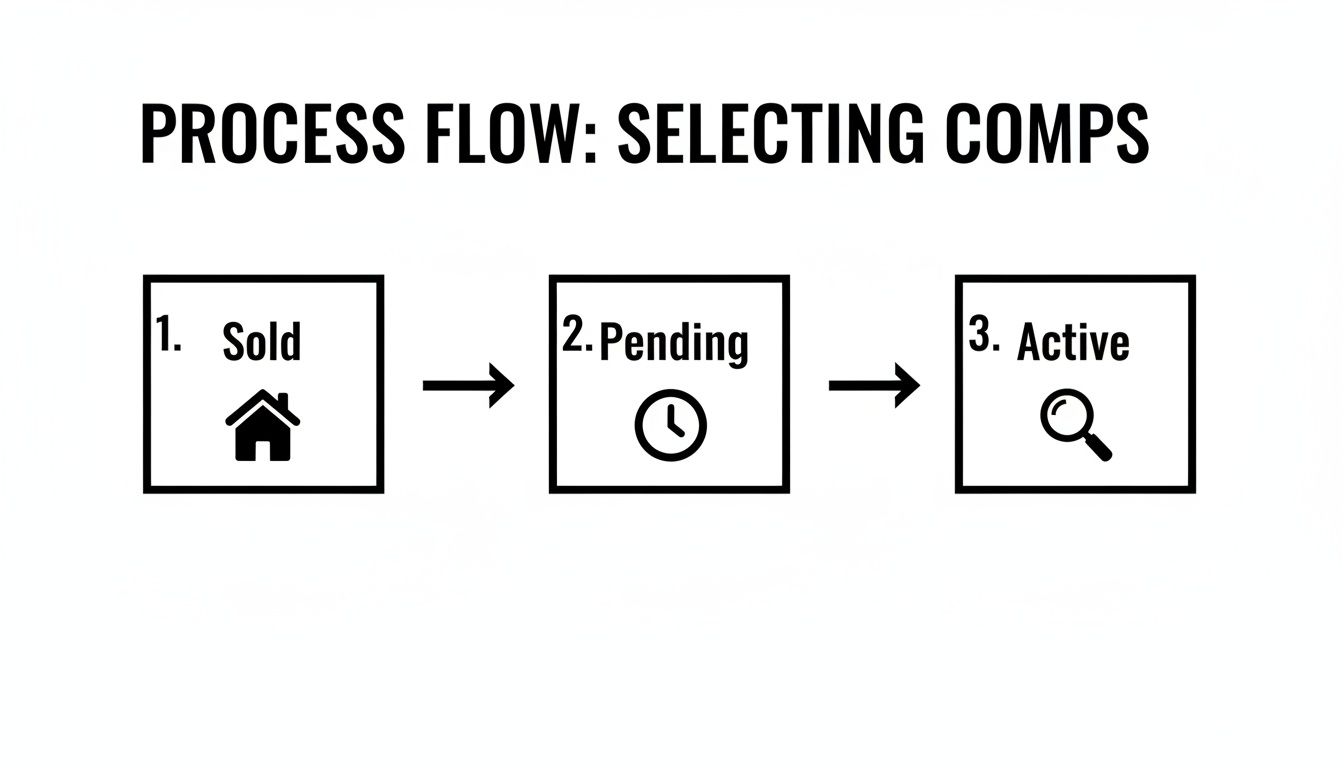
This hierarchy shows why we start with what’s already closed. That’s hard evidence. But what’s pending tells you what buyers are willing to pay today, and active listings show you the competition.
A Practical Adjustment Walkthrough
Let's walk through a real-world scenario. Imagine your subject property is a 3-bed, 2-bath, 1,800 sq. ft. home with a 2-car garage. You've picked three solid comps.
Comp 1: This one sold for $425,000. It’s almost a perfect match, but it has a stunning new kitchen, while your client's is dated. Based on recent remodels, you know that kitchen added about $15,000 in value.
- Adjustment: -$15,000 (because the comp is superior).
- Adjusted Price: $410,000.
Comp 2: This one went for $400,000. It has the same bed/bath count and square footage, but it only has a 1-car garage. In your market, that second garage stall is a big deal—worth at least $10,000.
- Adjustment: +$10,000 (because the comp is inferior).
- Adjusted Price: $410,000.
Comp 3: Sold for $418,000. It’s listed as a 3-bed, 2.5-bath. That extra half-bath realistically adds about $5,000. The home is also in slightly better overall condition, which you estimate gives it a $3,000 edge.
- Adjustments: -$5,000 (for the bath) and -$3,000 (for condition).
- Adjusted Price: $410,000.
See what happened? Three properties with different sale prices all started pointing to the same number once we accounted for their differences. That’s when you know you’re on the right track.
The goal of adjustments is to make the price gap between your comps smaller. When the adjusted values start clustering together in a tight range, it’s a huge confidence booster. It means your analysis is solid.
Reconciling Values for a Final Price Range
After adjusting each comp, you'll have a list of adjusted prices. In our example, they all landed exactly on $410,000, which is rare in the real world. You’ll more likely end up with a tight range, something like $405,000 to $415,000.
This becomes your final, reconciled value range. It's not a single magic number; it's a professional opinion of the most probable selling price. From here, you can sit down with your client and confidently recommend a pricing strategy—maybe listing at $415,000 to build in some negotiation room, knowing you're backed by solid data.
Presenting Your CMA to Win the Listing

You've done the hard work. You’ve crunched the numbers, selected the perfect comps, and landed on a price you can stand behind. But a technically accurate comparative market analysis free of any errors won’t get you very far if you can't present it in a way that convinces the client.
This is where the real work begins. Your final step is to translate all that data into a compelling story that builds trust and showcases your expertise. This isn't just about showing homeowners a spreadsheet; it's about guiding them through your logic so they arrive at the final price with you.
Think of the presentation as your moment to shine. A jumble of raw data and MLS printouts will only confuse and overwhelm them. Your goal is to deliver a professional, visually engaging report that tells a clear narrative about their home's value in the current market.
Crafting a Winning Report with Free Tools
You don't need a graphic designer or expensive software to look polished. Honestly, free tools like Canva and Google Slides are more than enough to create a beautiful, client-ready CMA report that looks like it came from a major brokerage.
The key is to create a simple, branded template you can use for every listing appointment. This small bit of upfront work creates consistency and instantly elevates your professionalism. From there, it's all about structuring the presentation to walk clients from the 30,000-foot view down to the final number.
A winning CMA presentation should always include these key elements:
- A Clear Property Overview: Start with a clean title page. Use a high-quality photo of their home and list its key details (beds, baths, square footage).
- A Visual Map of Comps: Nothing establishes relevance faster than a map showing their home in relation to the comparables. It immediately proves you’ve focused on their hyper-local market.
- Detailed Comp Breakdowns: Dedicate one slide to each comparable property. Include a photo, key stats, its sale price, and a quick summary of the adjustments you made and why.
- The Final Pricing Summary: End with a simple, clear slide that shows the adjusted values of all your comps and presents your suggested price range.
Your presentation should be a visual journey. By guiding your client step-by-step through the data, you demystify the process and build the confidence they need to trust your recommended price.
Telling the Story Behind the Numbers
As you walk them through the report, focus on explaining the "why" behind every number. Don't just say you subtracted $10,000 for a dated kitchen. Instead, explain how recently sold homes in their neighborhood with modern kitchens are fetching a significant premium from today's buyers.
Frame your adjustments not as criticisms, but as strategic insights into buyer behavior and market demand. You can find more practical tips for shaping your narrative in our guide to building the perfect listing presentation template.
Of course, the industry is shifting. More and more agents are turning to cloud-based platforms that can automate this entire process. It’s no surprise that cloud deployments captured over 71% of the real estate investment software market in 2024. That market is projected to grow at a blistering 13.51% CAGR through 2030, showing just how powerful these tools have become. This trend underscores the value of platforms that can deliver accurate, data-driven pricing in seconds.
Whether you build it by hand or lean on a smart tool, a well-presented CMA is what transforms you from just another agent into a trusted advisor—and that’s how you win the listing, every single time.
Answering Your Top Questions About Free CMAs
Even when you've got the process down, creating a free CMA can still throw you a few curveballs. I get asked about this all the time. Let's clear up some of the most common questions and sticking points so you can build every report with confidence.
How Accurate Is a Free CMA, Really?
Honestly, the accuracy of a free CMA comes down to you. It's all about two things: the quality of the data you pull and how sharp your adjustments are. If you're meticulous, using solid MLS data and public records, and you make logical, evidence-backed adjustments, your report can be spot-on.
The catch with free sources, though, is that the data can sometimes be stale or missing key details. That's the real trade-off—you save money, but you spend time double-checking every last fact. This is where paid platforms have a clear advantage; they tap into live, verified data, which almost always means better accuracy right out of the gate.
A free CMA is a fantastic tool, but remember: its accuracy directly reflects the time you invest in validating the data and justifying your adjustments.
What are the Biggest Mistakes Agents Make?
By far, the most common mistake I see is agents grabbing an AVM (automated valuation model) from a big public website and treating it as gospel. Those Zestimates? They're a starting point, a conversation starter, but they are not your final answer. You have to dig in and make your own adjustments.
Another classic error is picking the wrong comps. You can't just pull any three homes that sold recently. A great CMA relies on critical thinking. You need to find the best comparables and then carefully adjust for the differences.
Always zero in on properties that are:
- Recent: Sold within the last 3-6 months is the gold standard.
- Nearby: The closer to your subject property, the better. Think same neighborhood, same school zone if possible.
- Similar: You're looking for a close match in style, size, age, and condition. An updated colonial isn't a great comp for a fixer-upper ranch, even if they're next door to each other.
When Should I Upgrade to a Paid Tool?
It's time to seriously think about a paid tool when you realize your time is more valuable than the cost of the subscription. If you're cranking out several CMAs every week, the hours you'll save with an automated platform are a no-brainer. What takes you an hour or more can be done in minutes.
Paid tools aren't just about speed, either. They give you professionally designed, branded reports, deeper data analytics, and often integrate right into your other marketing efforts. When you're ready to consistently deliver impressive, data-rich presentations that help you lock down more listings in a crowded market, that's when a paid tool stops being a luxury and becomes a necessity.
Ready to create stunning, accurate CMAs in seconds? Saleswise uses AI to research comps, make adjustments, and generate client-ready reports instantly. Stop spending hours on manual analysis and start winning more listings. Try Saleswise today and see the difference.