Email Marketing Realtors: A Pro Guide to Real Estate Lead Growth
In a world of noisy social media feeds and ads that vanish in an instant, email marketing for realtors remains your most profitable and powerful tool for building real client relationships and, ultimately, closing more deals. It’s your own private channel, a direct line to nurture a lead from a casual open house visitor all the way to a signed client, without having to fight for their attention.
Why Email Is a Realtor’s Most Powerful Tool

Social media is fantastic for getting your name out there, but email is where the real work gets done. Think of it like this: your Instagram profile is a billboard on a busy highway. Lots of people see it, but few engage deeply. Your email inbox, on the other hand, is a personal, one-on-one conversation.
This direct access lets you move past generic "just listed" blasts and start delivering real value. You become the go-to local expert, the agent who sends helpful advice at just the right moment, and the first person a homeowner calls when they're even thinking about selling. The goal isn't to just send a newsletter; it's to build a reliable, automated system that works for you 24/7.
The Unmatched ROI of Real Estate Email Marketing
The numbers don't lie. Email marketing consistently crushes almost every other channel when it comes to return on investment for real estate agents. While you have to keep feeding the beast with paid ads to stay visible, your email list is a business asset you own outright. You can talk to them anytime you want, for free.
Why? Because you're connecting with people who have already raised their hands and shown interest. They are, by definition, warm leads.
The real power of email is its ability to convert digital interest into real-world business. It’s the bridge between a website click and a scheduled appointment, making it an indispensable tool for lead nurturing and deal conversion.
Turning Contacts into Contracts
Great email marketing for realtors is all about delivering the right message to the right person at exactly the right time. This guide will show you how to do just that. We’re going to get beyond the basics and dive into real, actionable strategies that can turn your contact list into a predictable stream of income.
Here's why it works so well:
- You Own It: Your email list is yours. Period. Unlike social media, where a sudden algorithm change can completely tank your reach overnight, you are in full control.
- Laser-Focused Targeting: Through segmentation, you can send incredibly relevant content. Think a market update just for homeowners in a specific zip code or a first-time buyer's guide exclusively to your newer leads.
- You Can Measure Everything: Every email campaign gives you clear, hard data. You can see who opened it, who clicked, and which topics get the most engagement, letting you constantly improve your strategy.
Industry data confirms just how critical this channel is. Studies show that email marketing converts roughly 40% better than social media for real estate professionals. Better yet, experts often cite an average ROI of around $40 in revenue for every $1 spent—a number that speaks for itself. You can find more realtor marketing statistics from sources like AMRA & ELMA. This isn't just about keeping in touch; it's about systematically growing your business.
Building Your High-Quality Email List
Let's get one thing straight: when it comes to your email list, quality beats quantity every single time. A massive list of people who never open your emails is just dead weight. What you really want is a curated group of people who are genuinely interested in what you have to say about the local market.
Think about it—every single interaction you have is a chance to grow that list. Open houses, website visits, even a casual conversation at the coffee shop. The secret is to always give them a good reason to hand over their email address.
Turning Every Interaction into an Opportunity
That old-school clipboard at your open house? It's time for an upgrade. Switch to a tablet with a simple digital form. Instead of just asking for a name and email, frame it as an offer: "Would you like me to email you the full property details and a quick market snapshot of this neighborhood?"
This simple change does two crucial things. First, you get their explicit permission, which is huge. Second, you immediately position your emails as valuable and helpful, not just another piece of junk mail. You're not just collecting contacts; you're starting a conversation on the right foot.
Look for these high-value exchanges everywhere:
- On Your Website: Set up a simple pop-up offering a "First-Time Homebuyer's Checklist" or a "Guide to Selling in [Your City]." It’s a classic for a reason.
- Through Social Media: Run a poll on Instagram asking about the biggest challenges of selling a home. Then, point them to a link in your bio where they can get a free guide that solves those exact problems.
- At Networking Events: When you swap business cards, go a step further. Offer to send over a recent article you wrote about local market trends. It’s a perfect, low-pressure follow-up.
The golden rule of list building is simple: give something valuable to get something valuable. An email address is a form of currency, and people will only spend it if they believe the return is worthwhile.
Creating Lead Magnets People Actually Want
A lead magnet is just a fancy term for a free resource you give away in exchange for an email. For email marketing realtors, the best ones are always hyper-local. Nobody cares about national housing trends; they care about what’s happening on their street.
Your job is to create something so useful that potential clients feel like they're getting an amazing deal. This is where you can really show off your local expertise.
Here are a few lead magnet ideas I’ve seen work wonders:
- Hyper-Local Neighborhood Guides: Create a sharp-looking PDF that details the best parks, schools, restaurants, and hidden gems in a specific neighborhood. This screams, "I am the local expert."
- Seller's Staging Checklist: A practical, room-by-room checklist is incredibly helpful for homeowners getting ready to sell. It's an easy win that provides immediate value.
- CMA Offer: The classic "Free Home Value Report" is still a powerhouse. It directly targets homeowners who are already thinking about selling.
- "Mistakes to Avoid" Checklists: Think titles like, "The 5 Biggest Mistakes First-Time Buyers Make in [Your County]." This kind of content attracts people who need your guidance.
Building a solid email list is the foundation of a killer marketing strategy. To really round out your approach, you can explore various techniques for real estate lead generation at https://www.saleswise.ai/blog/lead-generation-real-estate-agents to see how it all fits together.
When you focus on consistently providing value, your list will grow organically with people who actually want to hear from you. You can also get insights by checking out the Top Email List Providers for Realtors. Always remember, a small, engaged list will run circles around a huge, indifferent one.
Mastering Segmentation for Personalized Outreach
If you're sending the same generic email to everyone on your list, you're making a huge mistake. It’s a fast track to the spam folder and, frankly, it just doesn’t work anymore. The real magic in email marketing for realtors happens with segmentation—the simple act of dividing your audience into smaller, more focused groups.
This is what turns your marketing from a loud, one-sided broadcast into a series of valuable, personal conversations. Think about it: you wouldn't give a first-time homebuyer the exact same advice you'd offer an empty-nester looking to downsize. Your email strategy needs that same level of care.
Going Beyond Basic Buyer and Seller Tags
So many agents stop at just "buyer" and "seller" tags. While that's a start, it's really just scratching the surface. To build real trust and authority, you have to get much more specific and deliver content that feels hyper-relevant.
The goal is to make your subscribers feel like you're speaking directly to them—because with smart segmentation, you actually are. Start by thinking about the different stages of their journey and the unique types of clients you serve. Each one is an opportunity.
Here are a few powerful ways to slice up your list right away:
- By Lead Source: Where did you meet them? An open house visitor needs a totally different follow-up than a Zillow lead or someone who downloaded a guide from your website. Tagging them by source lets you reference that first interaction, making your outreach feel warmer and less random.
- By Location: This is a goldmine. You can create segments for specific neighborhoods, zip codes, or even school districts. This allows you to send out ultra-local market updates, new listings, and community news that a generic newsletter could never compete with.
- By Engagement Level: Not everyone on your list is a hot lead ready to transact. You should have a segment for your super-fans (the ones who open every email) and another for contacts who've gone cold. You can send your best stuff to the active group and maybe run a targeted re-engagement campaign for the ones who have tuned out.
The whole point of segmentation is relevance. When a subscriber gets an email that directly addresses their situation—whether it's a guide to downsizing or a market report for their specific zip code—they're far more likely to see you as the go-to expert.
Segmenting your list might seem like extra work upfront, but the payoff is enormous. It allows you to deliver targeted, personalized messages that resonate deeply with each recipient, turning passive subscribers into active clients. Below is a table outlining some practical ways you can start dividing your list for better results.
Effective Realtor Email List Segmentation Strategies
| Segmentation Criteria | Example Segments | Targeted Content Idea |
|---|---|---|
| Client Status | First-Time Homebuyers, Past Clients, Investors, Renters | A "First-Time Buyer's Roadmap" e-book, an annual home equity update for past clients, or a list of high-yield rental properties. |
| Geographic Location | Specific Neighborhoods (e.g., "The Heights"), Zip Codes (e.g., "90210"), School Districts | A monthly market report for "The Heights," alerts for new listings in their zip code, or a guide on local school ratings. |
| Lead Source | Open House Attendees, Website Sign-ups, Zillow/Realtor.com Leads | A "Thank you for visiting" email with similar homes for open house leads, a welcome series for website sign-ups, or a direct offer for a free home valuation for Zillow leads. |
| Property Interest | Interested in Condos, Looking for 3+ Bedrooms, Has a Pool | Targeted property alerts that match their exact criteria. For example, "New 3-Bedroom Home Just Listed in Your Area!" |
| Engagement Level | Highly Engaged, Casually Engaged, Inactive Subscribers | Send exclusive listings to your highly engaged list, a "Did you see this?" email to casuals, and a re-engagement campaign ("Are we breaking up?") to the inactive group. |
By implementing these strategies, you can transform your email list from a simple database into a powerful communication tool that nurtures relationships and drives business. The key is to start small, pick one or two segments, and build from there.
Practical Segmentation in Action
Let's walk through a real-world scenario. You just hosted a busy open house and have a list of 30 attendees. Instead of just dumping them into your general newsletter, you create a new segment called "123 Maple St Open House - April."
Now you can craft a targeted follow-up sequence that actually makes sense to them:
- Email 1 (Day 1): "Thanks for stopping by 123 Maple St!" Include a link back to the property details and ask for their feedback on the home.
- Email 2 (Day 3): "Curious about other homes in the neighborhood?" Send them a link to a curated list of similar active listings in the area.
- Email 3 (Day 7): "The [Neighborhood Name] Market is Heating Up" along with a quick snapshot of recent sales and market trends.
This approach is infinitely more powerful than a generic monthly update. You can apply the same logic to virtually any client type, creating dedicated segments for first-time homebuyers, past clients (a great source for referrals), or homeowners you gave a CMA to six months ago.
The data absolutely backs this up. Email delivers a staggering average ROI of around 3,600% globally. In real estate specifically, the numbers are just as strong, with industry benchmarks showing average open rates of 32.8% and click-to-open rates near 13%. It's one of the best-performing channels we have. If you want to dig into the numbers, you can discover more email marketing statistics on EmailToolTester.com.
When you finally master segmentation, you make sure every email you send lands with impact. You're not just sending messages; you're building the kind of relationships that lead directly to closed deals.
Crafting Emails That Actually Get Opened and Clicked
Once you’ve got your contacts sorted, the real fun begins: writing emails that people want to read. It's so easy to fall into the trap of just blasting out "Just Listed" or "Just Sold" announcements. And while those have their place, a killer email strategy is about providing consistent value, not just property alerts.
The anatomy of a great email is pretty simple. It starts with a subject line that grabs attention without feeling like spam, and the email body has to deliver on that promise. Every single email should feel personal, relevant, and genuinely helpful. That’s how you become their go-to real estate resource.
Writing Subject Lines That Demand Attention
Let's be blunt: your subject line is everything. It’s the gatekeeper standing between your message and the trash folder. The best ones are personal, specific, and spark a little curiosity or urgency.
Ditch the generic, salesy stuff like "Don't Miss This Amazing Opportunity!" Nobody clicks on that anymore. You need to sound like a human.
Here are a few styles that I’ve seen work wonders for agents:
- The Question: "Are home prices in Northwood really dropping?"
- The Hyper-Local Tip: "The best new coffee shop in 92620"
- The Direct Value Prop: "Your October home value update for Parkside"
- The Personal Touch: "Following up from the open house at 123 Maple St."
The goal is to cut through the noise in a crowded inbox. A great subject line feels less like marketing and more like a helpful heads-up from a friend in the business.
Building an Email Body That Delivers Value
Okay, they opened it. Now you have maybe three seconds to prove it was worth their time. This is where your content strategy really shines. Forget long, dense paragraphs. Think short, scannable text that gets right to the point.
The most successful agents I know build their email marketing around automated sequences, not just one-off blasts. Why? Because most leads need at least 2–3 follow-ups before they even think about responding. A steady rhythm of 2–4 emails per month is often the sweet spot—it keeps you top-of-mind without annoying people. To see exactly how to structure these, take a look at these real estate email templates for inspiration.
Here’s the golden rule I tell every agent: your emails should be 90% helpful and 10% promotional. When you consistently give away great advice—market updates, neighborhood news, homeownership tips—your audience will actually welcome the occasional listing you send.
This value-first approach is especially powerful in real estate. Industry data shows that drip campaigns focused on local market insights and practical guides (think home-selling checklists or first-time buyer roadmaps) get far more engagement than generic newsletters. You can dig into more of these real estate marketing statistics on Marketing LTB to see the proof.
Content Ideas Beyond "Just Listed" Alerts
Staring at a blank screen? I get it. But your local market is an endless source of content. Just think about the questions clients ask you every single day—those are your email topics, right there.
Here are a few content pillars you can build your entire strategy around:
Hyper-Local Market Analysis
- Monthly Market Snapshot: Break down the key stats for a specific zip code—median price, days on market, inventory. But don't just list numbers; tell them what it means for them.
- "Deal of the Week": Highlight a recently sold property that was a fantastic value and explain why. This is a great way to showcase your expertise without being pushy.
Seasonal Home Maintenance Tips
- Spring: "Your Spring Cleaning & Curb Appeal Checklist"
- Summer: "5 Ways to Lower Your AC Bill This Summer"
- Fall: "How to Winterize Your Home Before the First Frost"
- Winter: "Protecting Your Pipes During a Cold Snap"
Community Spotlights and Events
- Become the town crier. Highlight a new restaurant, a great local park, or a cool new shop. This shows you're invested in the community, not just the transactions.
- Send a monthly roundup of local happenings, like farmer's markets, school festivals, or holiday events.
When you consistently deliver this kind of useful, non-salesy content, you're not just marketing—you're building relationships. And when the time comes for them to buy or sell, you won’t be just another agent in their inbox. You’ll be the only one they think of calling.
Automating Your Follow-Up with Drip Campaigns
As an agent, you can't be everywhere at once, but your marketing sure can. This is where automation becomes your secret weapon. By setting up an "always-on" system with automated drip campaigns, you can rest easy knowing that no lead will ever fall through the cracks, no matter how slammed you get.
Think of a drip campaign as a series of emails you write in advance, which are then sent out automatically to specific people on your list over time. It’s a brilliant way to nurture relationships and provide consistent value around the clock—without you having to manually hit "send" every single time.
The process is straightforward. A new lead signs up on your website, and your system immediately starts a welcome sequence. Someone from your open house gets added to a dedicated follow-up campaign. It's like having a personal marketing assistant working tirelessly in the background. For a great breakdown of the fundamentals, this guide to automated email success is worth a read.
Blueprints for Essential Realtor Drip Campaigns
Every agent should have a handful of core automated sequences ready to launch. These campaigns are built to engage leads at different points in their journey, from their first flicker of interest to long after a sale.
Let's walk through three of the most effective drip campaigns you can build today.
1. The New Website Lead Welcome Series
This is your first impression, so make it a good one. When someone downloads a guide or signs up for your newsletter, this sequence should kick in immediately to welcome them and show your value right out of the gate.
- Email 1 (Sent Immediately): "Welcome! Here’s the [Guide Name] you requested."
- The Goal: Deliver what you promised, fast. Keep this email short and friendly, introduce yourself, and give them the download link right away.
- Email 2 (2 Days Later): "Did you know this about the [Your City] market?"
- The Goal: Show off your local expertise. Share a surprising market stat or link to a blog post you wrote about the area. Give them an "aha!" moment.
- Email 3 (4 Days Later): "How I help my clients win."
- The Goal: Build trust. This is the place for a short client success story or a powerful testimonial. Let someone else brag for you.
- Email 4 (7 Days Later): "Ready to chat? No pressure."
- The Goal: Open the door for a real conversation. Offer a free, no-strings-attached consultation or simply ask them what their biggest real estate question is.
2. The Open House Visitor Follow-Up
People who walk into an open house are motivated, active leads. This campaign keeps the momentum going and frames you as a helpful expert, not just the agent for that one house.
- Email 1 (Same Day): "Thanks for stopping by 123 Maple Street!"
- The Goal: Reconnect while the visit is still fresh in their mind. Thank them for coming, include a link to the property details, and ask what they thought.
- Email 2 (2 Days Later): "Similar homes you might love in the area."
- The Goal: Provide instant value. Send them a hand-picked list of a few other active listings in the same neighborhood that have a similar style or price.
- Email 3 (5 Days Later): "The inside scoop on the [Neighborhood Name] market."
- The Goal: Flex your market knowledge. Send a quick snapshot for that specific area—recent sales, price trends, anything that shows you know your stuff.
No matter what you're sending, every great email boils down to three key parts.
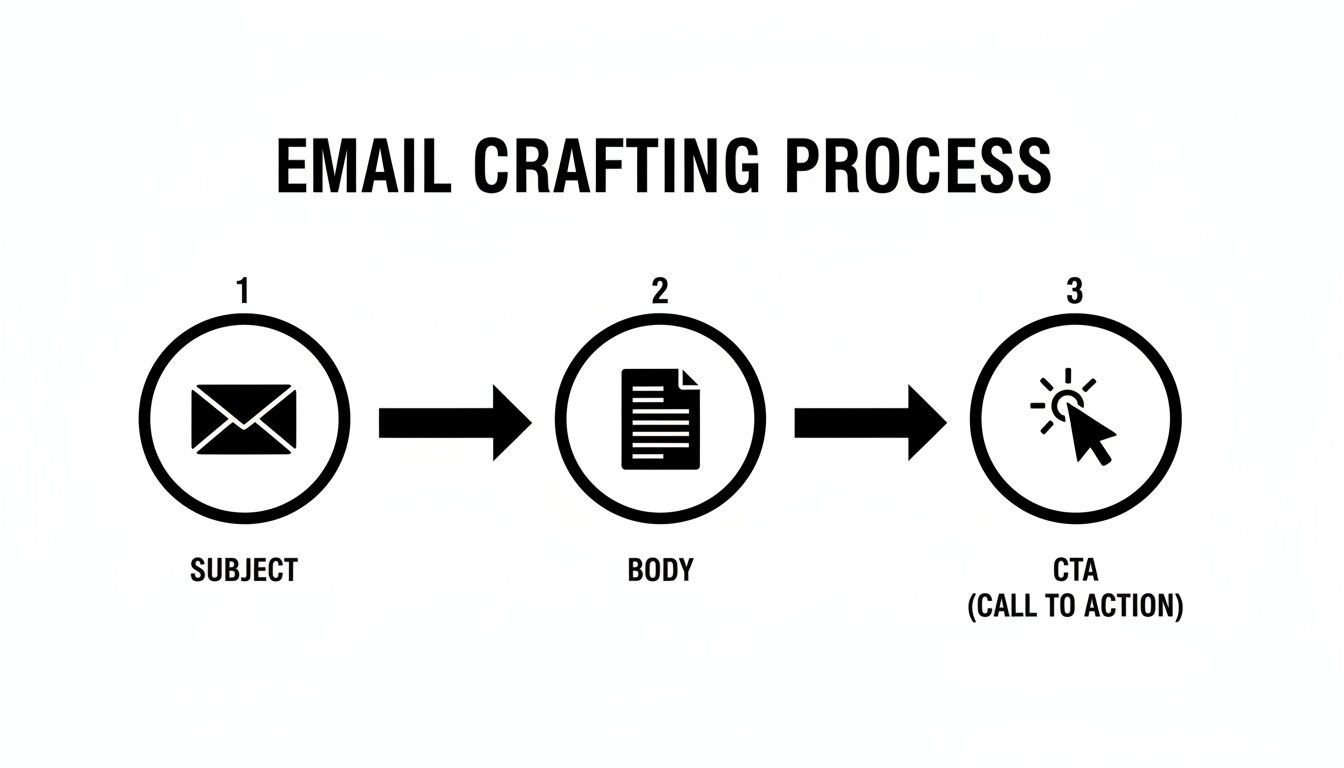
A killer subject line gets the open, genuinely useful content in the body builds trust, and a clear call to action tells them exactly what to do next.
3. The Long-Term Nurture Campaign
What about the leads who go quiet? This is the sequence for them. It's designed to run in the background for months, keeping you top-of-mind with helpful, non-salesy content. It’s perfect for past clients or leads who just aren't ready to make a move yet.
The point of long-term nurturing isn't to get a deal done today. It's to build such a strong reputation that when your contact is ready to buy or sell in six months or two years, you're the only agent they even think of calling.
This campaign can be as simple as one email per month, alternating between topics like these:
- Hyper-local market updates for their specific zip code.
- Seasonal home maintenance tips, like a fall checklist for winterizing their home.
- Community spotlights highlighting a new local restaurant, park, or event.
These sequences are the engine that drives an effective email strategy. Setting up these automated systems means you're delivering consistent, valuable communication that builds trust and brings opportunities to the surface. It's the smartest way to scale your outreach and connect with the right people at the perfect time. To see what tools can get the job done, check out our guide on real estate marketing automation software.
Measuring Success and Optimizing Your Strategy
Sending out emails without tracking what happens next is a lot like holding an open house and never asking for feedback. You're putting in the work, but you have no clue what’s actually resonating with people. If you want to turn email from a shot in the dark into a reliable business driver, you have to get comfortable with the data.
This isn't about becoming a data wizard overnight. It’s simply about understanding a few key numbers that tell a powerful story about how your audience is reacting to your messages.
Key Metrics Every Realtor Should Track
Your email platform probably throws a dashboard full of numbers at you, but for our purposes, only a handful really matter. Focus on these core metrics to get a clear, no-fluff picture of your campaign’s health and find easy ways to improve.
Here are the essential key performance indicators (KPIs) you should have your eyes on:
- Open Rate: This is the percentage of people who actually opened your email. It's a gut check for your subject line and whether people recognize and trust your name. If this number is low, your subject line just isn't cutting through the clutter in their inbox.
- Click-Through Rate (CTR): Of the people who opened your email, what percentage clicked on a link? The CTR is your real measure of engagement. It tells you if your message and call-to-action were strong enough to make someone actually do something.
- Unsubscribe Rate: The percentage of subscribers who hit the "unsubscribe" button. A few are inevitable and perfectly healthy for your list. But a sudden spike is a massive red flag that your content is missing the mark or, just as likely, you’re emailing them way too often.
- Conversion Rate: This tracks how many people took the specific action you wanted, like scheduling a CMA or filling out your "What's My Home Worth?" form. This is the money metric—it ties your email efforts directly to real business outcomes.
Don't just glance at the numbers; look for the story. A fantastic open rate but a dismal click-through rate usually means your subject line wrote a check that your email content couldn't cash.
Turning Insights into Action
Data is just trivia until you do something with it. The real magic happens when you use these numbers to make smarter decisions and constantly fine-tune your email marketing realtors strategy. This cycle of testing, learning, and optimizing is what separates the agents who thrive from those who just get by.
Let's say you notice a disappointingly low open rate on your last newsletter. That’s your cue to start A/B testing subject lines. Write two different ones, send them to a small portion of your list, and see which one gets more opens. Then, send the winner to everyone else. Easy.
Or maybe your unsubscribe rate is making you nervous. That might be a sign of a content problem. Take a hard look at your segmentation. Are you accidentally sending tips on downsizing to your list of first-time homebuyers? Your data is your best friend for figuring out when to adjust who gets what, keeping your emails relevant and genuinely helpful.
Your Top Email Marketing Questions, Answered
Getting into the weeds with email marketing always brings up a few questions. I hear them all the time from agents just like you. Let's tackle some of the most common ones so you can move forward with a clear plan.
What’s the Best Email Marketing Software for a Realtor?
Honestly, there isn't one perfect answer here—it really comes down to where you are in your business and how tech-savvy you feel. If you're just dipping your toes in, something like Mailchimp is a great starting point. It's straightforward and gets the job done.
But if you're looking for more horsepower, especially with automation and connecting seamlessly to your CRM, then you'll want to look at tools like ActiveCampaign or a real estate-specific platform like Follow Up Boss. They're built for the kind of sophisticated follow-up that turns leads into clients.
My advice? Don't get hung up on a million features. The two most critical things you need are powerful segmentation options and the ability to build automated drip campaigns. Find a platform that does those two things well and can scale with you as you grow.
How Often Should a Realtor Email Their List?
This is a classic question. The simple answer is that consistency is far more important than frequency. For your general audience receiving a newsletter or market update, sending an email 2-4 times per month is the sweet spot. It keeps you on their radar without becoming inbox noise.
Of course, this isn't a one-size-fits-all rule. A hot lead who's actively clicking on listings might get more frequent, targeted emails from you. The best way to know if you've got the balance right? Keep a close eye on your open and unsubscribe rates. Your audience will tell you if you're sending too much.
What Should I Send Besides New Property Listings?
This is where you go from being just another agent to being a genuine local expert. Your goal is to provide value even when someone isn't actively buying or selling. That’s how you build trust and stay top-of-mind for years.
Here are a few ideas that always work well:
- Hyper-local market reports: Forget city-wide stats. Break down what's happening in a single popular neighborhood.
- Home maintenance checklists: Think "Your Fall Home Maintenance Checklist" or "How to Prep Your Garden for Spring."
- Community spotlights: Feature a new local restaurant, a popular park, or an upcoming community event.
Content like this shows you're invested in the community, not just the transaction. It makes you the go-to resource people think of first.
Ready to create compelling emails, CMA reports, and virtual staging visuals in seconds? Saleswise uses AI to give you the tools top-producing agents rely on, saving you hours every week. Start your $1 trial of Saleswise today.