A Modern Playbook for Lead Generation Real Estate Agents

Let's be honest, "lead generation" can sound a bit cold and corporate. But for real estate agents, it's the lifeblood of your business. It's the art and science of attracting potential buyers and sellers, building a reliable pipeline of clients so you can stop chasing deals and start creating a predictable income.
Mastering this isn't about some secret formula; it's about blending your personal brand with smart marketing—both online and off.
Building Your Lead Generation Foundation

Before you even think about running an ad or buying a list, you have to lay the groundwork. This is the crucial work that separates agents who are always scrambling for their next closing from those who have built a thriving, scalable business.
It’s about creating a system that keeps working for you, even when you're busy with inspections and closings. You wouldn't build a house on a shaky foundation, right? The same goes for your business. Nailing these fundamentals ensures every dollar and every minute you spend on marketing later will deliver a much better return.
Define Your Ideal Client Avatar
Who do you really want to work with? Saying your client is "anyone buying or selling a home" is a fast track to getting lost in the noise. The top producers I know are laser-focused. This isn't about turning people away; it's about tailoring your message so it hits home with a specific group.
To build out your ideal client avatar, get into the details:
- Demographics: What's their age, income, and family situation? Are they young professionals, a growing family, or maybe empty-nesters looking to downsize?
- Location: Which specific neighborhoods, zip codes, or school districts are they obsessed with?
- Property Type: Are you going after first-time buyers hunting for condos, luxury clients who want private estates, or investors looking for their next multi-family property?
- Pain Points: What keeps them up at night? Are they terrified of the financing process, stressed about the logistics of moving, or worried they'll overpay in a hot market?
For example, an agent in Austin, Texas might zero in on the "Tech Relocator"—a 30-something professional moving for a new job, totally unfamiliar with the city, who needs a move-in-ready home in a walkable neighborhood. That level of clarity changes everything about your marketing.
Craft a Powerful Unique Value Proposition
Once you know who you’re talking to, you have to nail what you're going to say. Your Unique Value Proposition (UVP) is a simple, powerful statement explaining why a client should pick you over the dozens of other agents they could call. It’s your core promise.
A strong UVP isn't just a catchy slogan. It's the heart of your brand. It directly answers the client's biggest unspoken question: "Why should I trust you with what is likely my single largest financial decision?"
To figure yours out, think about what makes you different. Maybe you have a background in construction and can spot a money pit from a mile away. Perhaps you’re a data geek who provides market analytics that other agents don't. Or maybe your specialty is an unbeatable "24-hour response guarantee" that puts anxious clients at ease.
For that "Tech Relocator" avatar, your UVP might be: "I help Austin newcomers find the perfect home in under 30 days by providing virtual neighborhood tours and connecting them with my vetted network of local lenders and movers." See how specific that is?
Establish Your Non-Negotiable Tech Stack
In today’s market, your digital presence is your storefront. There are two pieces of tech you absolutely cannot afford to skip, even from day one.
First up is a mobile-first website. Well over half of all web traffic now comes from smartphones, so if your site is a pain to use on a phone, you're already losing. It needs a clean IDX feed for searching properties, obvious calls-to-action, and valuable content that makes people want to give you their contact info.
Second is a Customer Relationship Management (CRM) system. Think of a CRM as the command center for your entire business. It's where you track every lead, every conversation, and every follow-up task. Starting with a CRM from the get-go—even a simple one—is the single best way to prevent leads from falling through the cracks. For a deeper dive into attracting clients and starting strong, check out these essential real estate lead generation strategies. Getting this right is the first real step toward building a predictable and profitable career.
Mastering Digital Channels to Attract High-Quality Leads
In today's market, having a strong digital presence isn't just an advantage—it's the engine that drives a modern real estate business. But it's not enough to just be online. You need a deliberate, multi-channel system where every piece, from your social media ads to your website, works together to pull prospects into your world.
Think of it as creating a digital ecosystem that generates opportunities for you 24/7. When done right, this frees you up to do what you do best: build relationships and close deals. Let’s dive into the channels that really move the needle.
Dominate Local Search with Your Google Business Profile
Your Google Business Profile (GBP) is easily one of the most powerful—and free—tools in your arsenal for lead generation real estate agents. When someone in your town searches "real estate agent near me," this is your ticket to showing up in that all-important local map pack at the top of the results. Neglecting your GBP is like having an unlisted phone number.
To really stand out, you need to treat it like a dynamic part of your marketing:
- Fill Out Everything: Don't skip a single field. Add your service areas, hours, and a keyword-rich business description that tells people exactly what you do and where you do it.
- Become a Review Magnet: Make asking for reviews a non-negotiable part of your closing process. Every happy client is a potential five-star review, which builds massive social proof and boosts your local ranking.
- Post Regular Updates: Use Google Posts to share new listings, celebrate recent sales, or promote an upcoming open house. This signals to Google that you're active and relevant, which they love to see.
A well-managed GBP makes you instantly findable to motivated local buyers and sellers right when they’re looking for help.
Create Hyper-Targeted Social Media Ad Campaigns
Boosting a "Just Listed" post to everyone in your city is just throwing money away. The true magic of platforms like Facebook and Instagram is in their laser-focused targeting. You can put your ad directly in front of the people who are most likely to become your next client.
Let’s say you’re listing a three-bedroom home in a sought-after school district. Instead of a generic ad, you could build a campaign that targets:
- People aged 30-45 who live within a 10-mile radius.
- Users who have shown interest in Zillow, home improvement, or parenting pages.
- Individuals who have recently interacted with mortgage lenders or calculators.
This kind of precision ensures your budget is actually working for you. It's no surprise that 92% of Realtors use Facebook to attract clients. And don't forget video—listings that include a video tour can generate a staggering 400% more inquiries than those with just still photos.
Attract and Capture with High-Value Lead Magnets
A lead magnet is simply something valuable you offer for free in exchange for an email address. This is how you turn anonymous website visitors into real, actionable leads.
Effective lead magnets for real estate agents are all about solving a problem:
- Downloadable Neighborhood Guides: A beautifully designed PDF covering a hot neighborhood's schools, parks, market stats, and best coffee shops.
- Instant Home Valuation Tools: A landing page offering a free, automated estimate of a home's value is practically irresistible to homeowners thinking about selling.
- First-Time Homebuyer Checklists: A simple, step-by-step guide that walks a nervous buyer through the entire process positions you as a trusted expert.
Once you have that email, the real work begins. This is your chance to start an automated nurturing sequence that builds trust over time. You can dive deeper into these strategies in our guide on email marketing for real estate.
The best lead magnets answer a pressing question or solve a specific problem for your ideal client. Provide immense value upfront, and you’ll earn their trust.
Comparing Top Digital Lead Generation Channels
To build a well-rounded strategy, it helps to see how the most popular digital channels stack up against each other. Each one serves a different purpose and shines with a different type of audience.
| Channel | Primary Use Case | Best For Attracting | Key Metric |
|---|---|---|---|
| Google Business Profile | Local SEO & discovery | Local buyers/sellers actively searching for an agent | Phone Calls, Website Clicks, Direction Requests |
| Social Media Ads | Targeted brand awareness & lead capture | Specific demographics (e.g., first-time buyers, luxury clients) | Cost Per Lead (CPL), Click-Through Rate (CTR) |
| Website/Lead Magnet | Turning traffic into contacts | In-market researchers and future clients | Conversion Rate, Email Sign-ups |
| PPC (Google Ads) | Capturing high-intent search traffic | Motivated buyers/sellers searching specific terms | Cost Per Click (CPC), Lead Conversion Rate |
Choosing the right mix depends entirely on your specific market and business goals, but a healthy combination of these channels creates a powerful and consistent lead pipeline.
For agents ready to tackle paid search, pay-per-click (PPC) ads on Google can deliver incredibly high-intent leads. These are people actively typing "homes for sale in [Your City]" into the search bar. If you're looking to get started, a resource like this PPC for Lead Generation: A Modern Google Ads Guide can be an excellent roadmap.
Proven Offline Strategies for a High-Touch World

While your digital marketing is busy working 24/7, never forget that real estate is, at its core, a deeply personal, relationship-driven business. This is where high-touch, offline strategies truly shine, creating the genuine connections that build lasting trust and bring in your most loyal clients.
These methods are far from old-fashioned; they're the bedrock of a balanced approach that successful lead generation real estate agents rely on. They anchor your brand in the community and show everyone you’re more than just a face on a screen.
Turn Every Open House into a Lead Magnet
An open house isn't just a tour—it's a golden opportunity for face-to-face lead capture. I’ve seen too many agents let motivated buyers walk right out the door without making a real connection. To get the most out of your next event, you need to shift your mindset from "tour guide" to "invaluable resource."
Ditch the simple paper sign-in sheet. Instead, use a tablet with a tool that asks a single, insightful question like, "What's the one feature you must have in your next home?" This immediately starts a conversation and gives you incredible insight. Have neighborhood market reports and lists of other available homes printed and ready to hand out.
Remember, you're not just there to sell that specific house. You're demonstrating your local expertise to everyone who walks in, including the curious neighbors who might just be thinking of selling next spring.
The real goal of an open house isn't just to sell the listing. It's to meet the next ten buyers and the next two sellers in that neighborhood. Every handshake is a chance to build your pipeline.
Master the Art of Authentic Local Networking
Showing up at community events just to hand out business cards always feels awkward and rarely works. The key is to lead with genuine curiosity and a real desire to help. Forget the sales pitch. Just focus on building relationships.
- Volunteer Strategically: Join the board of a local charity or volunteer at the annual town festival. This positions you as a committed member of the community, not just another salesperson.
- Join a Business Group: Get active in a local business association or a group like BNI (Business Network International). These organizations are literally built on the principle of reciprocal referrals.
- Become the Local Expert: Offer to give a free 15-minute talk at the library or community center on topics like "How to Prep Your Home for a Top-Dollar Sale" or "Navigating Today's Tricky Market."
This approach builds your sphere of influence naturally. People start to see you as the go-to real estate resource because they know, like, and trust you. That personal connection is incredibly powerful; in fact, research shows that networking for referrals produces the highest ROI (40.4%) among free lead generation techniques. You can dig into more of these lead generation statistics on Growthlist.co.
Build a Powerful Referral Engine
Your past clients and professional network are your greatest untapped lead sources, period. A referral from a trusted friend is the warmest lead you'll ever get, but it won't just happen by accident. You need a system that actively encourages and rewards referrals.
Think about creating a "Client for Life" program. It could include simple touches like:
- An annual "home-versary" gift card to a local coffee shop.
- Quarterly market update emails that are genuinely useful, not just sales fluff.
- A client appreciation event, like a summer BBQ or a private movie screening.
At the same time, build a tight-knit network of preferred local vendors—plumbers, lenders, landscapers, and inspectors. When you send business their way, they'll be far more inclined to send it right back. This creates a mutually beneficial ecosystem that consistently sends new opportunities your way.
Modernize Your Direct Mail Campaigns
Direct mail isn't dead—but bad direct mail definitely is. Blasting a generic "Just Sold" postcard to an entire zip code is a waste of money. A modern approach uses data to send hyper-targeted, high-value mailers that feel personal and actually get a response.
Instead of a broad campaign, zero in on a specific niche. For instance, send a personalized letter to homeowners in a particular subdivision who have lived there for 10+ years, offering a custom home equity report.
Here’s the crucial final step: include a clear call to action that bridges the offline-to-online gap. A simple QR code or a memorable URL that directs them to a dedicated landing page is perfect. When they go online to claim their free report, you've just made your ROI trackable and moved a lead from a physical mailer right into your digital nurturing funnel.
From Handshake to Keys in Hand: The Art of Nurturing Your Leads
Getting a new lead is a great feeling, but let's be honest—it’s just the starting line. The real work, and where most deals are actually won or lost, happens in the follow-up. A name in your CRM isn't a commission check; it's an opportunity that needs careful cultivation.
I’ve seen too many agents let high-potential leads go cold simply because they didn’t have a consistent plan. This is where a solid nurturing system comes in. It’s your blueprint for turning lukewarm interest into a signed contract, ensuring no lead ever falls through the cracks.
Speed to Lead: Why the First Five Minutes Matter Most
In real estate, the early bird absolutely gets the worm. The second an inquiry hits your inbox—whether from your website, Zillow, or a social media ad—the clock is ticking. Waiting even an hour can torpedo your chances of ever connecting with that person.
This isn't just a hunch; the data is crystal clear. "Speed to lead" is everything. I've seen it time and again: contacts made within the first five minutes are a staggering nine times more likely to convert. It’s also why agents who embrace marketing automation see, on average, a 451% increase in qualified leads. They're simply getting in the door first.
You can find more eye-opening numbers on this at Resimpli.com’s real estate lead statistics page.
Remember, this first contact isn't about a hard sell. It's about being incredibly responsive, genuinely helpful, and establishing yourself as the go-to professional from the jump.
Building Your 24/7 Nurturing Engine
You can't be everywhere at once. As your business grows, it’s physically impossible to call every new lead the moment they come in. This is where automation becomes your most valuable assistant, working around the clock to engage leads and keep your name top-of-mind.
A powerful nurturing engine isn't just one-note; it's a mix of different channels working together.
- Immediate SMS Response: This should be your first move for any new online lead. A simple, automated text like, "Hi [First Name], this is [Your Name]. Just saw your inquiry about the home on Elm Street. Are you free for a quick chat in the next 15 minutes?" is personal, immediate, and has a much higher open rate than email.
- Value-Driven Email Campaigns: Forget just sending listings. Design an automated email series that provides real value. Think market updates, neighborhood guides, or tips for first-time homebuyers. Solve their problems before they even ask.
- Smart Task Reminders: Automation is there to support your personal touch, not replace it. Your CRM should be set up to automatically create tasks for you, prompting you to make a personal phone call at key moments in the nurturing journey.
A proven workflow might look something like this:
- Day 1: An instant SMS goes out, followed by a welcome email with a helpful resource (like a buyer's guide).
- Day 3: Your CRM reminds you to make a personal call to introduce yourself and ask a few discovery questions.
- Day 7: An automated email sends a video tour of a popular local neighborhood they might like.
- Day 14: Another email shares recent market stats for their specific area of interest.
This blend of automation and personal outreach is what keeps you top-of-mind. For a deeper dive into these strategies, our guide on how to follow up with leads effectively has you covered.
The best nurturing systems don't feel automated. They feel like a thoughtful, attentive agent is consistently sending exactly the right information at exactly the right time.
The First Phone Call: Ditch the Script, Build Rapport
When you finally get that lead on the phone, your primary goal isn't to sell them a house. It’s to build a connection. I see so many agents jump straight to the numbers—"What's your budget? Are you pre-approved?"—which can feel like an interrogation.
Instead, lead with genuine curiosity. Here's a simple framework that works:
- Acknowledge and Validate: Start warm. "Thanks so much for taking my call! I saw you were checking out homes in Maplewood online. It's a fantastic neighborhood with a lot going on right now."
- Ask Open-Ended Questions: Shift from "what" to "why." Instead of "What's your budget?" try asking, "What is it about the Maplewood area that caught your eye?" or "Tell me a little bit about what's prompting your home search."
- Listen More Than You Talk: This is crucial. Let them do most of the talking. Your job is to listen for their true motivations, their pain points, and their timeline.
- Offer Immediate Value: End the call by giving them something. "Based on what you've told me, I'm going to set up a custom search for you that only includes homes with a fenced-in yard for your dog. I'll send that over this afternoon."
This approach instantly changes the dynamic from a sales pitch to a helpful consultation. You’re no longer a salesperson; you’re their trusted advisor.
Prioritizing Your Day with Lead Scoring
Once your pipeline is buzzing, you’ll have dozens—maybe hundreds—of leads at different stages. So, who do you call today? The answer is lead scoring. It’s a simple system for figuring out who’s hot and who’s not.
Lead scoring works by assigning points to leads based on their actions. A lead who opens every email, clicks on listings, and uses your mortgage calculator is far more engaged than someone who’s gone dark for a month. You’re just ranking their digital body language.
Here’s a basic lead scoring model to get you started:
| Action | Points |
|---|---|
| Visited website in last 7 days | +10 |
| Opened an email | +5 |
| Clicked a link in an email | +10 |
| Viewed 5+ properties | +15 |
| Saved a property as a favorite | +25 |
| Requested a showing | +50 |
By setting a simple threshold—for example, any lead with over 50 points gets a personal call—you can instantly focus your time and energy where it will make the biggest difference. It ensures you’re always talking to your most motivated prospects first.
Choosing the Right Technology for Your Business
If you’re serious about scaling your real estate business, you can't rely on sticky notes and spreadsheets. You need a solid tech stack. And I'm not talking about a random collection of trendy apps; I mean a cohesive system where every tool talks to each other to save you time and make sure no lead ever slips through the cracks.
Think of it as the central nervous system for your entire operation. It handles all the repetitive, time-sucking tasks, freeing you up to do what you do best: build relationships and close deals.
Your CRM Is Your Command Center
If you're going to invest in just one piece of technology, make it a Customer Relationship Management (CRM) system. Your CRM should be the absolute single source of truth for your business—a digital filing cabinet for every lead, contact, conversation, and follow-up.
A good real estate CRM is built around the way agents actually work. It lets you see your entire pipeline at a glance, from the moment a new lead comes in to the day you hand over the keys. Getting this organized is a game-changer. In fact, agents who use a CRM see a boost in lead conversion rates by as much as 41%, simply because they're more organized and can automate their follow-up. You can dig into more stats about how real estate CRMs impact conversion rates over at GoliathData.com.
Platforms like Saleswise are designed to be this command center, pulling all your lead generation and nurturing activities into one place.
Essential Tools Beyond the CRM
While your CRM is the heart of your operation, a few other tools are critical for building a complete system that actually pulls in and converts leads.
- IDX-Enabled Website: This is your digital storefront, and it absolutely has to be integrated with the MLS. An IDX (Internet Data Exchange) feed lets visitors search for active listings right on your site. This is non-negotiable. It keeps them on your turf instead of sending them back to Zillow.
- Email Marketing Platform: This is your workhorse for nurturing leads automatically. Tools like Mailchimp or Constant Contact let you set up email sequences that send valuable information over time, building trust and keeping you top-of-mind.
- Social Media Scheduler: Let's be honest, nobody has time to post on social media every single day. Consistency is huge for building a following, and a scheduler like Buffer or Hootsuite lets you knock out a whole week's worth of posts in a single afternoon.
The whole point of your tech stack is to automate what you can and simplify what you can't. Every tool you pay for should either save you time or make you money. If it's not doing one of those two things, get rid of it.
This flowchart gives you a simple look at how these pieces work together to move a new contact from just a name on a list to a qualified prospect ready to talk.
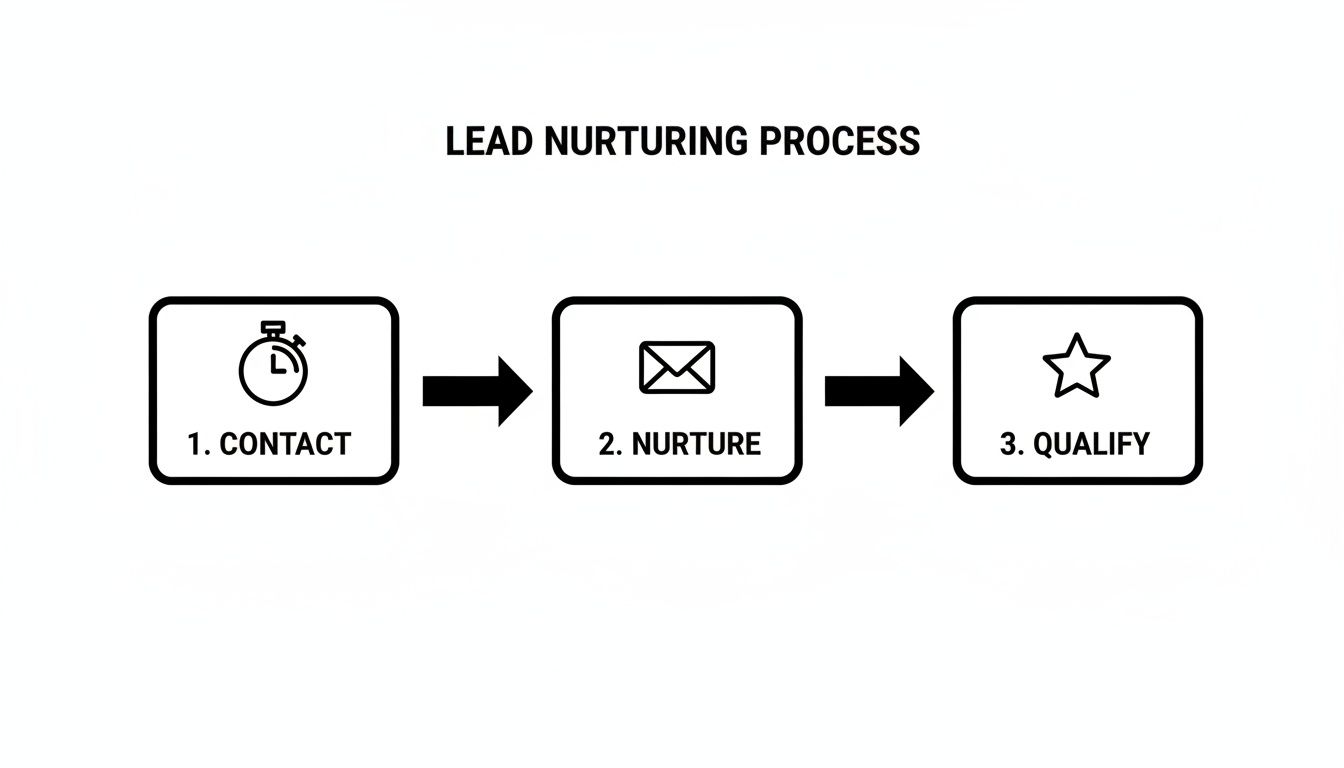
As you can see, a structured system powered by the right tech is what consistently turns leads into clients.
Bringing It All Together
This is where the magic really happens—when your tools are integrated. Imagine a lead fills out a form on your website. That contact is instantly added to your CRM, which immediately triggers a welcome email from your marketing platform. Just like that, you've created a lead-generating machine that works for you 24/7.
This seamless flow guarantees that every new lead gets an immediate response and is placed into a nurturing campaign without you lifting a finger.
For agents who really want to get an edge, it’s also worth learning about real estate market analysis software and how these tools can plug into your CRM to provide incredible insights. The right combination of technology doesn't just help you manage your business; it actively helps you grow it.
Answering Your Top Questions
When you're trying to build a solid lead generation system, questions are going to pop up. The market shifts, new tech emerges, and it's easy to wonder if you're on the right track. Let's tackle some of the most common questions I hear from agents trying to build a more predictable business.
How Much Should I Actually Spend on Lead Generation?
The old rule of thumb is to set aside 10% of your gross commission income (GCI) for all your marketing and lead gen. But honestly, that’s just a starting point.
If you're new, you might need to push that number higher to get your name out there and build some initial momentum. On the flip side, a veteran agent who gets most of their business from referrals might spend significantly less. The real key isn't the percentage—it's the return on investment (ROI). You have to be a hawk about tracking where your money is going and what it’s bringing back. If your Zillow leads are converting but your Facebook ads aren't, it's a no-brainer: double down on what works and kill what doesn't.
I'm a New Agent. Where Are the Best Leads Hiding?
When you’re just starting out, your most valuable and cheapest leads are right under your nose: your sphere of influence (SOI). I’m talking about friends, family, old coworkers—anyone who already knows you and trusts you. Don't be shy; these are the people who will be your first champions.
Another goldmine for new agents? Hosting open houses for the top producers in your office. It costs you nothing but a weekend afternoon and puts you directly in front of buyers who are actively looking and don't have an agent. It’s one of the best ways to get face-to-face with potential clients, period. As for online tactics, start creating super local content. Think video tours of a new dog park or quick interviews with the owner of that new coffee shop. It's a low-cost way to become the go-to community expert.
For new agents, the game is all about trading time for money. Your sphere and other agents' open houses are your most powerful assets. Start there.
Seriously, How Long Does This Take? When Will I See Results?
This is the million-dollar question, and the honest answer is: it depends entirely on your strategy. You have to think in terms of short-term wins versus long-term growth.
- Paid Advertising (Short-Term): If you fire up a Google or Facebook ad campaign, you could see new leads coming in within 24 to 48 hours. The catch? These leads are usually ice-cold and need a ton of follow-up before they're ready to transact.
- Organic Content (Long-Term): Building your presence through a blog or SEO is a marathon, not a sprint. You’re planting seeds. Don't expect a flood of traffic overnight. Realistically, you're looking at 6 to 12 months of consistent effort before you start seeing significant results.
- Relationship-Based (The Wildcard): Networking and nurturing your sphere can land you a client tomorrow, or it might take six months. It's all about consistency.
The agents who crush it don't just pick one lane. They build a balanced machine—using paid ads to create immediate opportunities while they put in the work on their organic and referral strategies for that stable, long-term growth.
Ready to make your lead follow-up and conversion a whole lot easier? Saleswise uses AI to help you create stunning CMAs, virtual staging, and marketing content in just seconds. It's the perfect tool for turning more of those hard-earned leads into happy clients. See what it can do for you at https://www.saleswise.ai.