Proven Playbook to generate leads for real estate and scale your business

If you want a steady stream of real estate leads, you can't just rely on one or two methods. The secret is building a multi-channel system that blends organic marketing, smart paid advertising, and a rock-solid referral network. It’s about creating a predictable pipeline of quality prospects, not just throwing things at the wall and seeing what sticks.
This means moving beyond outdated tactics and embracing a more modern, integrated approach that combines proven digital strategies with the relationship-building that’s always been at the heart of this business.
Why Your Lead Generation Strategy Needs a Refresh
Look, the days of living off cold calls and door-knocking are long gone. While those can still play a small role, the modern homebuyer's journey almost always starts online. Just think about it—95% of all buyers now use online tools during their search. If you don't have a strong digital presence, you're practically invisible to the vast majority of your potential clients.
To really build a foundation that lasts, you need to understand what lead generation marketing truly entails. It’s not just about getting a name and a phone number; it's a systematic process for attracting strangers, capturing their interest, and turning them into real prospects.
Moving from Reactive to Proactive
A powerful lead generation strategy doesn't just wait for the phone to ring. It proactively goes out and finds leads by building assets that work for you around the clock. This playbook is all about creating an integrated system where every part supports the others.
- Your Organic Presence: This is your long-game. Think of your website, blog, and social media as digital real estate. Through smart SEO and authentic engagement, you build a brand that naturally attracts people actively searching for an agent with your expertise.
- Paid Campaigns: Need to turn on the faucet now? Targeted ads on platforms like Google and Facebook can deliver immediate, measurable results. They put your message directly in front of buyers and sellers who are ready to act.
- Referral Systems: This isn’t about luck or hoping a past client remembers you. It’s about creating a repeatable process to stay top-of-mind with your sphere of influence (SOI) and past clients, turning them into a consistent source of warm introductions.
The big shift in mindset is this: Stop chasing individual leads and start building a system that generates them for you. Real success comes from orchestrating a blend of these strategies to create a predictable stream of high-quality opportunities.
This guide is your step-by-step plan to build that exact system. We'll get into the nitty-gritty of executing each of these pillars—from creating hyperlocal content that actually ranks on Google to setting up Facebook ad audiences that clone your best clients. We’ll also show you how to use modern tools to analyze markets and craft messages that cut through the noise, giving you a serious competitive edge.
Building Your Organic Lead Generation Machine
While paid ads can get the phone ringing quickly, your organic channels are what build a truly sustainable business. This is the long game—creating a digital presence that works for you around the clock, attracting clients without you having to pay for every single click.
Think of it as building a brand, an undeniable digital footprint in your local market. The goal isn't to out-muscle Zillow on a national scale. It's to become the go-to digital authority for your specific slice of the world. When someone even thinks about moving to your area, your name should be the first one they see.
Dominate Local Search with Hyperlocal SEO
Most people start their home search on Google. SEO is simply the art and science of making sure you’re the one they find. For real estate agents, the most potent form of SEO is intensely local. Forget broad, generic keywords; the real money is in owning the phrases that matter to your community.
Get inside the head of a buyer or seller. They’re not just typing "homes for sale." They're searching for "three-bedroom homes in the Northgate school district" or asking, "what's the average sale price in the Meadowbrook neighborhood?" Your mission is to create content that directly answers these specific questions before anyone else does.
Actionable Hyperlocal Content Ideas
- Neighborhood Guides: Go deep on every key neighborhood you serve. I’m talking schools, parks, local coffee shops, commute times, and property value trends.
- Market Updates: Publish a monthly or quarterly blog post breaking down the latest local data. Discuss inventory levels, days on market, and sale-to-list price ratios for specific zip codes.
- Cost of Living Breakdowns: Create content comparing the true cost of living in different suburbs, covering everything from property taxes and utilities to other local expenses.
- Client Question Deep Dives: Turn common client anxieties into helpful posts like "A First-Time Buyer's Guide to Securing a Mortgage in Austin" or "How to Prepare Your Victorian Home for Sale in Savannah."
This kind of content shifts your position from a salesperson to a trusted local advisor. When you provide the answers, you build trust. And trust is what turns a casual Google search into a signed client.
Turn Social Media into a Lead Generation Engine
Let’s be clear: social media is not just for posting your latest listings. It's a powerhouse for building community, demonstrating your expertise, and forging genuine connections that lead to real business.
The numbers back this up. A staggering 39% of Realtors point to social media as their single best source for high-quality leads. That’s more than CRM systems (23%) and even the MLS (17%). Your clients are spending their time there, so you need to be there, too. You can dig into the full REALTOR® Technology Survey from NAR for more on these trends.
The trick is to stop broadcasting and start engaging.
Expert Tip: The goal of your social media isn't to sell a house with every post. It's to build such a strong personal brand that when someone in your network thinks "real estate," they immediately think of you.
Crafting a Social Strategy That Converts
A winning social media plan is all about giving value and building relationships through authentic content. Your feed should be a healthy mix of professional insights, community shout-outs, and personal touches that let people see the real person behind the real estate license. For a deeper playbook, check out our guide on creating compelling real estate social media content.
Here’s how to make that happen on the platforms that matter:
- Instagram Reels for Property Tours: Ditch the boring photo slideshows. Create snappy, engaging video walkthroughs set to trending audio. Use Reels to highlight a home's best features or film a "day in the life" to give followers a peek behind the curtain.
- Facebook Groups for Community Building: Why not start a group for residents of a specific neighborhood or for people moving to your city? You can share local events, recommend businesses, and just get conversations started. This move instantly positions you as a central community hub.
- LinkedIn for Professional Networking: This is where you flex your expertise. Share your hyperlocal blog content and market analysis to establish yourself as a data-driven pro. It’s also the perfect place to connect with local business owners, lenders, and attorneys to grow your referral pipeline.
To make all this manageable, lean on AI-powered tools like those inside Saleswise. You can generate authentic, professional-sounding social media captions and post ideas in seconds. This frees you up to focus on what actually matters: engaging with your audience and turning those online conversations into offline clients.
Turn on the Faucet: Paid Ads and Referral Systems That Deliver
Organic growth is fantastic for the long game, but let's be real—sometimes you need leads now. This is where a smart investment in paid advertising and a rock-solid referral system can completely change your business, giving you a predictable flow of clients.
Think of it this way: paid ads put you right in front of motivated buyers and sellers the moment they start searching. Meanwhile, a great referral system taps into your most powerful asset—your relationships—to bring you warm, high-trust introductions. When you combine the two, you’ve got a pipeline-filling machine.
Launching Hyper-Local Paid Ad Campaigns
The beauty of digital ads on platforms like Google and Facebook is the incredible precision they offer. You’re not just throwing money at a billboard and hoping for the best. You can target your ideal clients with surgical accuracy, which means a much higher return on every dollar you spend.
The whole game is won with laser-focused targeting. You aren't trying to reach everyone; you're trying to reach the right one.
Here’s how you do it:
- Google Ads Keyword Targeting: Don't just bid on "homes for sale." Get specific. Think like a buyer and target long-tail, hyper-local phrases that scream intent, like "new construction homes in Green Oaks" or "best real estate agent for downsizing in North Creek." These are the people who are ready to make a move.
- Facebook Lookalike Audiences: This is pure gold. You upload a list of your past clients, and Facebook’s algorithm goes to work, building a brand new audience of people who share similar demographics, interests, and online habits. You're basically cloning your best clients.
The biggest mistake I see agents make with paid ads is casting too wide a net. A small, focused budget aimed at a highly specific audience will always outperform a huge budget wasted on a generic one.
Designing Ad Creative That Stops the Scroll
You’ve got about two seconds to grab someone's attention as they're scrolling through their feed. That generic, boring listing photo isn't going to cut it. Your visuals have to pop.
This is a perfect place to use a little tech to your advantage. For instance, with a tool like Saleswise, you can use AI virtual staging to take an empty, uninspiring room and turn it into a gorgeous, fully-furnished space. An ad showing a vacant living room is forgettable. But an ad showing that same room virtually staged with stylish furniture? That tells a story and helps a buyer imagine their life there. It’s a simple trick that can seriously boost your click-through rates.
Building a Referral System That Actually Works
Referrals are the lifeblood of this business. A lead from a trusted friend or family member comes with built-in trust and converts at a much higher rate than almost any other source. But "hoping" for referrals isn't a strategy. You have to build a system that actively generates them.
It all starts with your Sphere of Influence (SOI)—that’s everyone you know, from past clients and relatives to your favorite barista. The goal is to stay top-of-mind, so when someone they know mentions real estate, your name is the first one that comes up. For a deeper dive into ad strategies that can help with this, check out these effective real estate Facebook ad examples.
A Simple Framework for Consistent Referrals
Don't leave this to chance. Put a repeatable process in place.
- First, deliver an amazing experience. This is the non-negotiable foundation. No system in the world will work if your clients aren't thrilled with your service.
- Make the post-closing ask. The absolute best time to ask for a review and mention referrals is right after a successful closing, when your clients are on cloud nine. Keep it simple and genuine: "I'm so glad we were able to get this done for you. My business is built on helping great people like yourselves, so if you know anyone else thinking of buying or selling, I'd be honored to help them, too."
- Nurture your network. You have to stay in touch. This could be a monthly email newsletter, a few personal check-in calls each quarter, or even an annual client appreciation party. Just be consistent.
- Give to get. The best referral relationships are a two-way street. Be proactive about sending business to your partners—your go-to lender, your home inspector, your favorite local restaurant. When you give, you’ll be amazed at how much you get back.
How to Build a Powerful Lead Conversion Engine
Getting a click or a form submission is just the start. The real work—and frankly, where most agents drop the ball—is turning that initial interest into a signed client agreement. This is where you need a rock-solid conversion engine, a repeatable system for turning prospects into clients.
The whole thing boils down to three key ingredients: speed, personalization, and persistence. If you don't have a plan for all three, you're leaving money on the table every single day. The goal is to make the journey from casual browser to committed client feel effortless and natural for them.
This graphic really breaks down the path a lead takes, from the first time they hear about you all the way to becoming a source of new business themselves.
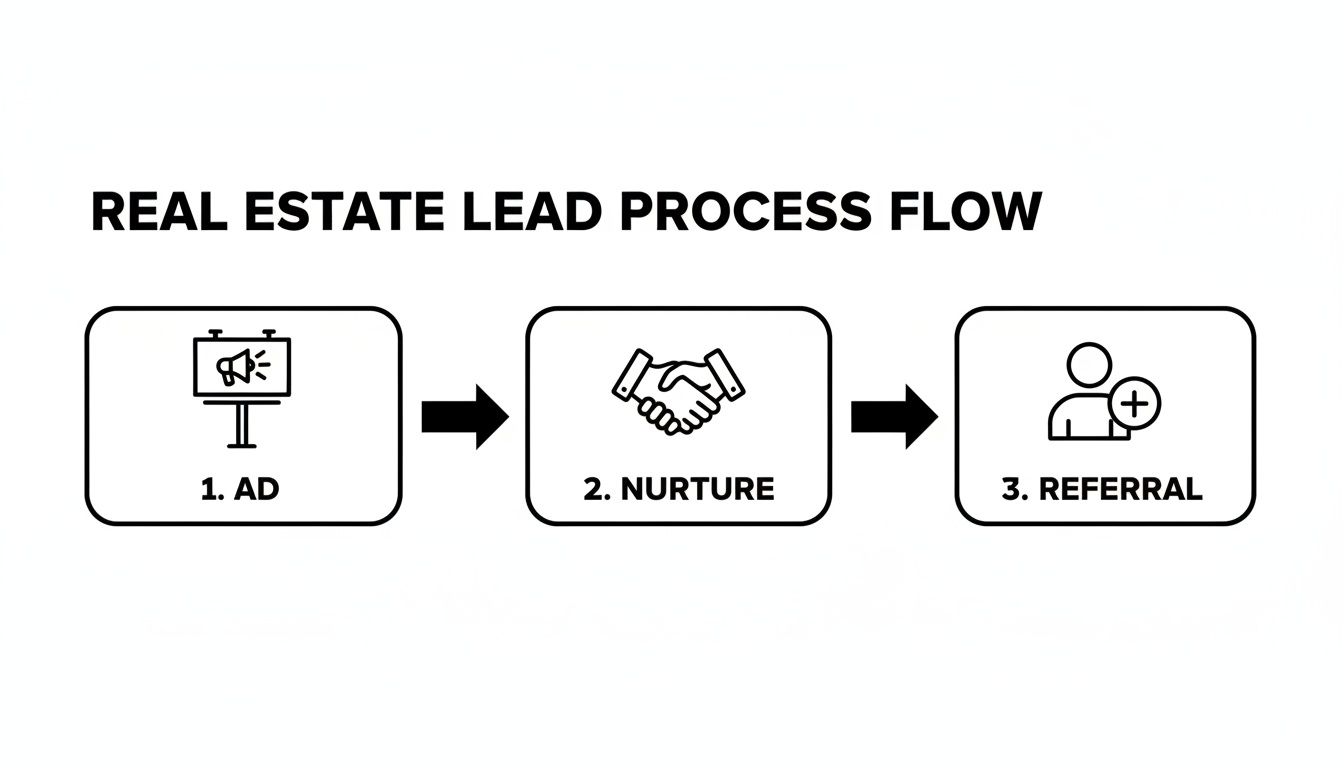
It’s a good reminder that lead generation isn’t a one-and-done deal. It’s a continuous cycle of attracting new people, nurturing those relationships, and then turning happy clients into your next wave of referrals.
Mastering the Art of Lead Capture
Before you can even think about follow-up, you have to get their information. Your website, landing pages, and social media need to be more than just digital business cards; they need compelling offers that give people a real reason to hand over their contact details.
A "Contact Us" button just doesn't cut it anymore. You need to create irresistible offers, what we call lead magnets, that solve an immediate problem for a potential client.
High-Converting Lead Magnet Examples
- The Instant Home Valuation: This is the undisputed king of seller lead magnets. People are obsessed with knowing what their home is worth. Offer a free, instant valuation on a dedicated landing page, and you’ll capture seller leads all day long.
- Neighborhood Market Reports: Pull together the latest sales data, inventory stats, and price trends for a hot neighborhood and offer it as a free PDF download. It positions you as the local expert.
- First-Time Homebuyer Checklists: Buying a home for the first time is overwhelming. A simple, step-by-step guide can be a lifesaver for them and a great lead source for you.
The secret is offering something with immediate, tangible value. A fast CMA from a tool like Saleswise is the perfect lead magnet because it gives a potential seller the exact data they're looking for in seconds. You instantly look like a knowledgeable, tech-forward agent.
The Critical First Five Minutes
In real estate, speed isn't just a suggestion; it's everything. Study after study has shown that if you contact a new lead within 5 minutes, you are 9 times more likely to convert them than if you wait even an hour. This is the "golden window," and it’s why top producers are so focused on their response systems.
This is where you let technology be your assistant. Simple automations can make a massive difference. Set up instant email and text auto-responders that fire off the second someone fills out a form. It confirms you got their request and lets them know a personal follow-up is coming right away.
To really dial this in, a good CRM with VoIP integration can be a game-changer, putting all your calls, texts, and client data in one place for lightning-fast follow-up.
Designing a Multi-Touch Follow-Up Sequence
One call or one email will never be enough. You need a persistent, value-driven follow-up plan to stay top-of-mind and build the trust required to win their business. The goal isn't to be annoying; it’s to be a consistently helpful resource.
A proven strategy uses a mix of communication channels over the first couple of weeks.
Sample 10-Day Follow-Up Blitz
- Day 1 (Instant): Automated email/text confirmation.
- Day 1 (Within 5 Mins): Your first personal phone call. Just aim to connect and understand what they're trying to do.
- Day 1 (Evening): A personal follow-up email recapping your chat and sharing something valuable, like a relevant blog post.
- Day 3: A quick, friendly check-in text. "Hey, just thinking of you. Any questions pop up?"
- Day 5: Another email with a market update or a new listing that fits their search.
- Day 7: Time for a second phone call.
- Day 10: A "no-pressure" email asking if they'd prefer you check back in a month or so.
Personalizing Your Outreach with AI
Generic, copy-and-paste messages get deleted. It’s personalization that makes your communication feel human and stand out. This is where AI tools can give you a huge advantage, boosting your efficiency without sounding like a robot.
Instead of sending the same old "Just checking in" email to everyone, you can use an AI content generator to whip up unique messages for different types of leads.
- For a Seller Lead from a CMA Request: Use an AI script generator to create an email that references their actual property address and points out a compelling market stat for their specific neighborhood.
- For a Buyer Lead from an Open House: Generate a text script that mentions a feature of the home they saw ("Remember the great backyard at 123 Main St?") and asks a thoughtful question about their search.
When you provide value at every single touchpoint, you transform yourself from a salesperson into a trusted advisor. For more ideas on writing messages that actually get a response, check out our deep dive on https://www.saleswise.ai/blog/email-marketing-for-real-estate.
This combination of speed, personalization, and persistence is the engine that will not only bring you a steady stream of leads but, more importantly, turn them into clients for life.
Tracking Your Metrics and Scaling for Growth
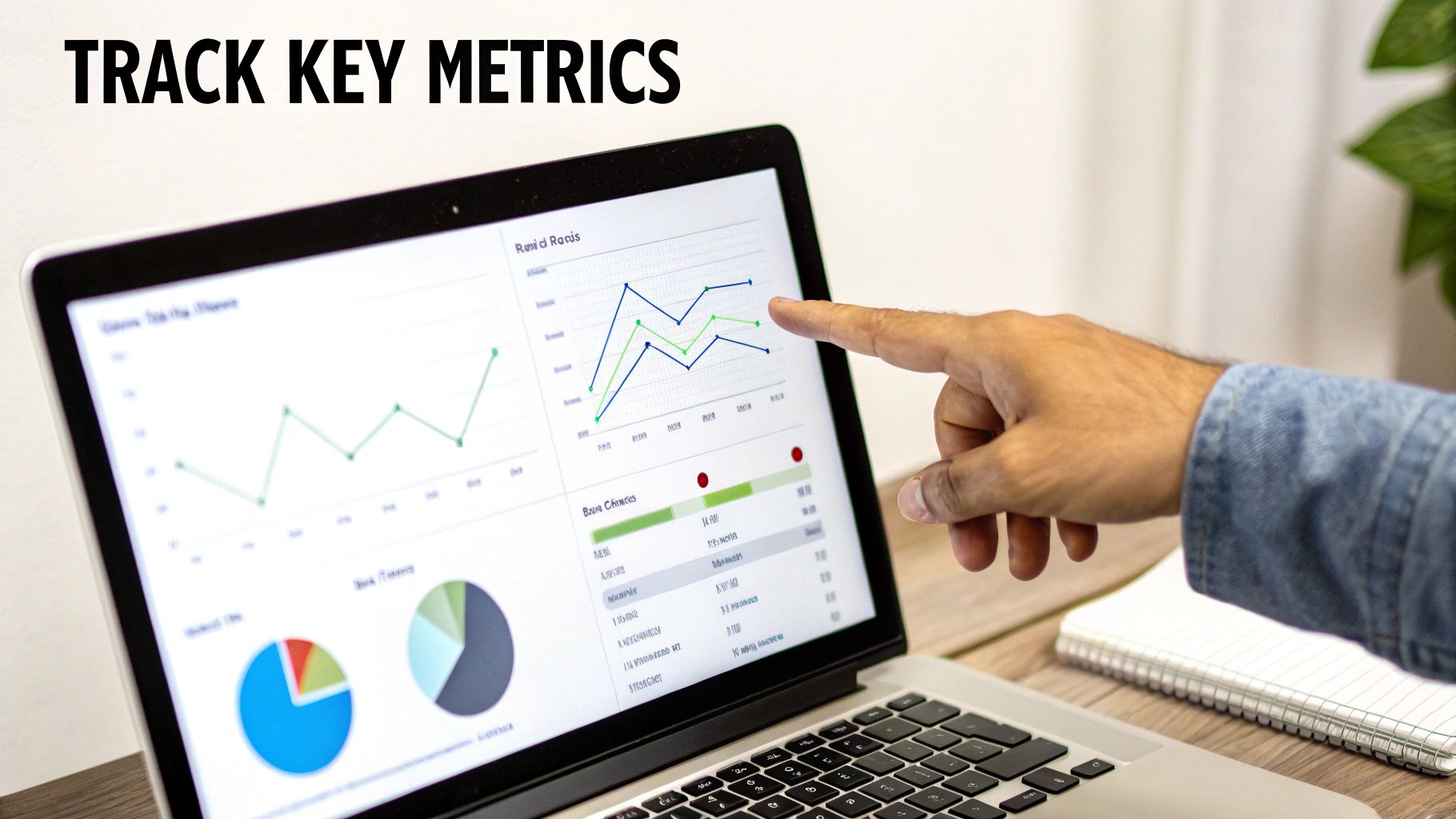
Running brilliant marketing campaigns is only half the battle. If you aren't tracking your results, you're essentially flying blind. You have no real way of knowing what's working and what's just burning through your budget. To truly scale your efforts and build a predictable pipeline of real estate leads, you have to get comfortable with your numbers.
This isn't about getting lost in complicated spreadsheets. It’s about focusing on a few key metrics that give you an honest, clear-eyed view of your business's health. Once you understand these numbers, you can make smart decisions that fuel real growth, turning your lead generation from a daily grind into a well-oiled machine.
Identifying Your Most Important KPIs
Vanity metrics like social media likes and website visits might feel good, but they don't pay the bills. You need to zero in on the Key Performance Indicators (KPIs) that directly connect your actions to your income. These are the numbers that tell the real story.
For most agents, the essential KPIs boil down to a few core areas.
- Lead Source ROI: You have to know which channels are bringing you the best leads. Is it your hyperlocal blog, your Facebook ads, or your referral network?
- Conversion Rate: What percentage of leads from each source actually turns into an appointment? And of those appointments, how many become signed clients?
- Cost Per Lead (CPL): For any paid channels, how much are you spending to acquire a single lead? This number is crucial for managing your budget effectively.
- Sales Cycle Length: On average, how long does it take for a new lead to become a closed deal? Understanding this helps you forecast your income with more accuracy.
Tracking these numbers helps you stop guessing and start making strategic moves. You might find that while Zillow leads cost more upfront, they close twice as fast as your website leads, making them far more profitable in the long run.
A Simple Framework for Tracking and Analysis
You don’t need a data science degree to make this work. A simple CRM or even a well-organized spreadsheet is all you need to get started. The real key is consistency—you have to track every single lead that comes into your business.
Here’s a practical way to organize your data for each and every lead:
- Lead Source: Where did they come from? Be specific (e.g., "Facebook Ad - Green Oaks," "Open House - 123 Main St," "Referral from Jane Smith").
- Date Acquired: The day they first entered your system.
- Appointment Set: A simple yes/no, along with the date.
- Client Signed: A yes/no and the date they signed.
- Deal Closed: The date and your final commission amount.
- Marketing Cost: If it applies, note the ad spend or cost tied to acquiring that specific lead.
Over time, this data will paint a powerful picture. You’ll be able to see at a glance which lead sources are producing the highest-quality opportunities and giving you the best return on your investment.
Using Data to Make Smarter Decisions
Once you have a few months of this data, the path to scaling becomes crystal clear. Your goal is simple: do more of what works and less of what doesn't.
If your data shows that your "Downsizing in North Creek" Google Ad campaign has a low CPL and a high conversion rate, that’s a flashing green light to increase your budget there. On the flip side, if you find that a particular online lead source is generating tons of clicks but almost no appointments, it's time to either rethink your approach or cut that channel loose.
This data-driven mindset is how you transform your business. It lets you invest your time and money with confidence, ensuring every marketing dollar is working as hard as possible to generate quality leads and grow your bottom line predictably.
Frequently Asked Questions
Even with the best playbook in hand, you're bound to have questions. Here are some straight-to-the-point answers to the most common hurdles agents face when trying to drum up new business.
What’s the Most Cost-Effective Way for a New Agent to Get Leads?
When you're new and watching every penny, your best bet is to lean into methods that cost time, not cash. Your absolute first stop should be your Sphere of Influence (SOI). I’m talking about friends, family, old coworkers—anyone who already knows and trusts you.
At the same time, get serious about building a hyperlocal social media presence. Don't try to be everywhere; pick one or two platforms and own them. Share content that's genuinely useful for the community, not just a constant stream of listings. Well-run open houses are another goldmine for meeting active buyers and sellers face-to-face. Think of it this way: you're swapping sweat equity for leads.
The real secret for new agents is to become the go-to local expert. When you provide value before you ask for anything, you're building a business that doesn't need a huge ad budget to survive.
How Many Times Should I Follow Up with a New Real Estate Lead?
You have to be persistent, but you also have to be smart about it. For a fresh online lead, a good rule of thumb is an 8-12 touch campaign that unfolds over a few weeks. This strategy uses a mix of calls, texts, and emails to keep you top-of-mind without being annoying.
Kick things off with an immediate phone call and text message. From there, your follow-up should be a sequence of helpful emails and occasional check-in calls. The entire goal is to frame yourself as a helpful advisor, not a desperate salesperson. A good CRM is essential here—it'll track everything and make sure no one gets forgotten.
How Can I Get More Leads from My Property Listings?
Stop thinking of your listings as just ads. They should be powerful lead-generating machines. First things first: professional photography is non-negotiable. Period. Then, take it a step further with AI-powered virtual staging to show buyers what's possible with an empty or outdated space. This can completely change how they see a property.
Next, rewrite your property descriptions. Ditch the boring list of features and tell a story that sells a lifestyle. Finally, every major listing deserves its own dedicated landing page with a simple lead capture form. When you run social media ads, send people directly to that page, not a crowded portal where they can get distracted by other agents' listings.
Should I Buy Real Estate Leads from Services Like Zillow?
Buying leads from a platform like Zillow can give you a quick boost in activity, but it’s a tricky game. These leads are not only expensive, but they’re also usually sent to a handful of other agents at the exact same time. It’s an immediate, high-stakes race to be the first to respond.
Your chance of converting a lead you bought plummets after just five minutes. While it might be a decent patch for a slow month, building your business on purchased leads is rarely a sustainable or profitable strategy in the long run. You'll almost always see a better ROI by investing that same money into your own brand and lead-generation efforts, like targeted local ads that you control.
Ready to put these ideas into practice? Saleswise provides the tools you need to create lightning-fast CMAs, beautiful AI virtual staging, and top-tier marketing content in seconds. It's time to stop guessing and start converting.