How to Generate Seller Leads: Proven, Modern Strategies for Listings
If you're tired of the feast-or-famine cycle that plagues so many real estate careers, you're in the right place. The secret to a stable, thriving business isn't some magic bullet; it's a smart, multi-channel system for generating seller leads. It's about blending timeless, relationship-based tactics with the incredible power of modern AI tools.
This approach helps you find potential sellers long before your competition even knows they're thinking about moving.
Building Your Foundation for Consistent Seller Leads
A steady stream of seller leads doesn't just fall into your lap. It’s the direct result of a deliberate, multi-faceted strategy. I've seen countless top producers, and the one thing they all have in common is that they never rely on a single source for business. That's a recipe for disaster.
Instead, they build a resilient lead-generation engine that works for them around the clock, even when they're not. This is about more than just chasing the next deal; it's about building a robust pipeline that sustains your business for years to come.
A solid foundation for this kind of system typically includes three core pillars:
- Nurturing Your Network: This means systematically engaging with your sphere of influence (SOI). These are your highest-converting referrals, but they don't happen by accident.
- Targeted Digital Outreach: Using smart, automated systems to pinpoint and connect with potential sellers online before they even start searching for an agent.
- Establishing Authority: Creating genuinely valuable content that cements your reputation as the go-to real estate expert in your community.
A huge part of laying this groundwork is understanding how to effectively generate leads on social media. It's often the first step in building the visibility you need to capture attention and pull people into your world.
Where Do Seller Leads Come From?
Today, generating leads is a mix of old-school networking and new-school tech. The best agents I know have mastered both. This chart gives you a pretty clear picture of where leads are actually coming from in today's market.
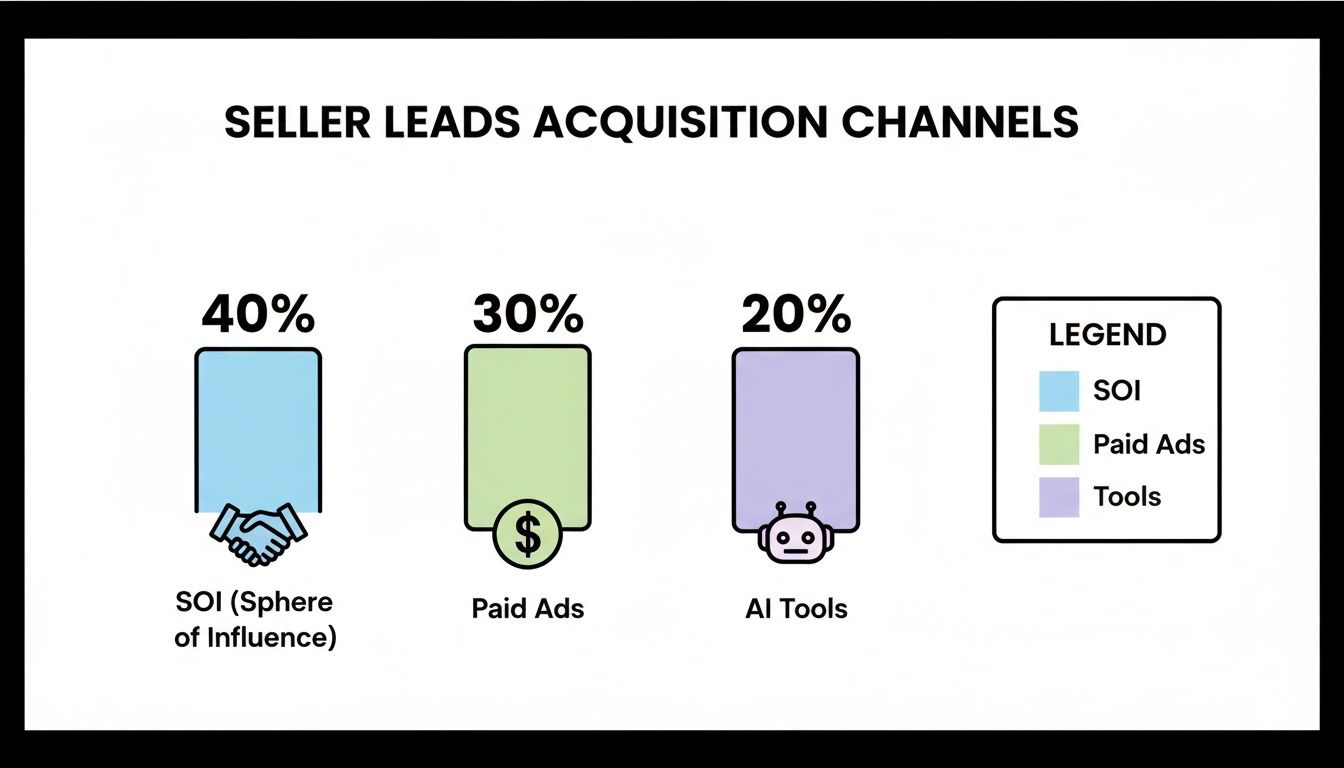
As you can see, your personal network (SOI) is still king. But look at how much ground paid ads and AI tools have gained. This data proves that a diversified approach isn't just a good idea—it's essential for consistent growth.
For a much deeper dive into creating this kind of multi-channel system, check out our complete guide on how to https://www.saleswise.ai/blog/generate-real-estate-leads. It's less of a list and more of a blueprint for building a machine that delivers predictable results.
Comparing Seller Lead Generation Methods
To help you decide where to focus your time and money, here's a quick breakdown of the most common strategies. Each has its pros and cons when it comes to cost, effort, and what you can realistically expect in return.
| Strategy | Primary Channel | Effort Level | Potential Conversion Rate |
|---|---|---|---|
| Referrals & SOI | Personal Network, Email | Low to Medium | Very High |
| Paid Ads | Social Media, Google | High | Low to Medium |
| AI Predictive Analytics | Software Platforms | Low | High |
| Open Houses | In-Person Events | High | Low |
| Geographic Farming | Direct Mail, Door-Knocking | High | Low to Medium |
| Content Marketing | Blog, Social Media, Video | Medium | Medium to High |
This table makes it clear that there's no single "best" way. A healthy lead-generation plan incorporates a few of these methods. The right mix depends entirely on your budget, your market, and where you want to take your business.
Don't get me wrong, all the new marketing fads are exciting, but the most dependable source of seller leads is probably sitting right in your phone. I'm talking about your personal network—your Sphere of Influence (SOI). This is where the highest-converting opportunities always come from. These aren't just names on a list; they're real relationships built on trust, and in real estate, trust is everything.
But let's be real, just "talking to your network" isn't a business plan. If you want to turn this goldmine into actual seller leads, you need a system. It’s all about providing consistent, genuine value, not just hitting people up when you need a commission check.
Turn Your Sphere of Influence Into a System
First things first, you need to get your SOI out of your head and into an organized system. Gather up all your contacts—past clients, friends, family, the owner of your favorite coffee shop, everyone—and put them into a CRM or even a well-organized spreadsheet. This is the only way you can actually track your conversations and be strategic about your outreach.
Once you have your list, it's time to create a communication plan. The goal here is to give, give, give without asking for anything in return. Think about what a homeowner actually finds useful.
Here are a few ideas that have always worked for me:
- Monthly Market Updates: A quick, no-fluff email or video breaking down what’s happening in the local market. Keep it simple.
- Annual "Home-iversary" Check-ins: This is a killer touchpoint. It shows you remember them and care about their journey long after the deal is closed.
- Local Event Info: Sharing what's going on around town makes you look like the connected, local expert you are.
The point is to become their go-to resource for all things home and community. When you consistently show up with valuable information, you’re the first person they’ll call when they—or someone they know—thinks about real estate.
The Impact of Proactive Value
Let me paint a picture for you. You have a past client, Sarah, who bought her home from you three years ago. On the anniversary of her closing day, she gets a personal message from you. Attached is a quick, updated Comparative Market Analysis (CMA) that you pulled together in 30 seconds using a tool like Saleswise. It instantly shows her the incredible equity she's built.
That single, simple act does so much more than just say "happy home-iversary." It shows off your expertise, proves her home was a great investment, and plants a seed that you are the person to talk to about home values in her neighborhood.
This is what I call proactive value. You're not waiting for them to reach out; you're anticipating what they'd want to know and delivering it. When Sarah, or one of her friends, is ready to sell, who do you think she's going to call?
Don't just take my word for it. Referrals and your sphere of influence are the undisputed kings of lead generation. The numbers back it up: these organic channels have conversion rates that can soar above 30% from lead to close. That blows paid ads and cold calling out of the water. Sellers trust people they know, which is why 40.4% of agents say networking for referrals gives them the best ROI of any free method. You can dig deeper into how to convert these valuable lead sources on Opendoor.com.
Become a Community Hub, Not Just an Agent
Another fantastic way to tap into your network is to become a central figure in your community. When you host local events, you position yourself as a helpful expert, not just someone trying to get a listing.
Think about hosting a free, casual home-selling workshop at a local library or coffee shop. You could cover topics that homeowners are actually curious about:
- "5 Simple Upgrades to Maximize Your Home's Value"
- "How to Make Sense of the Current Seller's Market"
- "Getting Your Home Ready for a Quick Sale"
By educating people, you build an incredible amount of trust and credibility. These events are magnets for homeowners who are just starting to think about a move, giving you the chance to build a relationship long before they're ready to interview agents. It's a long game, for sure, but it solidifies your reputation and keeps your pipeline full of warm, high-quality leads.
Scaling Your Reach with Paid Advertising

Building your network and sphere of influence is a fantastic foundation, but when you’re ready for serious, predictable growth, it's time to pour some jet fuel on the fire. That's where paid advertising comes in. Platforms like Facebook and Google are powerful tools for getting in front of potential sellers when you need a consistent flow of leads.
The biggest mistake I see agents make is simply boosting a "Just Listed" post and hoping for the best. That's not a strategy. To win with paid ads, you need to stop thinking like an agent and start thinking like a homeowner. What problem can you solve for them right now? It's simple: they want to know what their home—their biggest asset—is worth. And they want to know instantly.
Crafting a High-Converting Offer
The success of your entire ad campaign boils down to your lead magnet. This is the valuable hook you offer in exchange for their contact details. "Call me for a Free Home Valuation" is a dead end. It’s too much commitment, asks for a phone call, and frankly, gets ignored.
Instead, your offer needs to tap into a seller's natural curiosity and deliver immediate gratification. Think about it from their perspective. Which of these is more compelling?
- "Thinking of selling? Find out your home's new value with our 30-second AI analysis."
- "The market in [Your City] is heating up. Get an instant, data-backed home equity report."
- "Curious what your home is worth in 2024? Your free property report is ready."
This approach is low-pressure and gives them something tangible right away. The real magic happens when you connect this compelling copy to a tool like Saleswise that can actually deliver on the promise. An ad that clicks through to an instant, AI-generated CMA report will absolutely crush a basic "contact me" form every single time.
Dominate Neighborhoods with Hyper-Targeting
The true power of platforms like Facebook is the ability to get laser-focused. Don't waste your budget blasting an ad across the entire county. Use geo-targeting to zero in on specific zip codes, or even better, draw a digital fence around a particular neighborhood you want to own.
Think about the impact. When a homeowner in the "Maple Creek" subdivision sees an ad talking specifically about Maple Creek home values, it feels personal. It instantly positions you as the go-to expert for their street, not just another agent in town.
While old-school direct mail still boasts a high reported ROI for agents at 29.2%, digital is close behind. A solid 15.6% of agents say Facebook ads are their best-performing paid channel. Profitability comes down to efficiency. While some sources report an average cost per lead nearing $200, a well-optimized campaign can bring in quality prospects for under $60. You can dig into more real estate lead generation statistics on RealEstateBees.com.
Speed to Lead Is Everything
Getting the lead is just the first step. The moment a homeowner submits their info, a timer starts, and it's ticking fast. All the data shows that your chance of actually converting that lead drops dramatically with every minute that goes by.
This is why automation isn't just a nice-to-have; it's a requirement. Your ad platform needs to be wired directly into your CRM to kick off an immediate follow-up. This ensures every single lead gets:
- The Promised Value: An automated email zips over with their home valuation report.
- A Personal Touch: A text message lands on their phone from you, introducing yourself and asking if they have any questions.
This one-two punch of instant value and personal outreach makes a massive difference. Remember, leads who are contacted within the first five minutes are 9 times more likely to convert. In the world of paid ads, speed isn't just an advantage—it's everything.
Using AI and Automation to Find Hidden Listings
What if you knew who was thinking about selling before they ever planted a "For Sale" sign in their yard? This isn't a sci-fi movie plot; it's what's happening right now with AI in real estate. This technology completely flips the script on lead generation, letting you get ahead of the game instead of just reacting to it.
Instead of waiting for homeowners to decide to call an agent, you can now use predictive analytics to find them based on thousands of tiny, data-driven signals.
Uncovering Pre-Selling Behaviors
The decision to sell a house doesn't happen overnight. It starts with small things—life changes, financial shifts, and a whole lot of online searching. AI platforms are built to comb through massive amounts of data—things like public records, mortgage details, consumer spending habits, and even social media trends—to spot these early patterns.
Think about it. A system could flag a homeowner who recently had a baby, started looking at bigger homes in a better school district, and whose property value has shot up. That’s a potential seller that old-school methods would never catch.
These platforms essentially give every home in your farm area a "likely to sell" score. This lets you laser-focus your marketing budget and time on the people who are statistically most likely to list in the next 6-12 months. It's a huge advantage.
Automation That Actually Builds Relationships
Of course, identifying these homeowners is only the first step. You still have to reach out, and this is where AI can make your follow-up feel incredibly personal and efficient. It's how you stand out.
The real magic of AI isn't just in finding leads. It's in helping you connect with them on a massive scale in a way that feels one-on-one and genuinely helpful. It takes the grunt work off your plate so you can focus on what matters: the relationship.
Let’s say the system identifies a promising lead. You can use an AI tool like Saleswise to instantly create a hyper-personalized email. I'm not talking about a generic "Hi [First Name]" template. This email could mention specific market trends in their neighborhood and even offer an AI-generated virtual staging concept of their own living room.
Tools like this are completely changing the game. Platforms that can pull a detailed CMA in 30 seconds are helping agents boost their qualified leads by 60% while slashing operational costs. The numbers don't lie: businesses that automate their lead management see a 10% revenue increase in 6-9 months and generate a staggering 451% more qualified leads.
Practical AI Applications for Your Business
You don't need a computer science degree to get started. Here are a few straightforward ways you can put AI to work finding and converting seller leads today:
- Predictive Lead Scoring: Use a platform that ranks every homeowner in your database by their likelihood to sell. Then, focus your direct mail, ad spend, and cold calls on just the top 10-20%.
- AI-Generated CMAs: The second a lead comes in, don't keep them waiting. Use a tool like Saleswise to send over a comprehensive, accurate CMA in under a minute. It's an instant way to show you're on the ball.
- Automated Content Creation: Need a killer listing description? Or a social media post about local market stats? AI can draft compelling copy and even build out entire email nurture campaigns for you.
To really get an edge, you can dive deeper into AI-powered advertising strategies that will seriously level up your marketing. And if you want to get these systems up and running, check out our guide to real estate marketing automation.
When you combine predictive insights with smart, personalized automation, you build a lead-generation machine that your competition simply can't keep up with.
Creating Content That Attracts Home Sellers

Content marketing isn't about landing a listing tomorrow. It's the ultimate long-game for generating a steady stream of seller leads. Think of it as systematically building your reputation as the real estate authority in your community. When a homeowner in your area has a question about the market, you want your website or video to be the first thing they find.
This strategy shifts you from being just another agent to an indispensable local resource. The goal is simple: by the time someone is ready to sell, they’re already thinking of you because you've been providing them with value for months, maybe even years.
Develop a Hyperlocal Content Strategy
Forget the generic, one-size-fits-all real estate advice. Your content has to speak directly to homeowners in your specific market. This is how you cut through the noise. Potential sellers aren't just searching for general tips; they want to know what's happening on their street, in their school district.
So, start writing blog posts that answer the real questions local homeowners are asking. Don't guess—listen to the conversations you're already having with clients and prospects every day.
Here are a few content ideas that consistently pull in sellers:
- Neighborhood Deep Dives: Don't just list amenities. Talk about the lifestyle, the community vibe, and the hidden gems that make a neighborhood special.
- ROI on Home Improvements: Write a post like, "5 Home Upgrades with the Best ROI in [Your Town Name]." This is gold for homeowners on the fence about selling.
- Local Market Breakdowns: Take complex data and make it simple. For example, "What the Recent Price Drop in [Neighborhood] Means for Your Home's Value."
This hyperlocal focus does more than just boost your local SEO; it builds genuine trust. You're showing that you don't just sell houses here—you understand the community inside and out.
Weave in Live Market Data
To really elevate your content, you need to infuse it with real-time market data. This is where tools like Saleswise give you a serious edge. You can pull its live data to create timely social media updates, quick video reports, or detailed blog posts that are always current.
Imagine this: you create a weekly "Market Minute" video for your Instagram story. You pull up live stats for a specific zip code, showing days on market and recent sale prices. This instantly positions you as the expert with their finger on the pulse, offering insights your competitors just can't match.
Once you’ve captured their attention, you need a clear path to continue the conversation. That’s why integrating your content with your other marketing is crucial. For a deeper look, our guide on email marketing for real estate shows you exactly how to nurture these leads. By consistently delivering valuable, data-backed insights, you build an audience that trusts your advice and sees you as the only logical choice when it's time to sell.
Common Questions About Generating Seller Leads

Even the most seasoned agents have questions when it comes to consistently finding new seller leads. Let's tackle some of the most common hurdles you'll face and give you clear, actionable answers to keep you moving forward.
What's the Most Cost-Effective Way to Start Generating Seller Leads?
When you're keeping a close eye on your budget, nothing beats your own sphere of influence (SOI). It's all about relationships, and these leads are built on a foundation of trust you've already earned. Honestly, you don't need a huge ad budget to make this work.
The key is to provide consistent, real value. Think about sending out monthly market updates or personalized annual home equity reports to everyone in your database. This approach costs more in time than in dollars, but it's how you build a sustainable pipeline of high-quality leads that will pay off for years to come.
How Can I Make My Paid Ads Actually Stand Out?
Your ads need to cut through a lot of digital noise. A generic "Call me for a free home valuation" just won't cut it anymore—homeowners see that from a dozen other agents. The secret is to offer immediate, tangible value that piques their curiosity.
Try an ad with a headline that’s impossible to ignore: "Get a Free, AI-Powered Home Value Report in 30 Seconds." It's specific, feels modern, and gives them the instant information they're looking for.
Pair that with a cool visual, like an AI-generated virtual remodel of a local listing, and then hyper-target your ads to specific zip codes. Suddenly, your ad doesn't feel like an ad; it feels like a personalized, relevant solution, which is what gets people to click.
How Much of My Budget Should I Actually Put Toward Lead Gen?
There's no single magic number, but a solid benchmark for established agents is to reinvest 10-20% of your gross commission income (GCI) right back into marketing. This creates a scalable model that grows as your business does.
If you’re just getting your feet wet, focus your energy on the free stuff first—networking, open houses, and creating helpful content. Then, set aside a small, fixed monthly budget, maybe $200-$500, to experiment with one paid channel like Facebook ads. Once you see a positive return on investment (ROI) from a specific channel, you can confidently scale up your spending.
How Long Does It Realistically Take to See Results?
This is the big question, and the answer really depends on your strategy. You need to have realistic expectations for each tactic.
- The Long Game: Things like nurturing your SOI and content marketing take time. You're building momentum over months, not days. But the result is an incredibly stable foundation for your business.
- The Quick Wins: Paid ads can bring in leads almost immediately, sometimes within a few days. The catch? They require constant attention and investment to stay profitable.
The smartest agents I know do both. They run paid ads for immediate opportunities while simultaneously building their brand and relationships for the long haul. This balanced approach ensures you have leads coming in the door today while building a rock-solid pipeline for the future.
Ready to offer that instant value and finally stand out from the crowd? With Saleswise, you can generate impressive, accurate CMA reports in 30 seconds, create AI-powered virtual staging, and put your marketing content on autopilot. Start your seven-day trial for just $1 and see what it can do for your business.