Real Estate Marketing Automation The Ultimate Agent Playbook
So, what exactly is real estate marketing automation? Put simply, it’s using smart technology to manage your repetitive marketing tasks, letting you step away from the keyboard and focus on what truly matters: your clients.
Think of it as your own tireless digital assistant. This assistant works around the clock—24/7—to capture new leads, figure out who’s serious, and follow up consistently. It’s the secret to making sure no opportunity ever slips through the cracks and turning a chaotic process into a predictable sales pipeline.
Your Tireless 24/7 Digital Assistant

Picture this: it's 2 AM and someone fills out a form on your website. Or it's the middle of a hectic Sunday open house. Instead of that lead sitting in your inbox for hours, they get an immediate, personalized response. That's the power of real estate marketing automation.
This isn't about replacing the human touch; it's about amplifying it. Automation builds a rock-solid system that works for you in the background, handling all the tedious stuff you wish you had time for. It acts like the most dependable member of your team, sending welcome emails, setting up property alerts, and nurturing those "maybe later" leads so you don't have to.
Turning Repetitive Tasks into Reliable Systems
The real magic happens when you turn those manual, everyday chores into automated workflows. Instead of dedicating huge chunks of your week to admin work, you get that time back to build relationships, negotiate deals, and grow your business.
Just think about these common tasks that automation can take off your plate for good:
- Instant Lead Response: A potential buyer submits an inquiry. Your system immediately texts them and sends a welcome email filled with listings that match their interest.
- Long-Term Nurturing: A lead has gone cold. No problem. Your automation can send them a monthly market report, keeping your name right in front of them until they’re ready.
- Client Follow-up: It's a past client's one-year "home-iversary." Your system automatically sends a friendly, celebratory email, nurturing that relationship for future referrals.
Automation ensures every single lead gets the right attention at the right time. It's how you deliver consistent, high-quality service at a scale that's just not possible to do by yourself. You can see more on how this works with these insights on AI for real estate agents.
More Than Just Software
At the end of the day, adopting real estate marketing automation isn't just about buying a tool. It's about bringing on a strategic partner for your business.
These digital assistants, often supercharged by things like Real Estate AI Chatbots, are completely changing the game. They allow you to shift your focus from being a full-time marketer to being a trusted real estate advisor, all while being supported by a system that guarantees nothing gets missed.
Why Top Agents Are Automating Their Business
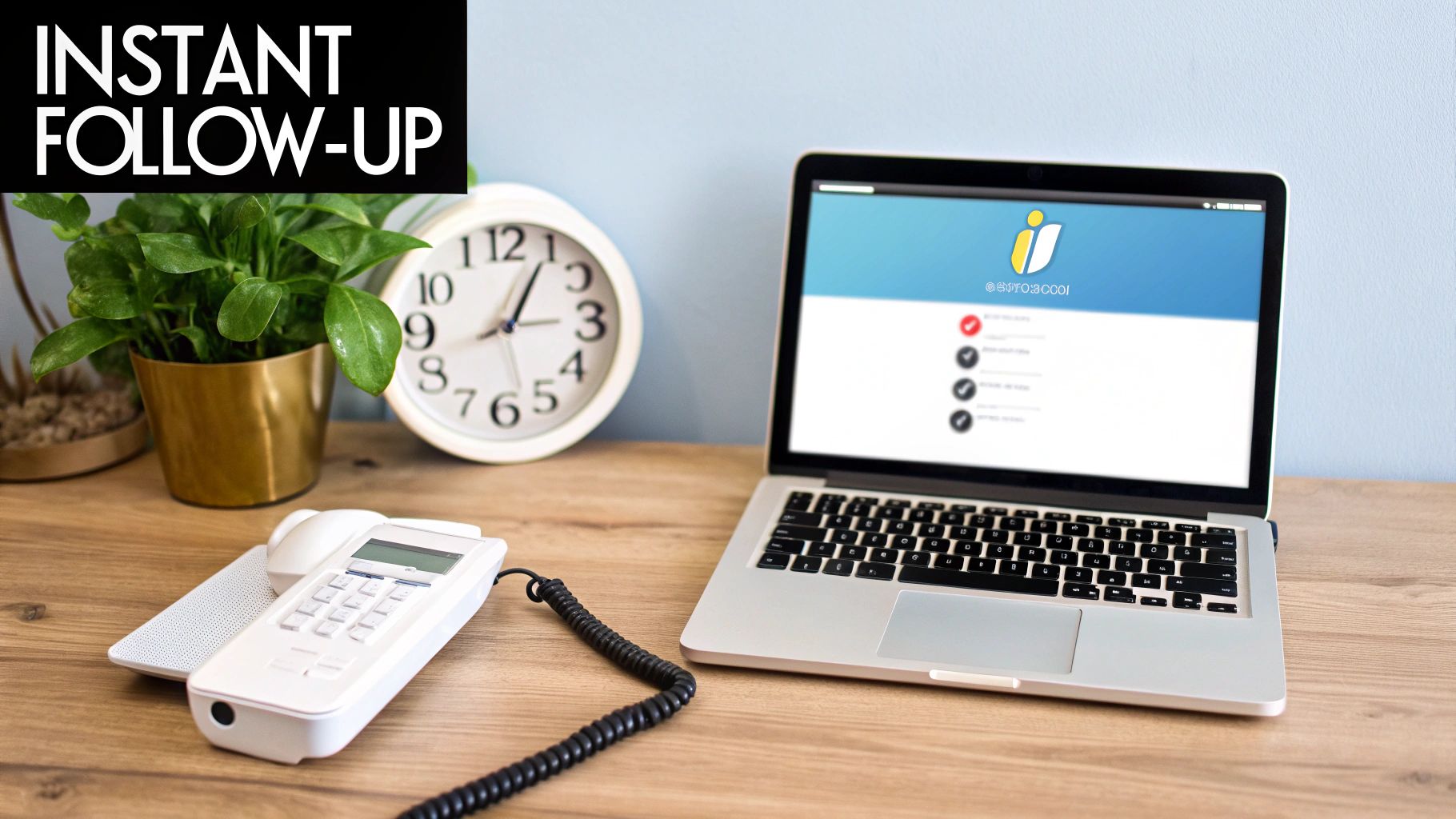
In real estate, the gap between a closed deal and a lost lead is often just a matter of minutes. The best agents get this. They're not just dabbling in real estate marketing automation; they're building their entire business strategy around it. It’s about creating a bulletproof system that delivers speed, consistency, and a personal touch—three things that are nearly impossible to juggle manually when you're busy.
The biggest win here is immediate response. The second a lead hits your website or a portal like Zillow, the clock starts ticking. We know that responding within the first five minutes dramatically boosts your chances of actually connecting with that person. Automation makes that instant follow-up possible every single time. It ensures every potential client gets a welcome text or email the moment they reach out, whether you're at a showing, in a meeting, or asleep.
This isn't just about being convenient; it’s a killer conversion strategy. By engaging leads right away, you grab their attention while their interest is red-hot. It stops them from simply clicking on the next agent in their search results and solidifies your position as their first call.
Reclaim Your Most Valuable Asset: Your Time
Beyond lightning-fast lead response, automation tackles the mountain of admin work that eats up an agent's day. Just think about all the hours you spend sending follow-up emails, scheduling appointments, posting to social media, or updating your CRM. Each task is important, but it's also pulling you away from the face-to-face activities that actually make you money.
Think of real estate marketing automation as a force multiplier for your time. Once you set up your workflows, the system takes over. You can:
- Nurture long-term leads with pre-scheduled market reports and casual check-in emails.
- Remind past clients of their "home-iversary" to stay top-of-mind for referrals.
- Schedule all your social media posts for the week or month in one go.
This simple shift can free up dozens of hours every month. That's time you can pour back into high-value work like hosting open houses, negotiating offers, networking, and giving clients the kind of service that builds a five-star reputation.
The numbers don't lie. For every dollar spent on marketing automation, companies see an average return of $5.44, and more than 80% of users generate more leads. For agents, having a CRM drives 41% better lead conversions—a huge advantage when 52% of leads are coming from social media. You can find more eye-opening marketing automation stats on Digital Silk.
Achieve Personalization At Scale
A common worry is that automation will make your communication sound robotic. But modern tools are built to do the exact opposite. They let you deliver incredibly personalized experiences to hundreds, or even thousands, of contacts at once—something you could never do by hand.
The key is segmentation. You can group your contacts based on who they are and what they need. For instance, you can create separate nurture campaigns for first-time homebuyers, luxury sellers, or investors.
This means you can automatically send out:
- Relevant Listings: New buyers see only the properties that fit their budget and desired neighborhood.
- Targeted Advice: Potential sellers get content on staging and market analysis, not articles about getting a mortgage.
- Customized Updates: Past clients receive neighborhood-specific news or home maintenance tips.
This level of detail builds serious trust and establishes you as the local expert. Instead of blasting out a generic newsletter, you’re delivering real value to every single person in your database. It’s a thoughtful approach that strengthens relationships and makes sure you're the first agent people think of when they're ready to make a move.
What's Under the Hood? Your Automation System's Key Parts
To get the most out of real estate marketing automation, it helps to know how it actually works. Think of your automation platform less like a single piece of software and more like a high-performance engine. Each component has a specific job, and when they all fire in sync, they create a powerful system that drives your business forward.
Let's pop the hood and look at the four essential parts. Understanding what each one does takes the mystery out of the technology and shows you exactly how it all connects to find, nurture, and convert leads into clients.
H3: The CRM: Your Central Hub
The heart of your entire automation setup is the Customer Relationship Management (CRM) system. This is your command center—the brain of the operation where every single piece of information about your contacts lives.
Think of it as your digital black book, but supercharged. It doesn't just store names and phone numbers; it tracks every interaction you have with a person. Every email they open, every link they click, every property they view on your website—it's all logged. This history gives you the context you need to make every other piece of automation feel personal and relevant.
In practical terms, this means you can pull up a contact and instantly see they’re a first-time buyer, have been searching in a specific neighborhood, looked at three of your listings online, and even downloaded your mortgage guide. That's the kind of intel that turns generic marketing into a meaningful conversation.
H3: Lead Capture Forms: The On-Ramps
If the CRM is your command center, then lead capture forms are the on-ramps. Their job is to pull new, interested people into your world from all corners of the internet—your website, social media, and portals like Zillow or Realtor.com.
Every time someone fills out a "What's My Home Worth?" or "Schedule a Showing" form, they're taking the on-ramp. That form instantly and automatically sends their details straight into your CRM, creating a new contact profile without you having to do a thing.
This instant connection is a game-changer. It closes the gap between someone showing interest and you following up. An automated system makes sure that the moment a lead raises their hand, they're immediately acknowledged and put on the right path.
This is how you turn your website from a passive digital brochure into an active, 24/7 lead-generating machine that constantly feeds your pipeline.
Before automation, many of these tasks were manual, time-consuming, and prone to error. An automated system transforms these repetitive chores into efficient, background processes that run on their own.
The table below shows a direct comparison of the old way versus the new, automated way.
Manual Tasks vs. Automated Workflows
| Manual Task | Automated Workflow Solution | Benefit |
|---|---|---|
| Manually entering new lead info from website forms into a spreadsheet. | A lead capture form automatically creates a new contact in the CRM. | Instant response, no data entry errors, and zero leads fall through the cracks. |
| Remembering to follow up with a new lead via email or text. | An automated welcome sequence sends a pre-written email and SMS instantly. | Consistent follow-up, builds immediate trust, and keeps you top-of-mind. |
| Sending out individual market updates or new listings to contacts. | An email campaign system sends personalized updates to segmented lists. | Saves hours of work, delivers relevant content, and nurtures hundreds of contacts at once. |
| Guessing which marketing efforts are actually working. | An analytics dashboard tracks email opens, click rates, and lead sources. | Data-driven decisions, allows you to double down on what works and fix what doesn't. |
As you can see, the shift isn't just about saving time—it's about creating a more reliable and effective system for growing your business.
H3: Email and SMS Sequences: Your Nurturing System
Once you have leads in your system, you need to stay in touch. That’s where email and SMS sequences come in. These are your automated communication lines, responsible for building relationships over time with perfectly timed messages.
These aren't just one-off email blasts. A sequence—often called a "drip campaign"—is a series of pre-written messages that go out automatically based on a set schedule or a specific action a lead takes.
For example, a new buyer lead could automatically kick off a sequence like this:
- Immediately: A welcome email hits their inbox while a friendly "hello" text hits their phone.
- Day 3: An email arrives with a helpful guide to the local area.
- Day 7: A text message checks in to see if they have any initial questions.
- Day 14: An email shares a few recent client success stories.
This system works tirelessly for you, building rapport and keeping you on their radar so no lead goes cold just because you got tied up with a closing.
H3: Analytics and Reporting: Your Dashboard
Finally, no engine is complete without a dashboard. In automation, your analytics and reporting tools serve that exact purpose. They give you a clear, real-time look at how everything is performing.
Your dashboard will show you the numbers that matter most:
- Email open and click-through rates: Are people actually reading your messages?
- Lead source performance: Is your money better spent on Facebook ads or Zillow leads?
- Campaign conversion rates: How many people from your open house campaign actually scheduled a private showing?
By keeping an eye on these insights, you can see exactly what's working and what's not. It lets you make smart, data-backed decisions to tune up your messaging, adjust your strategy, and get the best possible results from your marketing efforts. You stop guessing and start knowing.
Building Your First Lead Nurturing Campaign
Alright, let's move from theory to action. This is where real estate marketing automation stops being just an idea and becomes a real, hardworking system that brings in business for you, even while you sleep. We're going to build your very first automated campaign from the ground up, focusing on a classic scenario: a new lead fills out a property inquiry form on your website.
Think of it like setting up a row of dominoes. The lead filling out the form is the first push, and a perfectly planned sequence of messages follows, each one gently nudging that person closer to a real conversation with you.
This simple flow is the core of it all: a new lead comes in, gets organized in your CRM, and then starts receiving a series of helpful, automated messages.
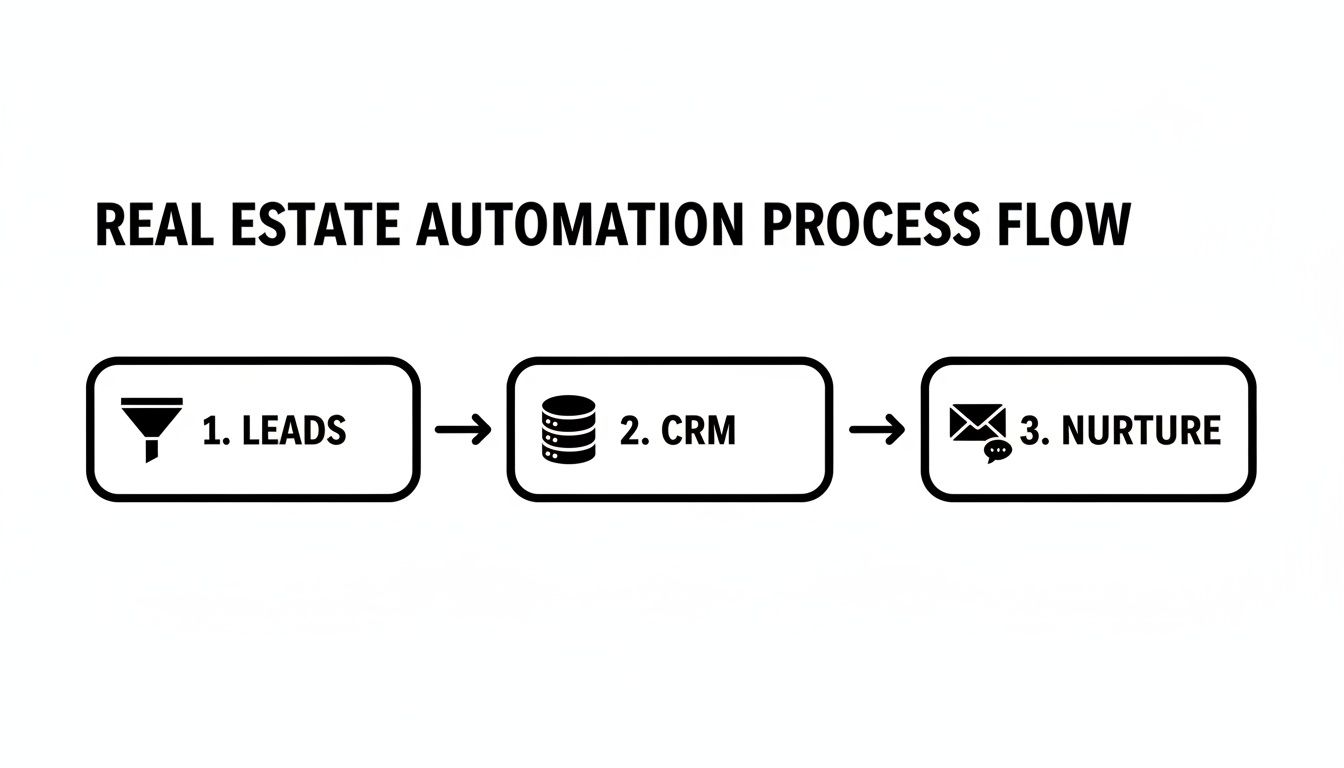
This three-part process ensures no lead ever slips through the cracks. It's simple, but it's powerful.
Step 1: Define a Clear Goal
Before you write a single word, you have to know what you're trying to accomplish. A campaign without a clear goal is like driving without a destination—you'll burn a lot of gas but never really get anywhere. Be specific and focus on moving the lead to the next logical step.
For someone inquiring about a property, an excellent goal is to book a showing or schedule a 15-minute introductory call. That's it. It’s a tangible outcome that your entire sequence will be built around. Every email and text you send should subtly guide the prospect toward taking that one action.
Step 2: Choose Your Trigger
The "trigger" is just what it sounds like—it’s the event that kicks off your automated sequence. It’s the starting gun. For this scenario, the trigger is one of the most common and effective ones you'll have.
The Trigger: A prospect completes and submits the "Request More Info" or "Schedule a Tour" form on one of your website’s property listing pages.
This is your bread and butter for new buyer leads. The second they hit "submit," your automation platform gets the signal to start. This immediate response is non-negotiable. Studies have shown that getting back to a lead within five minutes makes you 100 times more likely to actually connect with them.
Step 3: Map Your Workflow
Now it’s time to design the journey. This is the blueprint for your campaign, outlining what happens and when. A solid workflow for a new property inquiry should be a "multi-touch" campaign, mixing both email and SMS to stay top-of-mind without being annoying.
Here’s what a simple 7-day workflow could look like:
Instantly (0 minutes after submission):
- Action: Send an automated SMS and a welcome email.
- Why: You instantly confirm you received their request, making you look incredibly responsive and professional.
Day 2:
- Action: Send an email showcasing similar properties.
- Why: You're providing immediate value based on what they've already told you they like. It shows you're paying attention.
Day 4:
- Action: Send a short, personal-sounding text message.
- Why: It’s a casual check-in that feels less corporate than email. A simple, "Any questions so far?" can go a long way.
Day 7:
- Action: Send an email with a client testimonial or a guide to the local neighborhood.
- Why: You're building trust and positioning yourself as the local expert, not just an agent trying to sell one specific house.
Step 4: Craft Compelling Content
Your messages have to sound like they came from a human, not a robot. The trick is to write in a helpful, authentic voice and use personalization tokens—like [First Name] and [Property Address]—to make every message feel personal.
Feel free to adapt these templates:
Initial SMS (Instant):
- "Hi
[First Name], this is[Your Name]. Thanks for your interest in[Property Address]! Just confirming I got your request. I'll send more details to your email in a sec. Are you free for a quick chat later today?"
- "Hi
Initial Email (Instant):
- Subject: Info on
[Property Address] - "Hi
[First Name], thanks for reaching out about the property at[Property Address]. You can find all the listing details here:[Link to Listing]. Would you be interested in a private tour this week? Feel free to book a time directly on my calendar here:[Link to Your Calendar]."
- Subject: Info on
Day 4 SMS:
- "Hey
[First Name], just checking in. Any questions so far about the home buying process in[City/Neighborhood]? Happy to help. -[Your Name]"
- "Hey
For more inspiration, dive into our complete guide on email marketing for real estate, which is full of proven strategies and examples.
Step 5: Activate and Monitor
You've got your goal, your trigger, your workflow, and your content. The last step is to plug it all into your automation tool and flip the switch. Most platforms have visual builders that make this pretty straightforward.
Once your campaign is live, the job isn't quite done. You need to watch its performance. Keep an eye on your analytics dashboard. Are people opening your emails? Are they clicking the links? Most importantly, how many are actually booking that call or showing? This data is gold—it tells you exactly what’s working and what you need to tweak to get even better results over time.
How to Choose The Right Real Estate Automation Software
Diving into real estate marketing automation means picking the right software to act as your central hub. With a sea of options out there, it's easy to feel overwhelmed. The trick is to look past the slick marketing and zero in on what will actually help you run and grow your business.
Think of it like buying a new car. You wouldn't just grab the fastest one on the lot. You'd think about gas mileage, how many people you need to fit, and whether it’s reliable. In the same way, the perfect automation software depends entirely on your specific needs, your team's size, how tech-savvy you are, and your budget.
This isn't just a niche market anymore; it's exploding. The industry is projected to leap from USD 1.12 billion to a staggering USD 4.26 billion by 2034. This surge is fueled by powerful AI tools that get real results—just look at Salesforce's Agentforce, which helped agents cut their lead qualification time by 40%. You can dig into the market trends and key players over at market.us.
Core Features to Look For
Not all automation platforms are built the same, especially when it comes to real estate. To make sure you're getting a tool that understands your world, there are a few features that should be non-negotiable. These are the things that separate a "nice-to-have" gadget from an indispensable part of your business.
Here's what should be on your checklist:
- A Real Estate-Specific CRM: A generic CRM just doesn’t understand your business. You need a system built to track properties, manage complex transaction pipelines, and handle the unique nature of client relationships in this industry. Our guide on the best CRM for real estate teams dives deeper into what you should demand from your CRM.
- MLS/IDX Integration: This one is absolutely critical. Your software must be able to pull property data directly from your MLS. This is what powers automated new listing alerts, creates up-to-date market reports, and makes your website’s property search functional.
- Lead Source Integration: Your system needs to talk to everything. It has to connect seamlessly with Zillow, Realtor.com, your website forms, and social media ads to capture every single lead the moment it comes in. No more manual data entry.
- Email and SMS Marketing: Look for a powerful campaign builder. You need the ability to create automated drip sequences, personalize messages with client data, and segment your lists so you're always sending the right message to the right person at the right time.
Evaluating Usability and Scalability
Let's be honest: a powerful tool you can't figure out how to use is just an expensive paperweight. When you’re watching a demo or doing a trial, pay close attention to the user interface. Is it intuitive? Can you map out a simple workflow without feeling like you need a degree in computer science? The whole point is to save time, not create a new full-time job managing software.
Ask yourself this simple question: "Can I see my team and me actually using this every single day?" If the gut answer is no, walk away, no matter how impressive the feature list is.
Just as important is scalability. Your business is going to grow, and your software has to be able to keep up. Ask vendors how their platform handles more agents, larger contact lists, and increasingly complex marketing campaigns. The system that's perfect for you as a solo agent should have a clear, painless path to support a bustling brokerage later on. Exploring the best AI workflow automation tools can give you a head start in shortlisting platforms that are known to scale effectively.
Got Questions About Real Estate Automation? You're Not Alone.
Jumping into the world of real estate marketing automation can feel like a big step. It’s totally normal to have questions and maybe even a few doubts. After all, your business is built on relationships, so the idea of handing tasks over to a machine can feel a bit off.
But here’s the thing: modern automation isn’t about creating distance. It’s about creating efficiency so you have more time for the personal connections that actually close deals. Let's break down some of the most common questions agents have when they're thinking about making this shift.
Will Automation Make Me Sound Like a Robot?
This is easily the number one concern, and for good reason. The great news? Good automation does the complete opposite. It’s not here to replace your voice; it’s here to make sure that voice gets heard by the right people at the right time, every time.
Think of it less like a robot and more like a brilliant assistant. Instead of a generic, one-size-fits-all email, automation uses personalization tokens. These are just little placeholders like [First Name], [City], or [Property Address] that instantly tailor a message to each person. Your pre-written email can sound just as warm and personal as one you typed out on the spot.
The smartest approach is a hybrid one.
- Automate the first touch: Let your system handle the immediate follow-up the second a new lead comes in.
- Automate the info drip: Send out property alerts, market reports, and helpful guides without lifting a finger.
- Jump in when it matters: Your system can flag a lead who is showing serious interest—like viewing the same property three times. That’s your cue to pick up the phone or send a personal text.
The goal is to automate the predictable so you can personalize the pivotal moments. You're not replacing human connection; you're scaling it.
What's This Going to Cost Me?
The price of automation software varies quite a bit, which is actually a good thing. It means there are options for everyone, from solo agents just starting out to large, multi-office brokerages. There’s no single sticker price because the cost usually hinges on a few key factors.
Here’s what typically influences the price:
- Number of Contacts: Most platforms charge based on the size of your database. A list with 500 contacts will cost less than one with 10,000.
- Number of Users: The price often goes up with each agent on your team who needs their own login.
- Features You Need: A basic plan might just cover email campaigns, while premium tiers will roll in an advanced CRM, SMS marketing, and powerful analytics.
You can find some solid entry-level tools starting around $50 per month for an individual agent. At the other end of the spectrum, a comprehensive, all-in-one system for a large team could run several hundred dollars or more each month. When you're looking at the cost, the most important thing is to think about the return on investment (ROI). When you consider the time saved and the documented lift in lead conversion, the right platform usually pays for itself many times over.
How Long Does It Take to Get an Automation System Running?
The thought of a long, tech-heavy setup is enough to make any busy agent run for the hills. Thankfully, getting an automation system up and running is often much faster than you’d imagine, especially with today's more intuitive platforms.
The exact timeline really depends on the complexity of the software and how comfortable you are with new tech. But for most systems built specifically for real estate, you can realistically have the core functions working for you within a week.
That initial setup usually just involves a few key steps:
- Importing your contacts from your current spreadsheet or CRM.
- Connecting your lead sources, like your website’s contact form or your Zillow account.
- Turning on pre-built campaigns, like a welcome email series for new buyer leads.
Sure, mastering the more advanced stuff—like building a complex, custom workflow from scratch—might take a bit more time. But the key is to not get overwhelmed. Start simple. Automate just one thing first, like your new website lead follow-up. Once you see it working, you'll gain the confidence to build from there.
Can This Connect to My Zillow and Realtor.com Leads?
Yes, and honestly, it has to. This is one of the most vital features any real estate automation platform can offer. Any system worth considering is built to plug directly into the major lead portals where you’re already spending your money.
Seamless integration is the whole point. The best platforms connect with dozens of sources, including Zillow, Realtor.com, Trulia, and your own IDX website. This usually works in one of two ways: either a direct API connection or through something called email parsing, where the system can literally read the lead notification emails and pull out the contact details automatically.
This is the magic that makes instant follow-up a reality. It completely eliminates that soul-crushing task of manually copying and pasting lead info into your CRM. More importantly, it ensures every single prospect gets a response and is added to a nurture campaign the moment they reach out. In the race to convert expensive portal leads, that speed is your biggest competitive advantage.
Ready to stop guessing and start knowing? Saleswise gives you the tools to create lightning-fast, highly accurate CMAs in about 30 seconds, so you can answer the toughest pricing questions with confidence. Pair that with AI-powered content creation for emails, social posts, and listing descriptions to automate your marketing and win more business. Try it today and see how powerful your expertise can be.
Explore what you can do at https://www.saleswise.ai.