Best Real Estate Marketing Tools: The Essential Toolkit
The best real estate marketing tools don't work in isolation. They form a powerful trio: a smart AI-powered platform, a rock-solid CRM, and eye-catching visual marketing software. When these pieces work together, they create a system that handles the grunt work, adds a personal touch to your outreach, and frees you up to do what you do best—build relationships and close deals.
The Modern Agent's Guide to Smarter Marketing
Trying to keep up with client demands while managing all your marketing efforts can feel like you're constantly spinning plates. With a million different apps and platforms out there, it's easy to end up with a messy, disconnected toolkit that actually creates more work. This guide is designed to cut through that noise.
We're going to show you how to build a marketing engine that works for you, not against you. Forget about standalone apps that don’t talk to each other.
The goal isn't just to find tools; it's to build a system. An effective marketing engine automates the tedious work so you can focus on the high-value, human-centric parts of your business.
Building a Cohesive System
Picture this: a new lead comes in. It's automatically logged in your CRM, and right away, your AI assistant starts sending personalized follow-up content. At the same time, that same AI is helping you whip up a beautiful Comparative Market Analysis (CMA) and a week's worth of social media posts for your newest listing—all in a matter of minutes.
That kind of seamless integration isn't just a nice-to-have anymore; it's what top agents are using to stay ahead of the curve. Think of this guide as your roadmap. We'll cover:
- AI-Powered Platforms: Tools like Saleswise that can handle everything from deep data analysis to content creation and even virtual staging.
- Essential Core Tools: The must-have CRMs and visual marketing software that are the foundation of any successful real estate business.
- Strategic Integration: The real magic is in getting these tools to communicate, creating an automated workflow that saves you serious time.
This is your plan for building a smarter, more profitable business that gives you back your most valuable asset: your time.
How AI Is Transforming Real Estate Marketing
Artificial intelligence isn't some far-off concept anymore; for top-producing agents, it’s become an essential partner. Think about it this way: trying to run your marketing without AI is like using a paper map to get around a busy city. Sure, you might get there eventually, but you’ll be slow and stressed.
Using AI is like having a real-time GPS that spots traffic jams, finds clever shortcuts, and gives you clear turn-by-turn directions. It doesn't replace your expertise as an agent. Instead, it amplifies it by automating the tedious, time-sucking tasks, freeing you up to focus on the high-value activities that actually close deals.
From Hours to Seconds: The AI Advantage
Can you imagine putting together a comprehensive Comparative Market Analysis (CMA) in the time it takes to grab a cup of coffee? It’s not a fantasy. Platforms built specifically for real estate, like Saleswise, can crunch the numbers and produce a detailed, data-rich CMA in under a minute. That’s a job that could easily eat up an entire afternoon doing it the old-fashioned way.
This isn't just about saving time; it's about gaining a serious competitive edge. You can respond to a client's request almost instantly, showing up looking prepared and professional while other agents are still stuck digging through comps.
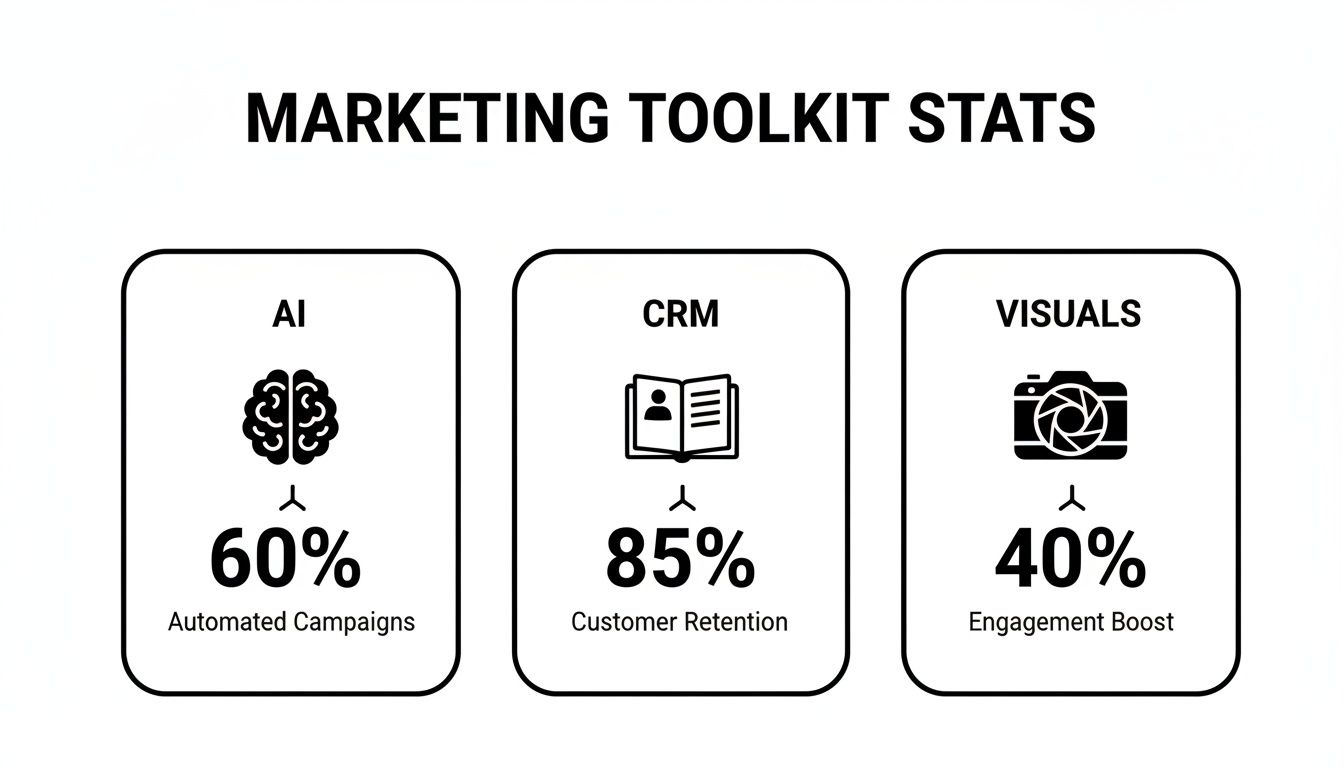
This visual really drives home how modern agents need a toolkit where AI provides the intelligence, a CRM manages the relationships, and great visuals grab everyone's attention.
Making Smarter Decisions and Creating Better Content
The real magic of AI goes beyond just speed. It’s in its ability to process mountains of data to help you create marketing materials that are both insightful and incredibly personal.
- Hyper-Personalized Outreach: AI can help you draft emails to clients that mention specific property features, recent neighborhood sales, and even their personal interests you’ve noted.
- Expert-Level Content: Imagine generating compelling listing descriptions, social media captions, or property flyers that sound like they were written by a top agent. That's because the AI is trained on their communication styles.
- Market Analysis on Demand: You can tap into live market data to fine-tune your pricing strategies and advise clients with the confidence that comes from being backed by up-to-the-minute trends.
Agents are catching on fast. A recent survey found that 46% of REALTORS® already use AI for things like writing listing descriptions, and 20% are using these tools every single day. The shift is massive: 85% of agents now report using AI in their business regularly, and it's paying off. 17% have seen a significant positive boost to their bottom line because of it.
AI marketing tools don't just do the work for you; they do it with a level of data-driven precision that's nearly impossible to replicate manually, giving you a powerful strategic advantage.
If you’re ready to see how these tools can fit into your business, our guide on https://www.saleswise.ai/blog/ai-tools-for-real-estate-agents is a fantastic place to start.
Beyond Text: The Visual Revolution
AI is also a game-changer for visual marketing. One of the most powerful examples is AI-powered virtual staging. We all know an empty room can feel cold and sterile, making it tough for buyers to see themselves living there.
With a tool like Saleswise, you can instantly furnish that empty space or even show what a virtual remodel could look like. This makes listings pop online and helps buyers form an emotional connection with a home before they even set foot inside. To get a better sense of how AI is shaking up the creative world, check out this list of the 12 best AI tools for content creators. You'll find plenty of ideas you can adapt for your own real estate business.
The 4 Essential Marketing Tools Every Agent Needs
Building a powerhouse marketing operation isn't about finding a single "magic bullet" tool. It’s about assembling a core toolkit—what we call a marketing stack—where every piece has a specific job.
Think of it like building a house. You can't skip the foundation (your CRM) or the electrical wiring (your email automation) and expect the structure to hold up. Each part is critical. These tools are the absolute non-negotiables for any agent who's serious about growth in today's market.
The real magic happens when they work together, creating a smooth system that captures, nurtures, and converts leads while you're out there closing deals.
To help you visualize this, here's a breakdown of the core categories.
Essential Real Estate Marketing Tool Categories
| Tool Category | Primary Function | Key Features | Top Examples |
|---|---|---|---|
| CRM | Manages all client relationships and interactions in one central place. | Contact management, sales pipeline, task automation, reporting. | Top Producer, Follow Up Boss, LionDesk |
| Social Media Scheduler | Plans and automates social media content across multiple platforms. | Content calendar, post scheduling, performance analytics, bulk uploading. | Buffer, Hootsuite, Later |
| Email Marketing Platform | Nurtures leads and stays in touch with past clients through automated campaigns. | Email templates, drip campaigns, audience segmentation, analytics. | Mailchimp, Constant Contact, Flodesk |
| Lead Generation Service | Attracts new buyer and seller leads to fill your pipeline. | Ad management, landing pages, lead capture forms, portal integration. | Zillow Premier Agent, BoldLeads, SmartZip |
Each of these categories addresses a different—but equally vital—part of your marketing workflow. Let's dig into why each one is so important.
1. Customer Relationship Management (CRM): The Central Hub
Your CRM is the heart of your entire business, period. It's so much more than a digital address book; it’s the command center that tracks every call, email, and milestone with your clients and leads. Trying to run a business from memory and sticky notes is a recipe for disaster.
A great real estate CRM will:
- Organize Your Contacts: Easily segment your database into buyers, sellers, past clients, and prospects so you can send them relevant information.
- Track Key Interactions: Log every conversation so you know exactly where a relationship stands before you even pick up the phone.
- Automate Follow-Ups: Set reminders and trigger automated check-ins so no lead ever falls through the cracks again.
For example, a CRM like Top Producer helps you systematically farm a neighborhood, turning a list of addresses into genuine relationships and future listings. This is how you build a predictable, scalable business instead of just lurching from one deal to the next.
2. Social Media Schedulers: Your Consistency Engine
Staying top-of-mind means showing up consistently on social media. But who has time to manually post content every single day across Facebook, Instagram, and LinkedIn? This is precisely why social media schedulers are a game-changer.
These platforms let you sit down once and schedule a week's—or even a month's—worth of posts in a single session. You can batch your creative work and then let the tool handle the rest, ensuring a steady stream of valuable content goes out while you're busy with clients.
3. Email Marketing Platforms: Your Nurturing Assistant
While social media is for casting a wide net, email is where you build real trust. An email marketing platform is your secret weapon for creating personal connections at scale, making sure the right message gets to the right person at exactly the right time.
A well-crafted email drip campaign can nurture a new lead for weeks on autopilot. It provides value, builds your authority, and keeps you front and center—all without you lifting a finger. It’s like having a virtual assistant working 24/7.
Think about it: a new lead signs up on your website. Your email platform immediately kicks off a "welcome series" that introduces you, offers a free home valuation, and shares helpful blog posts. This automated follow-up is absolutely critical for converting online leads who aren't quite ready to transact today.
4. Lead Generation Services: The Fuel for Your Pipeline
Finally, every business needs fuel. Lead generation services are designed to do one thing: deliver a consistent flow of new buyer and seller opportunities right into your pipeline. This category is broad, covering everything from advertising on major portals like Zillow to more specialized tools that find off-market deals.
This is where all your tools come together to create a powerful, automated machine.
Imagine this seamless workflow:
- A potential buyer clicks your ad on a lead generation site.
- Their info is automatically zapped into your CRM.
- The CRM instantly tags them as a "new buyer lead" and tells your email marketing platform to launch that welcome sequence.
- All the while, your social media scheduler is pushing out content that reinforces your expertise, making you look like the go-to agent in your market.
See how that works? You’ve just transformed four separate apps into an interconnected system that turns strangers into clients.
Mastering Visual and Video Marketing
Let's be blunt: in today's market, a picture isn't just worth a thousand words—it's worth thousands of dollars on the final sale price. Visuals have gone from a "nice-to-have" to your single most powerful sales tool. High-quality images and video are the currency of online real estate. They directly translate into more clicks, deeper engagement, and, ultimately, more serious buyers knocking on the door.
The numbers don't lie. Listings that feature a compelling video can pull in a staggering 403% more inquiries than listings that rely on photos alone. That's not just a small bump; it's a massive signal that buyer expectations have fundamentally changed. People want to experience a home before they ever set foot inside, and video is what makes that possible. It's why 73% of homeowners now say they are more likely to list with an agent who uses video.

Beyond Standard Photography
Look, professional photos are the absolute baseline. They're table stakes. But the agents who are truly winning are pushing the envelope with more dynamic visual assets. These tools don't just show a property; they tell its story and sell a lifestyle.
- Drone Footage: There’s no better way to show a property’s context. Aerial shots reveal the home’s relationship to the neighborhood, highlight nearby parks or amenities, and showcase the scale of the lot in a way ground-level photos never could.
- 3D Virtual Tours: Tools like Matterport empower potential buyers to "walk" through a home from their own couch, anytime. This isn't just a novelty; it's a powerful filter. You attract highly qualified leads who have already decided the layout works for them, saving everyone time.
- Video Walkthroughs: A simple, well-shot video tour guided by you, the agent, adds a crucial personal touch. It’s your chance to point out the custom millwork or the morning sun that pours into the kitchen—details that create an emotional connection static images can't.
Think of it this way: the modern homebuyer's journey starts online. If your listing doesn't immediately grab them with stunning visuals, they're gone. They just scroll right past. Your first showing is now a digital one.
The Power of Virtual Staging
One of the toughest marketing challenges? The empty room. A vacant property often feels cold, sterile, and smaller than it really is. It forces buyers to do all the imaginative heavy lifting, and many just can't see the potential. This is where AI-powered virtual staging becomes an absolute game-changer in your marketing toolkit.
Physical staging is a logistical headache—it's expensive, takes a lot of time, and requires a ton of coordination. Virtual staging, on the other hand, is a cost-effective and nearly instant solution. With a platform like Saleswise, you can snap a photo of a vacant living room and, within moments, digitally furnish it with stylish, modern pieces that resonate with today’s buyers. You can even show off multiple styles to help a wider audience connect with the space.
This technology does more than just fill a room; it helps buyers get over mental hurdles. They no longer have to guess if their king-sized bed will fit or how they'd arrange furniture in an oddly shaped room. You can actually show them the possibilities, turning a "maybe" into a "must-see." If you want to dive deeper into this, this complete guide to virtual staging for estate agents is a great resource. You can also see how different tools stack up in our guide on the best virtual home staging software.
By weaving these advanced visual and video tools into your strategy, you’re creating a marketing package that doesn't just meet buyer expectations—it blows them away. You’re no longer just selling a house; you’re selling a vision. And that approach leads to faster sales, higher offers, and a reputation as an agent who gets it.
Choosing the Right Tools for Your Business
The market is absolutely flooded with software and apps, each one screaming that it’s the magic bullet for your real estate business. It’s easy to get overwhelmed by the hype and even easier to waste money on tech that ends up gathering digital dust.
So, how do you pick the winners without breaking the bank? The secret is to stop thinking about buying gadgets and start thinking about building a custom toolkit.
Instead of chasing the newest shiny object, take a step back and look at your own business. Where are your biggest time-sucks? What are the most frustrating bottlenecks in your day? Are you spending hours pulling comps for CMAs? Drowning in follow-up emails? Struggling to make your social media content look professional?
Your pain points are your roadmap. They tell you exactly which problems you need technology to solve.
Start With Budget and ROI
For most agents, the budget is the first and most important filter. But remember, a cheap tool that doesn't deliver results isn't a good deal—it's just cheap. The real goal is to find affordable, high-impact solutions that give you a clear return on investment (ROI). You should be able to draw a straight line from what you pay each month to the time it saves you or the business it brings in.
Think about it this way: if a platform like Saleswise costs $39 per month but saves you ten hours of administrative work, what’s that time really worth to you? If you can use those ten hours to show one extra property or make five more prospecting calls, the tool has paid for itself many times over.
Look for platforms that bundle multiple features together. An all-in-one tool that handles your CMAs, content creation, and virtual staging offers way more value than paying for three separate services. This keeps your costs down and your workflow simple.
Prioritize Simplicity and Ease of Use
The most powerful software in the world is completely useless if you can't figure out how to work it. A steep learning curve is a hidden cost, eating up valuable time you should be spending with clients, not watching tutorials. Look for tools with an intuitive feel and a setup process that doesn't require a computer science degree.
The best real estate marketing tools don't require you to be a tech wizard. They should feel like a natural extension of your workflow, making your job easier from day one, not adding another complicated system you have to learn.
Always take advantage of free trials before you commit. Spend a week actually using the software. Can you generate a report easily? Is the main dashboard clean and easy to understand? If you find yourself constantly clicking the "help" button for basic tasks, it’s probably not the right fit.
Before you invest your time and money, it's smart to run any potential tool through a simple evaluation checklist. This helps you stay objective and focus on what truly matters for your business.
Here are the key questions you should be asking.
Your Marketing Tool Evaluation Checklist
| Evaluation Criteria | Key Question to Ask | Why It Matters |
|---|---|---|
| Problem-Solving | Does this tool solve a specific, recurring problem I have right now? | A tool should be a painkiller, not a vitamin. It needs to fix a real issue to be worth the investment. |
| Ease of Use | Can I figure out the basics within the first 30 minutes of the free trial? | If it's not intuitive, you won't use it. A steep learning curve is a productivity killer. |
| Return on Investment (ROI) | Can I clearly see how this will either save me time or make me money? | Every dollar spent on tech should have a measurable return, whether it's in hours saved or leads generated. |
| Integration | Does this tool connect easily with the other systems I already rely on (like my CRM)? | A well-integrated toolkit automates your workflow. Isolated tools just create more manual data entry. |
| Scalability | Will this tool still work for me if I hire an assistant or grow my team in the next year? | You want tools that can grow with your success, not ones you'll have to replace in 12 months. |
| Support | If I run into a problem, how easy is it to get help from a real person? | Good customer support is non-negotiable. When you're on a deadline, you can't afford to wait days for an email reply. |
This checklist isn't about finding a "perfect" tool—it's about finding the right tool for you, right now. A quick evaluation can save you from a lot of frustration and wasted money down the road.
Ensure Seamless Integration
Your marketing tools shouldn't be a bunch of separate islands. They need to talk to each other to create a smooth, automated system. This is what integration is all about, and it’s what separates a decent toolkit from a truly great one.
Here’s what that looks like in the real world:
- A new lead fills out a form on your website. That info should automatically pop up in your CRM.
- Your CRM should then be able to automatically trigger a welcome email sequence from your email marketing platform.
- All of this happens in the background, without you lifting a finger for manual data entry.
When you're looking at a new tool, always check its list of integrations. Does it play nicely with the CRM you already love? Can it connect to your social media accounts? A well-integrated system plugs the leaks in your funnel and ensures no lead ever falls through the cracks.
Plan for Scalability
Finally, try to choose tools that can grow with you. The software that’s perfect for you as a solo agent should also be able to support you when you hire an assistant or build out a team. Scalability simply means the platform can handle more volume and complexity without slowing down or breaking.
Ask yourself these questions:
- Can I add new users easily if my team expands?
- Does the pricing make sense as my business grows, or will it become outrageously expensive?
- Will the features still meet my needs a year or two from now?
Investing in a scalable platform from day one saves you from the massive headache of having to switch everything over to a new system later. It’s all about thinking ahead and building a tech foundation that’s ready for your future success.
Building Your Integrated Marketing System
This is where everything clicks. We've talked about individual tools, but now it's time to assemble them into a cohesive, automated system that works for you 24/7. An integrated system isn't just a random collection of apps; it’s a strategic workflow where each tool passes the baton to the next, creating a seamless productivity chain.
Think of it like an orchestra. A single violin or cello can sound beautiful on its own. But when you bring all the instruments together under a skilled conductor, you get a powerful symphony. In this case, your CRM, AI platform, and visual marketing software are the instruments, and your marketing strategy is the conductor.
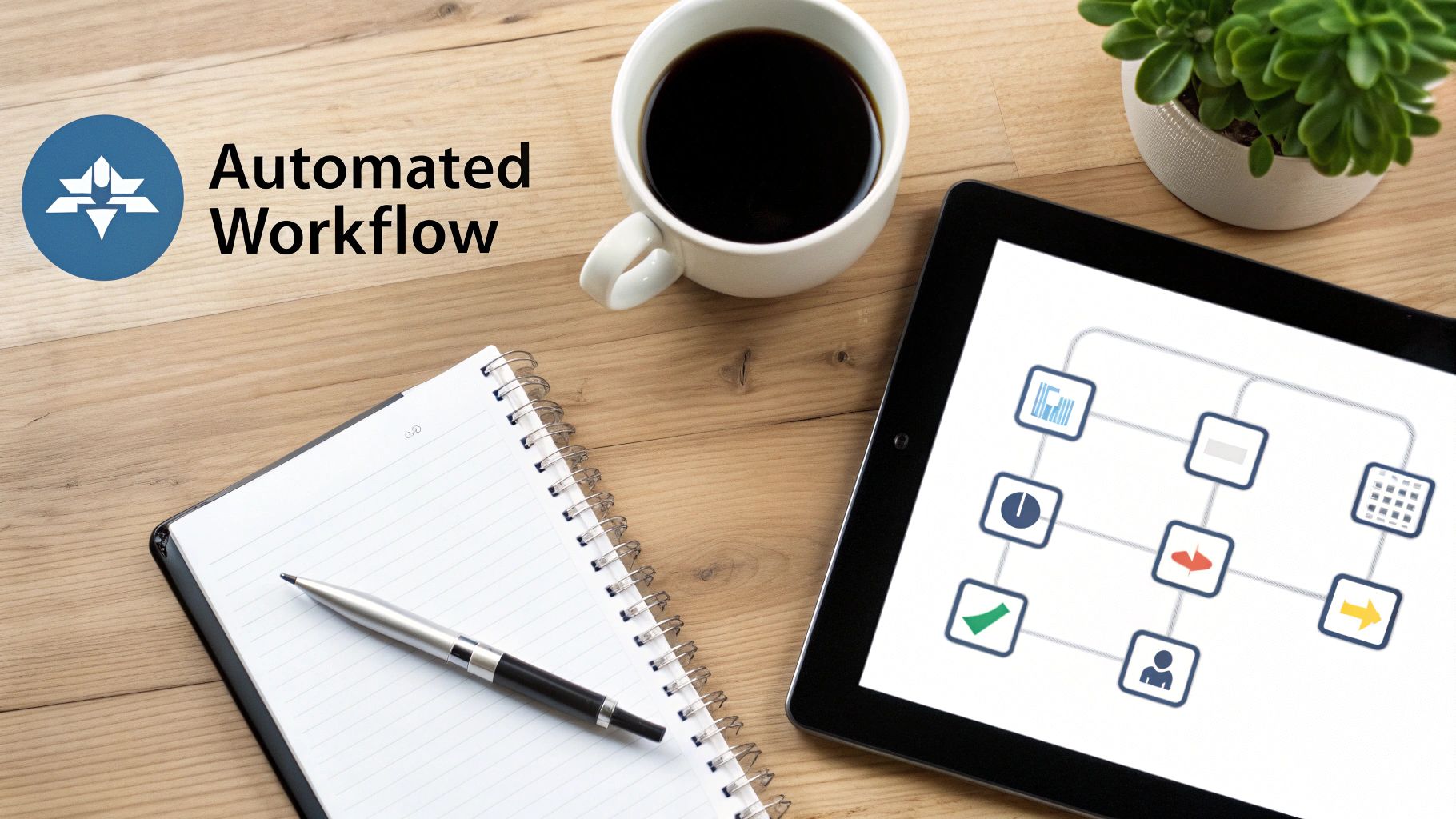
A Real-World Workflow Example
Let’s walk through a common scenario to see exactly how this integration plays out.
- A new seller lead fills out a form on your website, which automatically populates their info into your CRM.
- That entry instantly triggers a task in your calendar, reminding you to make a follow-up call.
- You then jump into an AI tool like Saleswise to generate a data-rich CMA, a compelling listing description, and stunning virtual staging photos—all in just a few minutes.
- With a couple more clicks, a full week's worth of social media posts promoting the new listing are drafted and scheduled.
This entire sequence condenses hours of tedious manual work into a few minutes of high-impact activity. The technology handles all the heavy lifting, from crunching numbers to creating content, freeing you up to focus on what matters most: the client relationship. You can dive deeper into creating these kinds of workflows in our guide to real estate marketing automation.
The takeaway is clear: the goal is not just to use technology, but to orchestrate it. By strategically connecting the right tools, you can reclaim your time, deliver an exceptional client experience, and build a more profitable and sustainable business.
This approach stops you from becoming the bottleneck in your own business. Instead of drowning in administrative tasks, you’re free to prospect, negotiate, and close deals. The result is a business that runs like a well-oiled machine and grows predictably, even when you aren’t personally pushing every button. It’s the definition of working smarter, not harder.
Your Questions, Answered
Jumping into real estate tech can feel overwhelming, and it's natural to have questions. Let's tackle some of the most common ones agents ask when they're looking to gear up with the right marketing tools.
What Are the Must-Have Marketing Tools for a New Agent?
If you're just starting out, your goal should be to build a simple, solid foundation. Don't get bogged down with a dozen different apps. At a bare minimum, you'll want to focus on three core pieces: a good CRM to keep your contacts organized, an email marketing platform to nurture leads, and a social media scheduler to stay consistent online.
But if you want a real edge right out of the gate, look into an AI-powered platform like Saleswise. Think of it as having a veteran agent guiding you from day one. It helps you instantly create expert-level CMAs, sharp listing descriptions, and professional marketing materials, which saves a massive amount of time and puts you on equal footing with more experienced pros.
How Much Should I Expect to Spend on These Tools?
You really don't have to break the bank to build a great tech stack. Most successful agents find that spending between $100 and $300 per month on their core tools is the sweet spot. What's more important than the total cost, though, is the return you're getting on that money.
The smartest way to budget is to focus on tools with a high ROI. An all-in-one platform that handles multiple jobs—like AI content writing, CMA generation, and virtual staging—gives you far more bang for your buck than juggling a bunch of separate subscriptions. Start lean and add more as your business grows.
This way, every dollar you spend is actively saving you time or making you money. Your tech becomes a profit driver, not just another line item on your expense sheet.
Are AI Marketing Tools Going to Make My Job Redundant?
Not a chance. It's much more helpful to think of AI as your most capable assistant, not your replacement. AI is fantastic at crunching data and knocking out repetitive, time-sucking tasks, which frees you up to do what only a human can do.
AI takes care of the grunt work so you can double down on:
- Building real relationships and trust with clients.
- Offering nuanced advice that comes from your deep local knowledge.
- Navigating tricky negotiations with a human touch.
The top agents are already using AI to automate up to 80% of their admin and content creation work. This lets them pour their energy into the high-value, relationship-focused activities that actually close deals and solidify their reputation as the go-to expert.
Ready to see how an AI-powered platform can reshape your workflow? Saleswise delivers lightning-fast CMAs, instant virtual staging, and expert-level marketing content in seconds. Start your $1 trial today at https://www.saleswise.ai.