Email Marketing Real Estate Your Guide to Converting More Leads
In the world of real estate, where relationships are everything, email marketing stands out. It's not just about sending out mass updates; it's a powerful, cost-effective way to build connections, stay top-of-mind, and guide leads from casual interest to a closed deal. Think of it as your digital handshake—a direct line to send valuable insights, property news, and market reports right to the people who matter most.
Why Email Is Your Most Powerful Real Estate Marketing Tool
It’s easy to get distracted by the latest social media craze, but remember this: you don't own your followers. Algorithms change, and platforms come and go. Your email list, on the other hand, is a business asset that you completely own and control. It’s your private communication channel to prospects, past clients, and your entire sphere of influence.
The goal here isn't just broadcasting new listings. It’s about cultivating trust. Every email is a chance to have a 'digital coffee' with your contacts—a way to share your expertise, answer questions they haven't even thought of yet, and prove your value long before they’re ready to buy or sell. This steady drip of value-packed communication is what turns a cold lead into a warm, trusting client.
The Unmatched ROI of Real Estate Email Marketing
Let's talk numbers, because the financial upside of a smart email strategy is impossible to ignore. Email marketing consistently delivers an incredible return, with studies showing an average of $36 to $40 earned for every single $1 spent. That’s an ROI of up to 3,600%!
In real estate specifically, email is a workhorse, converting leads 40% more effectively than social media. The data is clear: if you're not focusing on email, you're leaving money on the table.
The real power of email is its ability to nurture relationships at scale. You can simultaneously provide personalized value to a first-time homebuyer, a luxury seller, and a past client, all through automated, segmented campaigns.
Moving Beyond Basic Blasts
Effective email marketing for real estate today is a far cry from the generic "monthly newsletter" of the past. Modern, high-impact strategies are built on smart segmentation and automation, making every message feel like it was written just for the recipient. This isn't just about getting better open rates; it’s a core component of modern lead generation for real estate agents.
For agents who want to level up, it helps to borrow from proven B2B email marketing best practices that focus on building authority and driving action.
The good news is that sophisticated tools are no longer just for big-budget teams. With platforms like Saleswise, any agent can:
- Automate Follow-Ups: Set up emails to go out automatically after an open house visit or a website inquiry. No more missed opportunities.
- Segment Your Audience: Easily group your contacts by their interests—first-time buyers, investors, potential sellers, you name it.
- Deliver Hyper-Relevant Content: Send contacts an instant CMA for their property or share AI-generated content about a neighborhood they're eyeing.
Building a High-Quality Email List That Converts

Let's be honest: your email campaigns are only as good as the list you're sending them to. It can be tempting to buy a list of leads, but that's a shortcut straight to low engagement, sky-high unsubscribe rates, and a sender reputation that's hard to repair.
The secret to effective email marketing for real estate is building a list of people who actually want to hear from you.
This all comes down to organic growth, driven by offering real value. Instead of just asking for an email, you have to give people a compelling reason to hand it over. This is where lead magnets shine—they are valuable resources you offer in exchange for that coveted contact information. For any agent serious about lead gen real estate, these targeted offers are the foundation of a high-quality list.
Create Irresistible Lead Magnets
Put yourself in your ideal client's shoes. What problem can you solve for them right now? A potential seller is obsessed with their home's value, not general market trends. A first-time buyer is probably feeling completely overwhelmed. Your lead magnets need to be a direct solution to a specific problem for a specific person.
Here are a few ideas that consistently work:
- Instant CMA Reports: Offer a free, detailed Comparative Market Analysis. This is a home run for homeowners. With a tool like Saleswise, you can generate these in seconds, making it an incredibly powerful and scalable offer.
- Hyper-Local Neighborhood Guides: Go beyond generic stats. Create a beautifully designed PDF that dives deep into a specific zip code—think best parks, school ratings, hidden gem restaurants, and local market trends.
- Exclusive Buyer/Seller Checklists: Give them a roadmap. A guide like "The Ultimate Home Staging Checklist" or "10 Steps to Get Your Finances Mortgage-Ready" provides immediate, actionable value.
The goal is to provide so much value upfront that prospects feel like they've already won just by signing up. This immediately builds goodwill and lays the groundwork for a real relationship.
Segment Your Audience for Maximum Impact
Once emails start rolling in, the biggest mistake you can make is dumping everyone into one generic "newsletter" list. Smart segmentation is what separates emails that get opened from those that get deleted. You need to categorize your contacts based on their journey, not just a simple "buyer" or "seller" tag.
A well-organized list, ideally managed in one of the best CRMs for real estate teams, is your ticket to deeper personalization.
Think about segmenting your contacts this way:
- By Timeline: Are they "Just Looking," "Ready in 3-6 Months," or "Actively Searching"? This simple distinction dramatically changes the tone and frequency of your emails.
- By Property Interest: Tag people based on what they're looking for. Are they interested in condos or single-family homes? What's their price range? Which neighborhoods have they inquired about?
- By Lead Source: Where did they come from? A lead from an open house needs a different follow-up than a Zillow inquiry or someone who downloaded a guide from your website. Acknowledging that first touchpoint makes your outreach feel far more personal.
Crafting Emails That Prospects Actually Want to Read
Let's be honest, everyone's inbox is a battlefield. If your email doesn't immediately show its value, it's getting deleted—no questions asked. This is why great email marketing for real estate isn't about just blasting every new listing to your entire contact list. It’s a game of precision: sending the right message to the right person at the right time.
Think of every email as a conversation. You're building trust and showing you know your stuff with each message. You wouldn't shove a contract in a stranger's face the moment you met them, right? The same rule applies here. Focus on being genuinely helpful, and you'll become the agent people think of first when they're finally ready to make a move.
The Must-Have Email Campaigns for Any Agent
A solid email strategy is built on a few core campaigns that meet people where they are in their real estate journey. These aren't just single emails; they're smart sequences that move prospects along, from just browsing to closing the deal.
Here are the campaigns that should be in every agent's playbook:
- The New Lead Welcome Series: This is your digital handshake. A sequence of 3-5 emails is perfect for introducing yourself, giving them something valuable right away (like that neighborhood guide they requested), and letting them know what to expect from you.
- The "Just Listed" Announcement: Don't just send a boring Zillow link. Tell a story about the home. Use incredible photos to show off its best features and make your call-to-action about booking a private tour—something exclusive.
- The Open House Follow-Up: This is a golden opportunity that too many agents miss. A simple, personal thank you to everyone who came, maybe with a digital brochure attached, can turn a casual looker into a serious buyer. Ask for their honest feedback!
- The Long-Term Nurture Sequence: What about past clients or leads that went cold? A quarterly market report or an annual home equity update is the perfect way to stay on their radar without being pushy.
Your best bet is a mix of automated sequences and timely, one-off emails. Let the automation do the heavy lifting with nurturing, which frees you up to handle the hot leads and personal follow-ups that actually close deals.
Speed Up Your Workflow with AI Content Tools
Staring at a blank screen trying to write the perfect email for every situation is a massive time sink. This is where the right tools can completely change your workflow. Modern AI platforms can whip up professional, polished email copy in seconds.
Here’s a quick look at how a tool designed for agents can help with AI-powered content creation.
This shows how you can instantly create content for just about anything, from property descriptions to client follow-ups. You’re not starting from scratch; you’re starting with a great draft that just needs a few personal touches.
Think about it. You just finished a CMA presentation and need to send a follow-up. Instead of spending 20 minutes agonizing over the right words, you could have a professionally written draft in less than 30 seconds. That’s more time back in your day for the things that really move the needle. For more inspiration, check out our guide on impactful real estate marketing emails you can use in your own campaigns.
Putting Your Lead Nurturing on Autopilot
Consistency is the absolute key to nurturing leads, but let’s be real—who has the time to personally follow up with every single person who lands on their website? This is precisely where automation becomes your secret weapon in email marketing for real estate. It lets you build relationships around the clock.
By setting up a few smart, automated email sequences, you can make sure no lead ever slips through the cracks, no matter how slammed you are with showings and closings.
The point isn't to sound like a robot; it's to be reliably helpful. An automated sequence, often called a "drip campaign," simply delivers a pre-written series of emails to new contacts over a set period. This system warms up cooler leads and helps you figure out who's serious, so you can spend your valuable one-on-one time with the people who are actually ready to talk.
A Real-World Blueprint: The New Website Lead Nurture
Let's play out a common scenario. Someone visits your website and downloads your "Ultimate Buyer's Guide." Boom—you have a new lead. Instead of just sending a single "thanks for downloading" email and hoping they call, you can automatically enroll them in a five-part nurture sequence. The whole point is to build trust and get them to reply.
This is all about crafting emails that actually connect with people.
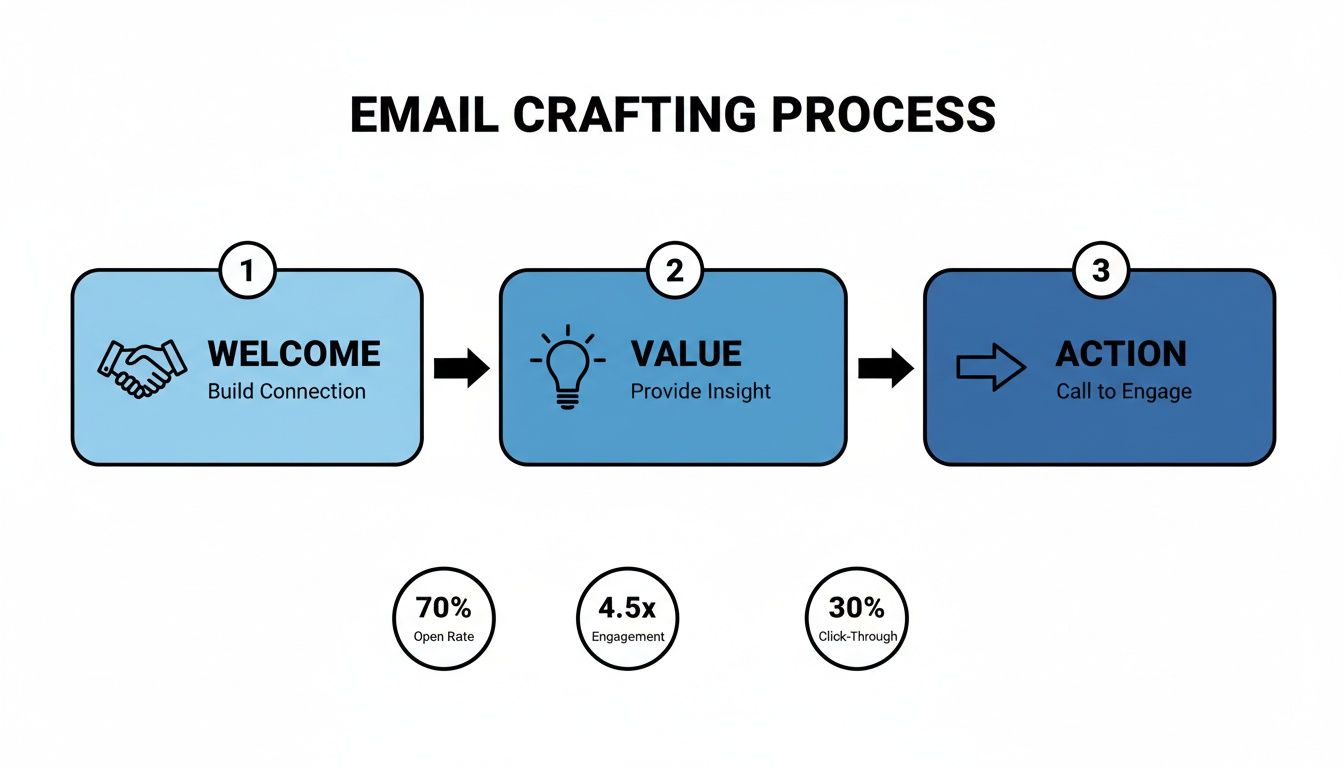
The graphic above really nails the flow: start with a warm welcome, give them something valuable, and then guide them toward a clear action.
Here’s what that five-part sequence might look like in your own business:
Part 1: The Instant Welcome
- When: Immediately after they sign up. Speed is everything here.
- What: This email does one thing: it delivers the guide they asked for. Keep the tone friendly and welcoming, briefly introduce yourself, and confirm they made a smart move. The only call-to-action should be a link to their download.
- Why: You’re fulfilling your promise right away, which builds instant trust and makes a fantastic first impression.
Part 2: The Freebie Value-Add
- When: About 2 days later.
- What: Send a quick, genuinely helpful tip that relates to the guide they downloaded. Something like, "3 Common (and Costly) First-Time Buyer Mistakes to Avoid." No sales pitch, just pure value.
- Why: This positions you as a helpful expert, not just another agent chasing a commission.
Part 3: The Soft Offer
- When: 4 days after the last email.
- What: Share something interesting, like a client success story or a blog post about a neighborhood you think they'd like. Then, at the very end, add a soft call-to-action. A simple "P.S. If you have any questions at all about the buying process, just hit reply and ask away!" works wonders.
- Why: You're gently opening the door for a conversation without being pushy.
The most successful nurture sequences are built on patience. Each email should have one, and only one, job to do. If you try to do everything at once—introduce yourself, provide value, and ask for a meeting—you'll just overwhelm them and end up in the trash folder.
Part 4: The Direct Question
- When: Give it a week after Part 3.
- What: Now it’s time to be a bit more direct. Keep this email short and sweet. Ask a simple, open-ended question to get a feel for where they are in their journey. For instance: "Just checking in—are you actively looking at homes right now, or just exploring your options for down the road?"
- Why: The goal is to qualify the lead. Their answer (or lack of one) tells you everything you need to know about their timeline.
Part 5: The "Breakup" Email
- When: Another week after the direct question.
- What: This is your friendly closing message. Something like, "Hey, I haven't heard back, so I'll assume now isn't the right time. I don't want to clog your inbox, but I'm here if you need anything in the future."
- Why: This often creates a little urgency and gets a response from people who were interested but just got busy. It also works as a great housekeeping tool, letting you move non-responsive leads to a long-term monthly newsletter list so you can focus on the hotter prospects.
Turning Your Email Data into Smarter Decisions
Hitting "send" on an email campaign is just the beginning. The real expertise in email marketing for real estate shines through when you start digging into the results and letting the data guide your next move.
Don't let the word "analytics" scare you. Think of it as direct feedback from your subscribers, telling you exactly what they love and what they’re ignoring. Every email platform gives you a dashboard with these numbers. Your job is to focus on the handful of metrics that actually matter for growing your business.
Key Metrics Every Agent Should Track
You don't need to be a data scientist to understand your email performance. Just a few key numbers will tell you the whole story about how engaged your audience is.
These are the essential KPIs I always keep an eye on:
- Open Rate: Simply, the percentage of people who opened your email. If this number is low, your subject line probably didn't grab their attention.
- Click-Through Rate (CTR): This is the gold standard. It’s the percentage of openers who actually clicked a link in your email. A healthy CTR shows your message and call-to-action were compelling.
- Unsubscribe Rate: The percentage of contacts who opted out. A sudden jump here is a major red flag that your content might be missing the mark or you're sending too frequently.
- Bounce Rate: This tracks how many emails never even made it to the inbox. A high bounce rate is usually a sign that your email list is getting stale and needs a good spring cleaning.
Your goal isn't just a high open rate. The real win is getting someone to take action—clicking a listing, replying to your email, or booking a call. A strong CTR is almost always a better sign of a successful campaign than opens alone.
Turning Numbers into Actionable Insights
Data is pointless if you don't do anything with it. The magic happens when you use these numbers to figure out what's not working and test new ideas to fix it. This is how you go from sending average campaigns to running a high-powered marketing machine.
Let’s say you notice your open rates are dipping below the industry average of around 20-25%. It's time to start experimenting. This is where A/B testing (or split testing) comes in, and it's easier than it sounds. You just send two different versions of an email to a small slice of your audience to see which one gets a better reaction.
Here’s a real-world example:
- The Problem: Your "Just Listed" email for a fantastic new property only got a 15% open rate. Ouch.
- The Hypothesis: The subject line was boring: "New Listing on Elm Street." It didn’t create any curiosity.
- The Test: For the next listing, you craft two distinct subject lines.
- Version A (The Factual): "New Listing: 4 Bed, 3 Bath with a Pool"
- Version B (The Emotional): "Your Dream Backyard Awaits on Elm Street"
- The Analysis: You send each version to just 10% of your list. Version B nails it with a 25% open rate, while Version A gets a respectable 18%.
- The Action: Now you know what works. You send the winning subject line, Version B, to the remaining 80% of your list and watch the engagement roll in.
By constantly testing small things—subject lines, calls-to-action, images, even the time of day you send—you methodically improve your results. This is how you ensure your email marketing for real estate efforts are actually paying off.
Got Questions About Real Estate Email Marketing? We've Got Answers.
Jumping into email marketing always brings up a few questions. It doesn't matter if you're a top producer fine-tuning your strategy or a brand new agent just trying to figure it all out—getting clear, straightforward answers is what gives you the confidence to actually hit "send."
We've pulled together the most common questions we hear from agents just like you. Think of this as your personal cheat sheet for getting past the usual sticking points.
How Often Should I Actually Be Emailing People?
This is the golden question, isn't it? The honest answer is that it completely depends on who you're talking to. Sending a daily email to a past client is a quick way to get an unsubscribe, but sending a monthly email to a hot new lead means you'll be forgotten.
Here’s a simple rule of thumb I've seen work time and time again:
- Active Leads (The "Right Now" Crowd): These are your new inquiries and hot prospects. Don't be shy here. A quick, value-packed nurture sequence over 1-2 weeks is perfect for building that initial trust and momentum.
- Past Clients & Your Sphere: For this crew, quality trumps quantity. A fantastic monthly newsletter or a quarterly market check-in is the perfect cadence. It keeps you on their radar without becoming background noise.
- Long-Term Nurture (The "Maybe Later" List): These are folks who aren't ready to move just yet. A simple monthly check-in is all you need. The goal is a gentle, consistent reminder that you're the expert they should call when the time is right.
What's the Best Email Marketing Software for a Real Estate Agent?
The best software is the one you don't have to fight with. Forget the dozens of flashy platforms out there—as an agent, you have a very specific workflow. You need a tool that gets it.
I always tell agents to look for a few non-negotiables:
- Dead-Simple Segmentation: You must be able to tag and sort your contacts (e.g., first-time buyer, past seller, investor). This is the foundation of relevant messaging.
- "Set It and Forget It" Automation: You should be able to build a welcome email series or a drip campaign without wanting to throw your computer out the window.
- Plays Nice with Your Other Tools: Does it connect to your CRM? Your lead gen sources? A smooth, integrated system saves you hours of manual work.
So many agents get trapped in "analysis paralysis," hunting for one mythical platform that does everything. My advice? Start with a solid, user-friendly tool like Mailchimp or Sender for the basics. You can then pair it with a real estate-specific powerhouse for creating your high-value content and lead magnets.
Is It Okay to Just Buy an Email List?
Let me be blunt: No. Please, don't do it.
Technically, you can buy a list, but it's the fastest way to kill your reputation and get your email address blacklisted by services like Gmail and Outlook. You're essentially paying for a list of stale emails and people who will immediately mark you as spam.
When you send emails to people who didn't ask for them, your spam complaint rate skyrockets. Anything over 0.1% is a major red flag to email providers, and they'll start sending all your emails—even the important ones to active clients—straight to the junk folder.
Building your list the right way, with sign-up forms and genuinely helpful content, is slower. There's no shortcut. But the payoff is a list of engaged people who actually want to hear from you, which is the only thing that leads to real conversations and closed deals.
Ready to create stunning CMAs and compelling email content in seconds? Saleswise gives you the AI-powered tools you need to attract leads, nurture relationships, and close more deals. Start your $1 trial today and see the difference.