How to find clients in real estate: 7 proven strategies to win listings
Let's be honest, finding a steady stream of clients is the lifeblood of any real estate business. The best agents I know have mastered a blend of timeless, relationship-based tactics with smart, modern digital strategies. This playbook is all about that balance—getting those crucial short-term wins while building a foundation for long-term, sustainable growth.
Your Blueprint for Finding Real Estate Clients Today
Building a successful real estate career comes down to one thing: mastering client acquisition. For a lot of agents, this feels like the biggest and most unpredictable part of the job. But it doesn't have to be. With the right framework, you can build a reliable system that consistently brings in leads and, more importantly, turns them into closed deals.
This guide isn't just another list of generic tips. It's an actionable playbook for generating and converting clients across the channels that actually work, from nurturing referrals to launching targeted online ad campaigns.
A Modern Mix of Strategy and Technology
The secret is combining what has always worked—building real relationships—with technology that gives you leverage. You'll learn how to work your personal network (your single most valuable asset) while also reaching entirely new audiences online. To keep your pipeline full, it's crucial to explore a variety of effective real estate lead generation ideas and see what clicks for you and your market.
Success in this business is about creating a balanced client-finding portfolio. You need strategies that deliver clients this month (like open houses) and strategies that will build your business for the next five years (like SEO and referrals).
The graphic below really drives this point home, breaking down the core strategies by their cost, speed, and overall value.
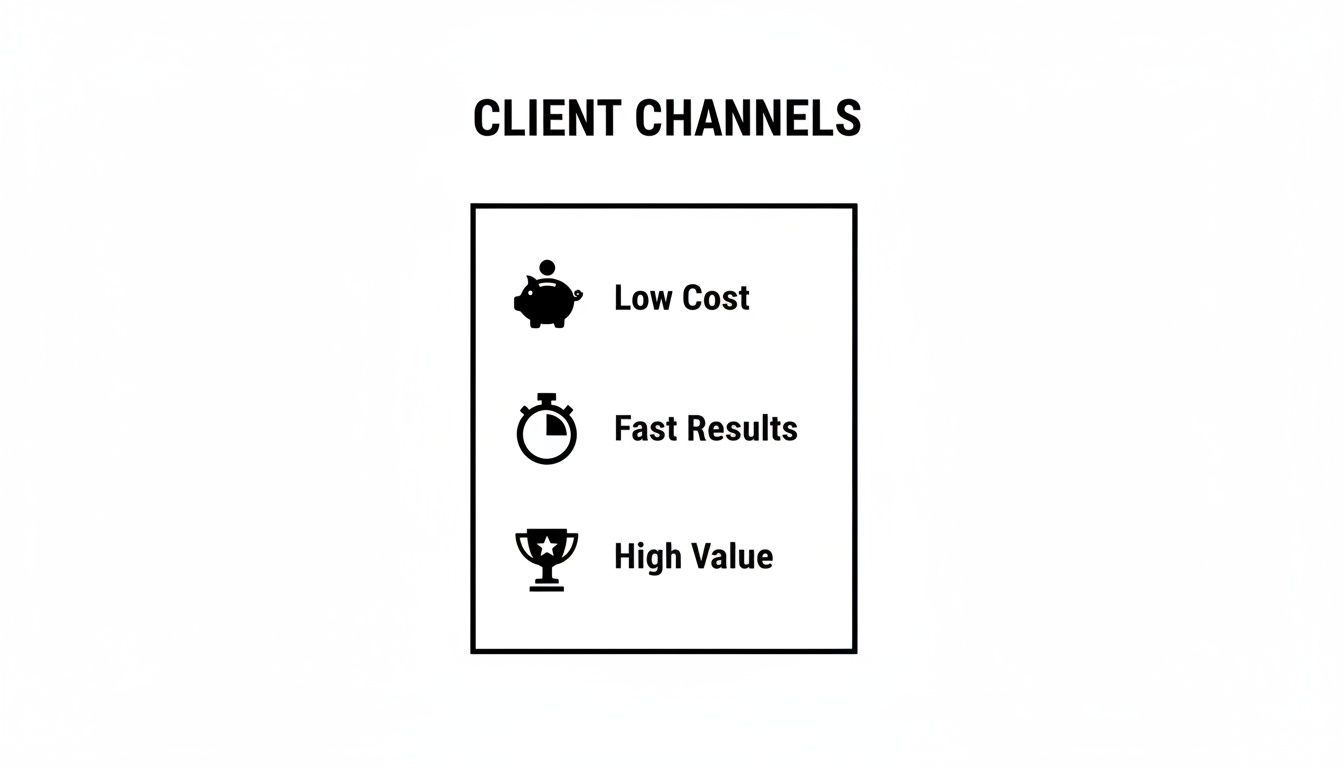
Think of it this way: your client acquisition plan needs a mix of low-cost, high-value activities (your marathon) alongside tactics that can produce faster results when you need a boost (your sprint).
Client Acquisition Channels at a Glance
To help you decide where to focus your energy and budget, here’s a quick breakdown of the top channels. I've seen agents build entire careers on just one of these, but the most successful agents I know pull from several.
| Channel | Average Cost (CAC) | Time to Results | Long-Term Value |
|---|---|---|---|
| Sphere/Referrals | Low | Slow to Start | Very High |
| FSBO/Expireds | Low to Medium | Fast | Medium |
| Open Houses | Low | Fast | Medium |
| Online Ads (PPC) | High | Very Fast | Low to Medium |
| Social Media | Low to Medium | Medium | High |
| SEO/Organic | Medium | Slow | Very High |
| Partnerships | Low | Medium | High |
Looking at this table, you can see there's no single "best" way—it's about building a system that aligns with your goals, budget, and timeline. Now, let's dive into how to execute on each one.
Your Sphere of Influence: The Goldmine You're Already Sitting On
Before you even think about spending a single dollar on ads, let's talk about the most valuable asset you have right now: your Sphere of Influence (SOI). This isn't just a fancy term for your contacts list. It's your network of friends, family, past clients, and local connections—the people who already know, like, and trust you. This is, without a doubt, your most powerful and cost-effective source for clients.
The secret isn’t just sending a holiday card once a year. The real magic happens when you shift from just "staying in touch" to systematically providing real value. The goal is to become the first person they think of—the automatic, go-to expert—the second real estate crosses their mind. It’s less about asking for business and more about consistently offering your help and insight.
Going From Random Check-Ins to a Real Nurturing Plan
Turning your SOI into a reliable referral machine takes a deliberate strategy. You can't just hope to run into people at the coffee shop. You need a system that delivers tangible value on a regular basis, transforming a simple "how are you?" into a moment that strengthens your relationship.
Here’s a perfect example of what this looks like in action. Instead of a generic call, what if you could offer a quick "home equity health check"? Imagine this conversation: "Hey, I was just thinking about you and decided to run a quick market analysis on your neighborhood. It looks like your home's value has jumped quite a bit since we last spoke. I can shoot over a 30-second report if you're curious to see the numbers."
This one simple act provides immediate, personalized value. It’s not a sales pitch; it's a helpful update that naturally opens the door for a real conversation about their goals.
Pro Tip: Providing unexpected value is the fastest way to build loyalty and get people talking. A past client who sees their equity has jumped by $100,000 because of your quick update is far more likely to recommend you than one who just gets another generic newsletter.
And the data backs this up. Realtors typically get 20% of their business from repeat clients and another 21% from referrals that came directly from those past clients. That’s a staggering 41% of your potential income, all sourced from the relationships you already have. For experienced agents, that number is often even higher. You can dig into more of these powerful member trends from NAR's report to see just how critical this is.
Your High-Value Outreach Playbook
A consistent follow-up plan is what separates the pros from everyone else. It ensures no one slips through the cracks. The idea is to create multiple, non-intrusive touchpoints throughout the year that always lead with value.
Here's a simple yet incredibly effective system you can put in place today:
- Quarterly Value-Add Email: Send a hyperlocal market update. Don't just spit out generic stats. Tell them what the numbers mean. Explain how rising interest rates might affect sellers in your town or shine a spotlight on a specific neighborhood seeing a surge in demand.
- Bi-Annual Personal Call: Just pick up the phone. Your only goal is to check in on them as a human being, not as a lead. If you're stuck on what to say, you can use a simple AI-generated script from a tool like Saleswise to get the conversation started naturally.
- Annual "Real Estate Review": This one is a game-changer. Offer a complimentary, no-strings-attached CMA to your past clients around the anniversary of their home purchase. It's a professional, high-value way to remind them of their investment's growth and your ongoing expertise.
When you consistently follow this value-first model, asking for referrals stops feeling awkward. It becomes the natural next step in the conversation. Instead of a cold ask, it’s a warm invitation: "I'm so glad this was helpful for you. My business is really built on helping great people like you, so if you happen to know anyone else who might be thinking about a move, I'd be honored to offer them the same kind of service."
A Modern Approach to Prospecting FSBOs and Expireds
Tapping into the world of For Sale By Owners (FSBOs) and expired listings is a time-tested strategy for one simple reason: these are highly motivated sellers. Their home didn't sell, or they're trying to navigate the complex market alone. Either way, they're prime candidates for an expert with a fresh game plan.
But the key to winning them over isn't about using aggressive, old-school sales tactics. It's about leading with undeniable, immediate value.
Forget the cold calls that start with a confrontational, "So, are you ready to list with a real agent yet?" That line of questioning just puts people on the defensive. Instead, your entire approach should be about positioning yourself as a helpful resource. The most powerful tool for this? A professional, data-driven Comparative Market Analysis (CMA). This isn't the generic Zestimate they can find online; it’s a detailed, insightful report they can’t create themselves.

Crafting a Value-First Outreach
Your first point of contact should be built around offering something genuinely useful. A simple, non-threatening script can open the door to a real conversation and is a fantastic way to find clients who desperately need a new strategy.
Here’s what a modern script sounds like:
- "Hi, I'm calling about the home on Main Street. I specialize in this neighborhood and put together a quick, professional market analysis showing how it stacks up against recent sales. It might offer some insights you haven't seen. Would you be open to me sending it over? No strings attached."
This works because it’s not an ask; it's an offer. With a tool like Saleswise, you can generate a detailed, impressive CMA in just 30 seconds, turning this into a highly scalable strategy. You're delivering real value without spending hours on research, which means you can connect with far more potential sellers. For a deeper look at what to say, check out our guide on the best expired listings script.
The goal isn’t to convince them they failed; it's to show them a clear path to success. By leading with a high-value CMA or innovative marketing visuals, you change the dynamic from a sales pitch to a strategic consultation.
A Multi-Touch Follow-Up System
Let's be real—a single call or email rarely closes the deal. Consistency is what builds trust and keeps you top-of-mind for when they're finally ready to make a move. A simple, effective follow-up cadence can make all the difference.
Try this three-part sequence:
- Day 1 (Initial Contact): Make your value-offer phone call. Immediately after hanging up, send an email with the CMA you promised.
- Day 4 (Direct Mail): Mail a high-quality postcard. For an expired listing, you could include an AI-powered virtual staging photo showing their living room beautifully redesigned, giving them a taste of your marketing savvy.
- Day 10 (Follow-Up Call): Circle back with a brief, friendly call. Just check in to make sure they received everything and ask if they have any questions about the market data.
This systematic approach communicates professionalism and persistence without being pushy. It shows you have a plan—not just for getting their listing, but for actually getting their home sold. When you consistently provide value, you become the obvious choice when they realize they need a professional partner.
Turning Open Houses into Reliable Lead Generation Events
In an industry that’s getting more digital by the day, open houses are one of the few places you get a real, face-to-face shot at connecting with people. But let's be honest: too many agents just show up, put out a sign-in sheet, and hope for the best. That’s not a strategy; it’s a chore.
A truly successful open house is an event. It’s a well-oiled machine that starts humming long before anyone walks through the door and keeps working for you long after the last person leaves. Your goal is to shift from being a "door opener" to the go-to market expert everyone in that room wants to talk to—whether they’re ready to buy tomorrow or just testing the waters.
Beyond the Sign-In Sheet Engagement
The real work at an open house happens away from the sign-in sheet. That piece of paper is just a formality. The gold is in the conversations you start. You need to gather intel and build a genuine connection, and you do that by asking better questions.
Instead of the robotic "Sign in, please," try opening up a real dialogue:
- "So, what brought you out to this one today? Are you seriously hunting in the neighborhood or just seeing what’s out there?"
- "How long have you been looking? I'm curious, what’s on your 'must-have' list?"
- "Are you already working with an agent on your search?"
These aren't just qualifying questions; they're conversation starters. When someone mentions they live nearby, that's your cue. That’s the moment to pivot from small talk to providing massive, immediate value.
The most powerful move you can make at an open house is to answer a visitor's unspoken question: "What is my current home worth?" If you can do that on the spot, you've just turned a casual browser into a potential listing.
Using On-Site Tech to Convert
Picture this: A couple mentions they live just a few streets over. The average agent says, "Great! I can email you some info later." They take a name, and the moment is lost.
But you’re different. You pull out your tablet.
Using a tool like Saleswise, you can run a professional, data-rich CMA for their exact property in about 30 seconds. Right there, standing in the kitchen. You're not just telling them you’re a local expert; you’re showing them in real-time.
This one action builds more credibility than a thousand business cards ever could. You've given them something of tangible value and instantly separated yourself from every other agent they've met that weekend.
Of course, the event itself is only half the battle. Your follow-up game is where the money is really made. For those you ran a quick CMA for, the first email is a slam dunk: "It was great meeting you today at the open house on Elm Street. As promised, here is the detailed market analysis for your home."
It's a personalized, value-first touchpoint that keeps the conversation going and puts you one step closer to that listing appointment.
Using Social Media and Digital Ads to Attract Buyers
Let's be honest, just throwing your listings on Facebook and hoping for the best isn't a strategy—it's a wish. To actually find clients online, you need to stop acting like a billboard and start acting like the local market authority you are. That means creating genuinely useful content that solves problems for potential buyers and sellers.
Instead of another cookie-cutter property post, think bigger. Shoot a quick video tour of a hot neighborhood, explaining the pros and cons. Break down the latest market report into a 60-second Instagram Reel. Create a simple, downloadable guide for first-time homebuyers. This is how you build trust and attract a following of people who will actually want to work with you down the road.

Launching Targeted Ad Campaigns
Once you have some solid content, it's time to put a little money behind it. Paid ads on platforms like Facebook and Instagram are your secret weapon for getting that content in front of the right eyeballs. The targeting capabilities are incredibly powerful. You can serve up ads directly to people flagged as "likely to move," zero in on first-time homebuyers, or even target homeowners in a specific subdivision who fit a certain income profile.
The trick is to pair your great ad with an irresistible call-to-action (CTA). "Call me for details" is a dead end. You have to offer them something valuable right now. A campaign targeting renters in a popular part of town could run an ad that says, "Tired of Paying Someone Else's Mortgage in [Your City]? See What You Can Actually Afford." That CTA can lead them to a landing page with a free home-buying guide or a mortgage calculator.
I see so many agents waste money by simply "boosting" a Just Listed post to a broad audience. A far smarter move is to create a specific ad offering a free, instant home valuation, and then target only the homeowners in that exact neighborhood. You'll generate a list of high-intent seller leads every single time.
Understanding the ROI of Digital Advertising
When you do it right, digital and social media ads offer some of the best returns in the business. The numbers don't lie. Targeted Meta Ads have an average customer acquisition cost of $2,437 for a single-family home—that's a whole lot better than a portal like Redfin, which comes in at $3,898.
The power of compelling visuals is undeniable, too. We know that listings with video get a staggering 403% more inquiries, and homes with professional photos sell 32% faster.
To really dial this in, you need to understand what works on each platform. For some battle-tested ideas, check out these real estate Facebook ad examples: https://www.saleswise.ai/blog/real-estate-facebook-ad-examples. And don't forget about other forms of digital advertising. Diving into something like PPC management for real estate can be a fantastic way to capture buyers and sellers who are actively searching on Google.
Building a Long-Term Lead Engine with SEO and Content
Paid ads are great for a quick burst of traffic, but it’s like a tap—the moment you stop paying, the flow of leads dries up. If you're serious about building a business that lasts, you need to think about creating a sustainable asset that works for you 24/7, attracting high-intent clients even while you sleep. That’s where SEO and content marketing come in. This is how you build a real estate business for the long haul.
The core idea is surprisingly simple: become the go-to digital resource for your local market. Forget the complex technical jargon. This is all about creating genuinely helpful content that answers the exact questions your future clients are typing into Google every day.

Identify and Answer Local Questions
Put yourself in your clients' shoes. What are they really searching for? Get hyperlocal and think beyond the obvious.
- "Best family neighborhoods in [Your City]?"
- "Steps to selling a home in [Your State]?"
- "Is [Specific Suburb] a good place to live?"
- "Property taxes in [Your County]?"
Every one of these questions is a golden opportunity for a blog post, a short video, or a neighborhood guide. When you create these resources, you stop being just another agent and become the definitive local expert. Our complete guide on lead generation for real estate agents dives deeper into how to turn this local expertise into a steady stream of leads.
This approach completely reframes your role from salesperson to trusted advisor. Think about it: when someone finds your in-depth guide to local schools, they aren't just getting information. They're getting a powerful first impression of your expertise and the value you provide.
The financial upside to this organic strategy is huge. There's a reason smart agents are doubling down on low-cost channels. A recent analysis revealed the average customer acquisition cost through SEO is just $1,354. That's a bargain compared to Google Ads ($2,166) or Zillow Premier Agent ($1,536).
And here’s a critical stat to remember: 81% of sellers only contact one agent. Being the agent they find organically through helpful content gives you a massive competitive advantage. You can discover more insights on real estate acquisition costs to see the full numbers for yourself.
Look, this isn't a get-rich-quick scheme; it's a get-rich-sustainably plan. Building out your content library takes time and consistent effort. But every article you publish is like planting a tree—it starts small, but over time it grows into a valuable, lead-generating asset that will strengthen your business for years to come.
A Few Common Questions About Finding Real Estate Clients
When you're trying to build your real estate business, a lot of questions pop up. It’s completely normal. Let's tackle a couple of the most common ones I hear from agents trying to get their footing.
A big one is always about the timeline. How long does this really take? The truth is, you can land your first clients in just a few weeks if you hit the ground running with things like open houses or calling For Sale By Owners.
But building a business that lasts—one that runs on referrals and a solid reputation—that’s a different story. You should expect that to take a good 6-12 months of consistent, smart work. The real trick is to play both the short game and the long game at the same time.
Another question I get all the time, especially from newer agents, is about money. What's the best way to get started without breaking the bank?
What’s the Most Cost-Effective Strategy for New Agents?
If you're just starting out, you want strategies that trade sweat equity for cash. Focus on effort, not a huge ad budget.
Here’s where I’d put my energy:
- Your Sphere of Influence (SOI): This is your goldmine. Tapping into your existing network of friends, family, and former colleagues costs you nothing but your time, and the return is often fantastic.
- Really Good Open Houses: A well-promoted and professionally run open house is one of the best bangs for your buck. You can meet a ton of active buyers and even some curious neighbors thinking about selling, all in one afternoon.
It's far better to master 2-3 client-finding strategies than to be mediocre at ten. A powerful combination for new agents is one long-term channel (like your SOI) and one or two short-term channels (like open houses or targeted prospecting).
Get those systems down pat, and then you can start layering in another channel to your marketing mix.
Ready to turn insights into action? Saleswise helps you create stunning, data-driven CMAs in 30 seconds, craft AI-powered outreach scripts, and generate virtual staging visuals to win over any prospect. Start your $1 trial and see how top agents find and convert clients faster.