How to Generate Listings in Real Estate A Modern Playbook

Getting more listings comes down to doing three things really well: consistently finding motivated sellers, knocking the appointment out of the park, and using the right tech to stay ahead of the competition. When you get these three pieces working together, hunting for your next listing stops feeling like a grind and starts looking like a predictable system.
The Modern Playbook for Generating Listings
The agents who are really crushing it today are the ones who mix old-school relationship building with new-school efficiency. You can't just rely on one source for leads anymore. The new playbook is all about a multi-channel approach that keeps your pipeline full, no matter what the market is doing. This guide is that playbook—a straightforward, actionable plan that cuts through the fluff.
We're going to dive into the practical steps that truly separate the top producers from everyone else. This isn't theory; it's what works in the real world. Here’s what that system looks like:
- Smart Prospecting: This means knowing where to find motivated sellers—like expireds, FSBOs, and your own sphere—and how to connect with them effectively.
- Winning the Appointment: It’s about walking into a listing presentation with so much value that you become the only logical choice for the seller.
- Working Smarter, Not Harder: You have to embrace tools that speed up the time-sucking tasks, from pulling a CMA in minutes to automating your follow-up.
This flowchart gives you a bird's-eye view of how these pieces fit together to create a powerful engine for getting listings.
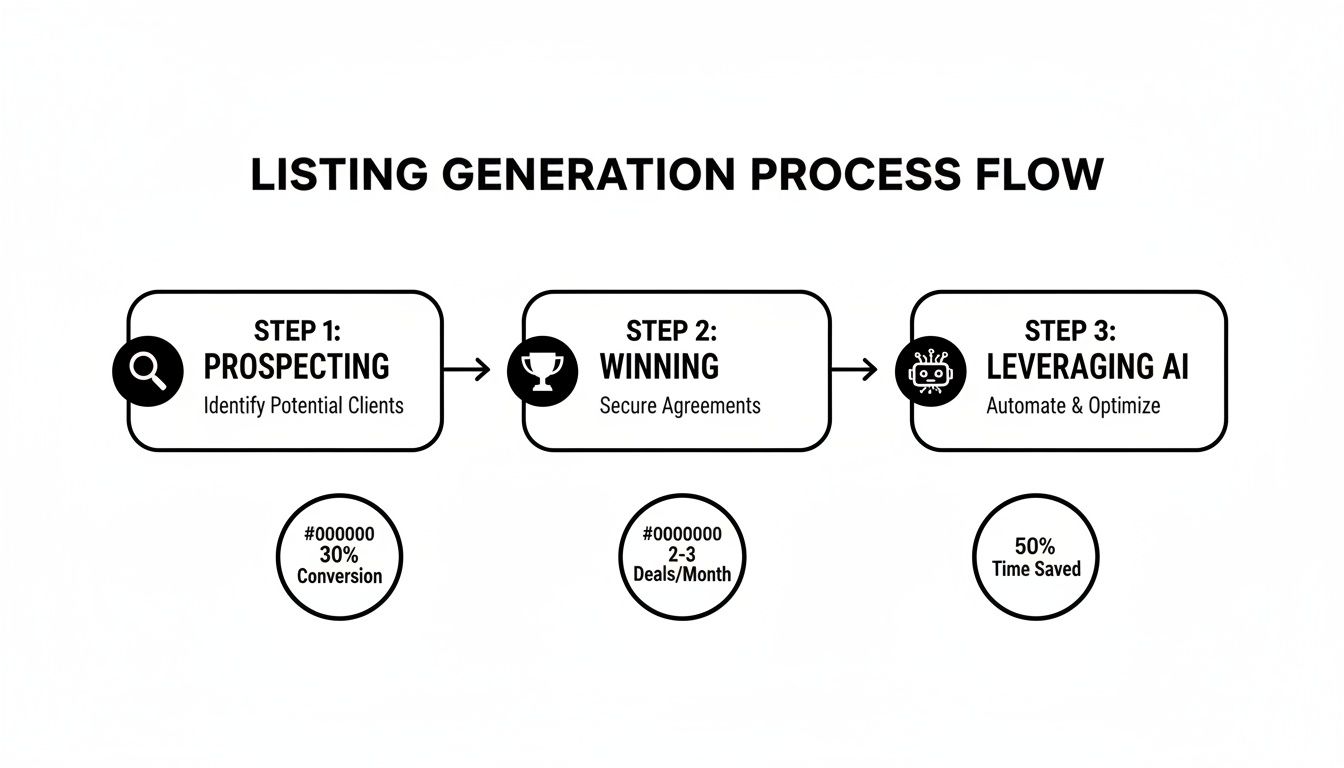
The big takeaway here is how each step fuels the next. Great prospecting gets you more appointments, and using AI makes both your prospecting and your presentations more effective. It's a cycle of success.
Finding Opportunity in Today's Market
Good news: the opportunity to land new listings is on the rise. We're finally seeing a real recovery in housing inventory. In fact, active for-sale listings are projected to jump by 8.9%, marking the third straight year of gains.
This isn't just about more homes hitting the market. It’s also revealing a "shadow inventory" of highly motivated sellers. Think about it: data shows that almost 60% of listings were pulled from the market late last year. That’s a massive group of homeowners who wanted to sell and are just waiting for the right time. For an agent with a solid game plan, this is a goldmine.
Top agents don't sit around waiting for listings to fall into their lap. They build a system that finds opportunities before anyone else sees them. It's all about being proactive, not passive.
For more deep dives into market trends and agent strategies, the Mindreader's real estate insights page is a great resource. By combining a smart approach with the right tools, you can build a reliable system that consistently puts you in front of sellers, ready to win their business.
Mastering Your Prospecting Engine for Consistent Leads
A full pipeline isn't something you stumble into; it's the direct result of a well-oiled prospecting engine. If you want to consistently sign listings, you can't just rely on one source of business. Banking on referrals alone leaves you exposed when the market shifts. The real pros build a diversified system that pulls in opportunities from several different angles, day in and day out.
Some of the most motivated sellers are hiding in plain sight. I’m talking about homeowners who’ve already tried selling and failed, or those determined to do it all themselves. These are golden opportunities because they've already raised their hand. Your job is to connect with them, show them you understand their frustration, and prove you have a better way to get it done.
Targeting Motivated Sellers: FSBOs and Expireds
For Sale By Owners (FSBOs) and Expireds are the low-hanging fruit in this business, but only if you approach them with genuine value. These sellers are often stressed out, and a direct, empathetic approach is the only way to cut through the noise of other agents calling them.
FSBOs are all about saving money on commission, but most have no idea what they’re really in for. Instead of hitting them with your sales pitch, lead with a helping hand.
- Offer a Free Resource: Give them something they can actually use, like a "FSBO Marketing Checklist" or a simple guide on navigating inspection negotiations.
- Share a Crucial Comp: Find one highly relevant comparable sale they likely missed and send it over. A simple note like, "Just saw this one close nearby and thought you'd find it useful. It could impact your pricing strategy," works wonders.
- Use a Smarter Script: Tools like Saleswise can generate non-pushy call scripts that are designed to uncover a seller's challenges, making your outreach feel more like a consultation than a cold call.
Expireds, on the other hand, are usually let down by their last agent. Maybe it was the marketing, the communication, or the strategy. Your first conversation should be about diagnosing the problem, not pitching yourself. I’ve found a great opener is, "I noticed your home came off the market and was curious—what do you think kept it from selling?" This immediately opens up a real conversation where you can listen and start offering real solutions.
Transforming Your Sphere into a Referral Machine
Your Sphere of Influence (SOI) is your personal goldmine, but you have to work it. The biggest mistake agents make is only calling people when they need a deal. The secret is to consistently add value to their lives, so you’re the first and only agent they think of when real estate comes up.
Your database is not just a list of contacts; it’s a community you are responsible for nurturing. Treat every person in it like a VIP, and they will become your most powerful advocates.
A simple but incredibly powerful strategy I swear by is the "5-5-5" method. Every single workday, make five calls, send five personal texts or emails, and write five handwritten notes to people in your sphere. These aren't sales calls. They're check-ins. Ask about their kids, bring up a fun memory, or share a piece of local news. This kind of consistent, genuine contact is what keeps you top-of-mind.
Geographic Farming for Neighborhood Dominance
Geographic farming is a long game, but it’s how you become the undeniable go-to expert for a specific neighborhood. And let's be clear: sending a postcard once a quarter isn't farming. To truly own an area, your presence has to be everywhere.
You need to hit them from all sides. Combine these channels to completely saturate your farm:
- Direct Mail: Send stuff they'll actually read. High-quality, data-rich mailers like "Just Sold" cards showing a great sale price, quarterly market reports, or even invites to a community shredding event you're sponsoring.
- Digital Ads: Get on their social feeds. Run hyper-targeted Facebook and Instagram ads aimed at the specific zip code you're farming. Promote a free home valuation tool or a guide to local market trends.
- Community Involvement: Show up in person. Sponsor the local Little League team, host a charity drive, or set up a booth at the neighborhood block party. Nothing beats face-to-face connection.
When residents see your face on a postcard in their mailbox, in their social feed, and at the local park, you build incredible name recognition. They start to see you as the real estate expert for their community, making you the only call they’ll make when it's time to sell.
Building a diverse lead generation system is foundational. For an even deeper look into this topic, our guide on how to generate real estate leads provides additional strategies to fill your pipeline. To ensure a steady stream of qualified leads in the competitive real estate market, discover these powerful real estate lead ideas that can add even more fuel to your prospecting engine.
Win Over Sellers with a High-Impact Listing Appointment
You got them to agree to a meeting. That’s a huge win, but the real work starts now. The listing appointment is your moment to shine, the point where you shift from a promising contact to their signed agent.
This isn’t about a slick sales pitch. It’s your chance to prove you’re the only person for the job by building undeniable trust and showing them a clear, data-backed plan. Walking in unprepared is the fastest way to lose credibility. Before you ever ring that doorbell, you need to be an expert on their property, the neighborhood stats, and what might be motivating them to sell.

From Data to Decisions: The Rapid CMA
In a market this fast, speed and accuracy are your secret weapons. Sellers are talking to multiple agents, and the first one to deliver a clear, compelling market analysis often sets the tone for everyone else. Forget spending hours pulling comps the old way; modern tools have completely changed the game.
Picture this: a motivated seller calls you out of the blue. While they're still on the phone, you can jump into a platform like Saleswise and generate a professional-grade Comparative Market Analysis (CMA) in minutes. This isn't just about speed; it's about showing up with instant credibility backed by live market data.
A truly powerful CMA needs to tell the whole story, so make sure it includes:
- Active Listings: Shows the seller who their direct competition is right now.
- Pending Sales: This is where the market is headed. It’s crucial forward-looking data.
- Sold Properties: These are the hard facts that ground your pricing strategy in reality.
When you present this information clearly, you stop being a salesperson and start being the market expert. The conversation shifts from your opinion to what the data proves.
Pricing Strategy as a Trust-Builder
Pricing a home is more art than science, and it’s easily the most emotional part of the conversation for a seller. Your role is to guide them with objective data, not just nod along with the dream number they have in their head. A classic rookie mistake is to overpromise on price just to lock down the listing. That almost always ends in painful price reductions and a frustrated client.
Try a more collaborative approach. Instead of dictating a price, use a "bracketing" technique to present them with a few strategic options.
- The Aspirational Price: An aggressive number that would be a home run but might mean sitting on the market a bit longer.
- The Market Value Price: The sweet spot where all the data suggests you’ll see the most buyer activity.
- The Quick Sale Price: A slightly sharper price designed to spark immediate interest, and hopefully, multiple offers.
This method empowers the seller. They become part of the decision, and you’re positioned as their trusted advisor, laying out the strategic pros and cons of each path.
The goal of a listing presentation isn't just to get a signature; it's to forge a partnership. When sellers see you as a strategic partner who has their best interest at heart, objections about commission and price fade away.
Showing the Vision with Virtual Staging and Remodel Mockups
Let's be honest, most sellers can't see past their own clutter or dated furniture. They struggle to envision their home's true potential, which makes it incredibly difficult for them to accept its real market value. This is where you can use technology to make a massive impact.
Don't just tell them what's possible—show them.
With AI-powered tools, you can take a photo of an empty or outdated room and instantly transform it into a stunning, modern space with virtual staging. Even better, for homes needing updates, you can generate virtual remodel concepts. Imagine showing them how that 1980s kitchen could look with new cabinets and countertops. This isn't a gimmick; it's a powerful demonstration of your marketing savvy.
You're giving them tangible proof of how you’ll present their home to attract the most buyers, justifying your commission and reinforcing the immense value you bring. That visual "wow" factor often makes a far bigger impact than words ever could.
Your presentation needs a solid framework to ensure you hit every key point that builds confidence. Here’s a breakdown of what every winning presentation should include.
| Key Components of a Winning Listing Presentation |
| :--- | :--- | :--- |
| Component | Objective | Key Talking Point Example |
| Introduction & Rapport | Build a genuine connection and show you've listened. | "I really appreciate you inviting me over. Before we dive in, tell me a bit more about what prompted you to consider selling now." |
| Your Unique Value | Differentiate yourself from every other agent. | "Most agents will put a sign in the yard and wait. My approach is proactive; here’s my 21-day marketing plan to actively hunt for your buyer." |
| The Market Analysis (CMA) | Establish market reality with clear, undeniable data. | "Here are the three homes most similar to yours that have sold in the last 90 days. This is the price range where buyers are actively writing offers." |
| Strategic Pricing Options | Empower the seller and position yourself as an advisor. | "We can price at X to test the market, or at Y to drive more traffic immediately. Let's look at the pros and cons of each strategy." |
| Marketing & Staging Plan | Demonstrate how you will make their home stand out. | "Your home has great bones. By virtually staging this empty room as a home office, we can help buyers see its full potential online." |
| The Net Sheet | Provide total transparency on their bottom line. | "After all estimated costs and fees, this is the number you can expect to walk away with at each of the pricing scenarios we discussed." |
| Asking for the Business | Confidently close the loop and ask for the signature. | "Based on the plan we've laid out, do you have any reservations about moving forward and letting me get to work for you tonight?" |
A presentation built around these core elements isn’t just a sales pitch; it’s a consultation. It respects the seller's intelligence, addresses their concerns head-on, and makes signing with you the most logical, comfortable decision they can make.
Using Technology to Accelerate Your Workflow
In real estate, speed wins. The agent who can spot an opportunity, crunch the numbers, and deliver a powerful message first is almost always the one who gets the appointment. This is where technology shifts from a "nice-to-have" to your most valuable partner in generating listings. It’s not about replacing your expertise; it’s about amplifying it so you can move faster and smarter than everyone else.
Let’s play out a real-world scenario. An expired listing pops up on the MLS at 8:00 AM. While other agents are just getting their coffee and slowly starting their research, you’re already making your move.
By 8:02 AM, you’ve used an AI-powered tool like Saleswise to generate a comprehensive, data-rich CMA. It’s already client-ready. By 8:05 AM, you’ve used the same platform to draft a personalized outreach email that speaks directly to that seller's likely frustrations.
And by 8:10 AM? You’ve even mocked up a few virtual staging concepts for their home’s most challenging rooms, ready to include in your follow-up. You're showing them you've already figured out how to market their property better. That’s the advantage of a modern tech stack—it condenses hours of legwork into mere minutes.
The AI-Powered Advantage for Listing Generation
Artificial intelligence is the engine driving this new level of speed and precision. Platforms built specifically for real estate agents can automate the most time-consuming parts of the prospecting process, which frees you up to do what you do best: build relationships and close deals.
These tools are designed to do the heavy lifting when it comes to data analysis and content creation. In an instant, they can:
- Generate Hyper-Accurate CMAs: By pulling live data directly from the MLS, these tools produce polished, professional reports in seconds. You establish yourself as the market expert from the very first touchpoint.
- Draft Compelling Outreach: From email templates to phone scripts, AI can create customized messaging for FSBOs, expireds, or your sphere, ensuring your communication is always sharp and relevant.
- Create Stunning Visuals: Instantly generate virtual staging or remodel ideas. This shows sellers the untapped potential in their home and is an incredibly powerful asset for your listing presentation.

Having these capabilities in one place means you can assemble a complete, high-value outreach package for a potential seller in less time than it takes to finish that morning coffee. This speed and preparation are what make you stand out. To dive deeper, our guide on how AI for real estate agents can be a game-changer offers even more practical insights.
Essential Tools Beyond AI
While an AI platform gives you a massive leg up, your tech stack isn't complete without a few other key players. These tools work together to create a seamless system for generating listings. Think of them as the supporting cast that makes your star performance possible.
Technology should work for you, not the other way around. The right tools automate the repetitive tasks, giving you back the time to do what only you can do: connect with people.
First, a robust Customer Relationship Management (CRM) system is non-negotiable. This is the central command for every lead, client, and conversation. It automates your follow-up reminders, tracks your communication history, and makes sure no opportunity ever slips through the cracks. When a lead from six months ago is suddenly ready to talk, your CRM will have you prepared with the full context of your last conversation.
Finally, don't overlook social media scheduling tools. Maintaining a consistent online presence is crucial, but it shouldn't consume your entire day. Tools like Buffer or Hootsuite let you plan and schedule posts for your geographic farm or sphere of influence weeks in advance. This ensures you stay top-of-mind with valuable content, even when you're buried in appointments.
Your Follow-Up System is Where the Money is Made
Let’s be honest. The single biggest mistake agents make isn't fumbling a presentation or losing a hot lead. It’s the lead you never bothered to follow up with.
The hard truth is that most sellers you speak with aren't ready to list today. Your ability to build a pipeline of future listings hinges entirely on what you do after that first conversation. This isn't about annoying people; it's about professionally nurturing relationships. When a "not right now" eventually becomes a "we're thinking about it," you need to be the only agent they consider calling.
Automate Your Nurturing
Your Customer Relationship Management (CRM) system is the engine of your follow-up machine. It’s what keeps you organized, automates the reminders, and ensures no one ever slips through the cracks. The real magic, though, is creating different follow-up plans—or "cadences"—for different types of leads.
After all, the "Someday Seller" you met at an open house needs a completely different touch than an expired listing who's still feeling burned.
The "Someday Seller" Plan: This is a long-term, low-key sequence. Think a quarterly email with a local market snapshot, a happy birthday text, and maybe an annual check-in call. The goal is to stay on their radar without being a pest.
The Expired Listing Plan: This requires a more direct approach that's still packed with value. You could start with a weekly email sharing a success story from your team, then a call offering a fresh market analysis, and eventually transition them to a monthly market update.
By segmenting your database like this, you can effectively automate 80% of the work. That frees you up to have the meaningful, high-intent conversations that actually lead to signed listing agreements.
Always Lead with Value, Never "Just Checking In"
Here's the golden rule: every single follow-up must provide value. A call or email that starts with "just checking in" is a complete waste of their time and yours. Every touchpoint is an opportunity to reinforce your expertise.
Instead of that generic opener, try offering something genuinely useful:
Hyper-Local Market Updates: Send a quick video or email breaking down a recent sale right in their neighborhood. Frame it like this: "I saw this home just sold down the street from you, and I thought you’d be interested in how its price might affect your own home's value."
Community News: Did the city just approve a new park, bike lane, or popular coffee shop nearby? Share that news! It shows you're plugged into the community and thinking about the details that impact their property.
A Free Resource: Offer something tangible, like a downloadable guide on "5 Simple Fixes to Maximize Your Sale Price" or an invite to a webinar you're hosting about the current market.
A great follow-up system isn't really a sales tool; it's a relationship engine. It runs quietly in the background, building trust and credibility with every helpful piece of information you share.
This consistent delivery of value is what will set you apart. For more ideas, our guide on how to follow up with leads is packed with more scripts and templates you can make your own.
Turning Market Shifts into Opportunities
A solid follow-up game becomes even more crucial when the market starts to move. Right now, buyer demand is picking up steam, which means more opportunities for agents who have been patiently nurturing their pipeline.
Projections show home sales are expected to jump by roughly 14% nationwide, a clear sign of a more active market ahead. This is being driven by an estimated 5.5 million households identified as potential movers. By staying in touch with your long-term leads, you’re perfectly positioned to catch this wave.
Your consistent, value-driven follow-up is what ensures that when these homeowners finally decide to act, you’re the first person they call. It’s how you turn patience into a predictable—and profitable—stream of listings.
Common Questions About Getting Real Estate Listings
Even with the best playbook in hand, you're going to hit some bumps in the road when you're out there trying to land listings. Let's tackle some of the most common questions and hurdles I see agents face every day, with straight-to-the-point answers to keep you on track.
How Many People Do I Really Need to Talk to Every Day?
Look, there isn't a single magic number, but most top producers I know are aiming for 20-30 real conversations a day. The secret isn't hitting an exact number, though—it’s about consistency.
It’s far better to block off a non-negotiable hour or two for prospecting every single day than to make 100 calls one day and zero the next three. Whether you're hitting the phones for expireds or grabbing coffee with people in your sphere, that daily rhythm is what builds momentum and fills your pipeline.
The agents who truly crush it don't just track calls; they track outcomes. Your real goal is to figure out your personal conversion rate. How many conversations does it take you to book an appointment? How many of those appointments turn into a signed listing agreement?
Once you have a handle on your numbers, you can reverse-engineer your goals. It stops feeling like a guessing game and starts feeling like a predictable business plan.
What’s the Best Way to Handle "I'm Interviewing Other Agents"?
First, don't flinch. Welcome it with confidence. This objection isn't a rejection; it's a golden opportunity for you to shine and prove you're the best choice.
Stay calm and respond with something that shows you're on their side: "That's a smart decision. This is a huge asset, and you should be 100% confident in the agent you hire. While you do that, would you mind if I get a head start on the marketing?"
Then, immediately pivot from talking to doing. Pull out your tablet and run a professional CMA right there. Use a tool to show them how that cluttered spare room could look with virtual staging, or have an AI assistant draft a sample property description on the spot. By showing them your expertise and speed before they've even spoken to anyone else, you set an incredibly high bar. You’re no longer just another agent they're interviewing; you're the one who's already working for them.
Should I Use Just One Prospecting Method or Several?
Master one, then add another. This is one of the biggest mistakes I see agents make. They try to do everything at once—cold calls, open houses, social media, direct mail—and end up getting mediocre results from all of them. It's a fast track to burnout.
Pick a primary method that actually fits your personality and market.
- Are you a natural relationship builder? Your sphere of influence (SOI) is where you'll thrive.
- Are you tenacious and great on the phone? Calling expireds and FSBOs can get you quick wins.
- Do you prefer a long-term, strategic approach? Geographic farming is a powerful way to build a dominant presence.
Commit to that one channel for a solid 90 days. Track your numbers, tweak your scripts, and get the system dialed in. Only when you have a predictable stream of business coming from that source should you think about layering on a second method. This focused approach is how you build a rock-solid, sustainable business.
Ready to stop spending hours on research and start winning more listings? Saleswise gives you the power to generate professional, data-driven CMAs, create stunning virtual staging mockups, and draft compelling outreach scripts in seconds. See how top agents are using AI to work smarter, not harder. Start your $1 trial at https://www.saleswise.ai.