A Modern Playbook for Real Estate Agent Lead Generation

In real estate, lead generation is all about identifying and attracting potential buyers and sellers to keep your business pipeline full. It's much more than just chasing one-off deals; it's a careful mix of smart technology and genuine, old-fashioned relationship building. The goal isn't just to collect a list of names—it's to create a predictable flow of qualified prospects who are actually ready to make a move.
Building Your Lead Generation Ecosystem

It’s time to stop thinking about leads one by one and start thinking about the bigger picture. Imagine a complete ecosystem where all your marketing channels, client relationships, and tech tools work together in harmony. This isn't a fantasy—it's a system. When you build this engine, it consistently churns out opportunities, freeing you up to focus on what you do best: closing deals.
The entire foundation of a strong ecosystem rests on knowing exactly who you're trying to reach. Are you the expert for first-time buyers in a specific suburb? Or do you specialize in luxury downtown condos? You have to get specific. An agent who tries to be everything to everyone ends up being an expert to no one.
Define Your Niche and Ideal Client
Your niche is more than just a geographic area; it’s the specialty that makes you the undeniable go-to expert. Maybe it’s historic homes, new construction, or investment properties. Once you've carved out that space, creating a profile of your ideal client becomes surprisingly simple.
Think about the details that make up your ideal client:
- Demographics: What's their age, income, family situation, and job?
- Psychographics: What are their motivations for moving? What are their biggest pain points or fears about the process?
- Communication Preferences: Are they quick-texters, email-checkers, or do they prefer a good old-fashioned phone call?
Knowing this stuff lets you craft messages that actually resonate and show up on the channels where your clients already are. You wouldn't waste your time advertising a million-dollar penthouse on a TikTok account geared toward budget-conscious first-time buyers. For more ideas on building a solid client attraction plan, you can check out these proven real estate lead generation strategies.
A successful lead generation ecosystem is built on providing immense value before ever asking for a transaction. It's about becoming a trusted resource, not just another salesperson.
Choosing Your Channels and Tools
Once you have a crystal-clear picture of your client, you can pick the right channels—both online and offline—that actually make sense for your brand. Forget trying to be everywhere at once. It's better to master one or two platforms where your audience truly lives than to spread yourself thin across a dozen.
This is where your core tools become absolutely essential. A solid CRM is the central nervous system of your entire operation, keeping track of every conversation and automating your follow-up so nothing slips through the cracks. If you're looking for the right fit, this guide to the https://www.saleswise.ai/blog/best-crm-for-real-estate-teams is a great place to start.
Beyond that, platforms like Saleswise are built to help you create high-value "lead magnets"—things like instant home valuation pages or in-depth CMA reports. These aren't just gimmicks; they offer real, tangible value to a potential client, giving them a compelling reason to share their contact info. This approach naturally filters out the casual browsers and fills your pipeline with people who are serious about their next move.
Mastering Digital Channels to Attract Clients
 Let's be real—having an online presence isn't optional anymore. But just "being online" is a surefire way to get lost in the noise. A smart digital strategy isn't about shouting into the void; it's about meeting your ideal clients exactly where they are and offering them something they actually want.
This doesn't mean you need to become a master of every single platform. In fact, it's the opposite. The real pros dominate one or two channels that matter most for their local market. By focusing your energy, you can build a powerful, consistent brand that pulls in the right kind of attention.
Building Your Social Media Content Calendar
A winning social media plan is so much more than just posting listings. You're building a community and cementing your reputation as the go-to neighborhood expert. A well-thought-out content calendar is your secret weapon, helping you consistently deliver a valuable mix of engaging and promotional content.
I've found the most success by building content around three core pillars:
- Property & Market Content: This is your bread and butter—virtual tours, "Just Listed" announcements, and quick market updates. With a tool like Saleswise, you can instantly create stunning virtual staging for empty homes or pull together a data-backed market snapshot that makes you look like a genius.
- Local Expertise Content: Show people you love where you live and work. Feature the new coffee shop that just opened, break down school district ratings, or create a guide to the best dog parks. This proves you’re invested in the community, not just the commissions.
- Personal Brand Content: Let your personality shine through. Share a heartwarming client success story, a behind-the-scenes look at a chaotic open house, or a personal tip for first-time buyers. People work with people they know, like, and trust.
A simple weekly plan that works wonders might look like this:
- Monday: Market Update Monday (post a key stat about your local market).
- Tuesday: Tour Tuesday (share a video walkthrough of a new listing).
- Wednesday: Community Spotlight (tag and feature a local business).
- Friday: Q&A Friday (answer a common question you get from clients).
Hyper-Local SEO to Capture Motivated Buyers
When someone is serious about moving, they don’t just google "homes for sale." Their searches get incredibly specific, and that's where hyper-local search engine optimization (SEO) becomes a game-changer for real estate agent lead generation.
Forget trying to rank for broad, competitive terms. The money is in long-tail keywords that signal serious intent. You have to think like a buyer in your specific area.
Here are a few examples of hyper-local keywords that convert:
- "Homes for sale near Lincoln Park Elementary"
- "Three-bedroom condos in downtown Austin with a pool"
- "What is my home worth in the 78704 zip code"
When you create blog posts and neighborhood guides that target these exact phrases, you attract visitors who are deep into their home search. These aren't just casual browsers; they're motivated prospects looking for answers.
The whole point of hyper-local SEO is to be the first and best answer to a very specific question a potential client is asking. When you pull that off, you don't have to chase leads—they come right to you.
Driving Leads with Targeted Facebook Ads
Paid ads give you a direct line to your ideal audience, instantly. Facebook's targeting tools are a goldmine for real estate, allowing you to zero in on users by location, income, and even life events like "likely to move."
The campaigns that get the best results don't just push a listing. They offer a valuable "lead magnet" in exchange for an email address. One of the most effective offers, time and again, is a free, instant home valuation.
Here’s a simple campaign framework that just works:
- The Ad: Use a great photo of a local home with copy like, "Home values in [Your Neighborhood] are up 12%! Find out what your home is worth in 30 seconds. Free, instant, and no strings attached."
- The Landing Page: The ad clicks through to a clean, simple landing page. The headline repeats the offer: "Get Your Free & Instant [Your Neighborhood] Home Valuation." All it needs is a brief explanation and a form for their property address and email.
- The Follow-Up: The second they submit their info, an automated system sends them a professional Comparative Market Analysis (CMA). A tool like Saleswise can generate these reports in less than a minute, giving the lead instant value while you capture their contact details.
This automated flow works around the clock to turn your ad spend into a list of qualified seller leads. For more great ideas on creating posts that stop the scroll, take a look at our guide on real estate social media content.
Digital vs. Offline Lead Generation Channel Comparison
Choosing where to invest your time and money can be tough. This table breaks down the pros and cons of some of the most common channels to help you decide what's right for your business.
| Channel | Average Cost | Typical Conversion Rate | Scalability | Best For |
|---|---|---|---|---|
| Facebook Ads | $500 - $2,000/mo | 1-2% | High | Generating seller leads quickly, targeting specific demographics. |
| Local SEO | $300 - $1,500/mo (or time) | 2-5% | Medium | Building a long-term asset that attracts high-intent buyers. |
| Open Houses | Low (Time + snacks) | 1-3% | Low | Meeting face-to-face with active buyers in a specific area. |
| Direct Mail | $0.50 - $2.00 per piece | 0.5-1% | High | Geographic farming in high-turnover neighborhoods. |
| Networking | Low (Time + coffee) | 5-10%+ | Low | Building deep, referral-based relationships over time. |
While digital channels offer incredible scale, don't discount the power of traditional methods. The most successful agents often find a sweet spot, combining the reach of digital with the personal touch of offline networking.
The great thing about this hybrid strategy is how cost-effective it can be. Recent industry data shows that for 2025, a whopping 63.7% of real estate agents are keeping their monthly marketing budgets under $1,000. This lean approach is also popular with investors, where 82.6% are skipping expensive marketing firms because free strategies like networking deliver such a strong ROI. By pairing these high-touch methods with low-cost, high-impact tech like Saleswise—which can generate unlimited CMAs and AI content for a small monthly fee—you can amplify your efforts without breaking the bank. You can discover more insights about these real estate lead generation trends.
Creating High-Value Assets That Actually Generate Leads
The best lead generation strategy isn't about chasing people down. It’s about getting them to come to you. You do this by offering something genuinely valuable right out of the gate—something so useful they’ll happily trade their contact info for it. We call these "lead magnets," and they essentially turn your expertise into a product that works for you 24/7.
Forget the generic newsletters and vague promises. The assets that really work are specific, solve an immediate problem, and give people an instant win. They frame you as the go-to expert, not just another agent trying to make a sale. Let's dig into three of the most powerful assets you can start using today.
The 30-Second Comparative Market Analysis
Every homeowner is curious about their property's value, especially when the market is all over the place. Offering a free, instant Comparative Market Analysis (CMA) is probably the single most effective lead magnet for finding sellers. It answers their million-dollar question: "What's my home worth right now?"
The days of spending hours manually pulling comps are long gone. With a platform like Saleswise, you can generate a polished, client-ready CMA report in about 30 seconds. That speed is your secret weapon.
Here’s how it plays out: Imagine a homeowner named Sarah scrolling through Facebook. She sees your ad: "Home values in Maplewood jumped 11% this year. Find out your new home value instantly." She's curious, so she clicks. After entering her address on a simple landing page, a professional PDF report lands in her inbox. Just like that, you've captured a high-intent seller lead by giving her something she actually wanted.
AI-Powered Virtual Staging for Sellers
So many sellers can't see past their home's current condition. A vacant room, dated kitchen, or cluttered living space can be a tough sell—both for them and for potential buyers. This is where AI-powered virtual staging becomes a game-changer.
This isn't just a cool gimmick; it's a serious sales tool. You can offer a "free virtual renovation mockup" to homeowners who are on the fence about selling because they're worried their place isn't market-ready. It opens their eyes to what’s possible and immediately shows them you’re an agent who thinks outside the box.
A vacant or dated listing leaves money on the table. By showing a seller how virtual staging can transform their space, you're not just offering a service—you're showing them a clear path to a higher sale price.
Here are a couple of ways to put this into action:
- On Social Media: Post something like, "Wondering if your 90s kitchen is holding back your home's value? Send me a photo, and I'll create an AI-powered virtual remodel mockup for you, free of charge. Let's see the potential!"
- In an Email to Past Clients: "Thinking of selling in the next year or so? Let me help you visualize a few key updates that could maximize your return. I'm offering complimentary virtual staging mockups to my valued clients this month."
This simple offer tackles a huge seller pain point head-on and gets a real conversation started about getting their home ready for the market.
Hyper-Local Neighborhood Guides
For buyers, especially those moving from out of town, the neighborhood is just as crucial as the house itself. They aren't just buying four walls and a roof; they're buying a lifestyle. This is why a hyper-local neighborhood guide is an absolute goldmine for capturing high-quality buyer leads.
Your guide needs to go deeper than generic city-wide info. It should be a true deep dive into a specific community, covering the nitty-gritty details that matter to a family making a big move.
What to pack into your guide:
- School Info: A real breakdown of specific schools, their ratings, and what makes them unique.
- Local Spots: A map of the best parks, coffee shops, grocery stores, and kid-friendly restaurants.
- Commute Times: Honest travel times to major employers during rush hour.
- The Neighborhood Vibe: Real insight into local events, farmers' markets, and what it feels like to live there.
Picture this: The Chen family is relocating for a new job and they’re in a time crunch to find a home before school starts. They google "best family neighborhoods in [Your City]." They stumble on your blog post, "The Ultimate Guide to Living in Northwood," and download your detailed PDF guide by entering their email. Now you have a direct line to a motivated, out-of-state buyer who already sees you as the expert on the ground.
Mastering the Follow-Up: From Hot Lead to Closed Deal
A new lead is like a lit match—it burns out fast. The second a potential client fills out a form on your website, the clock starts ticking. In residential real estate, your ability to respond quickly and with genuine value is what separates a signed listing agreement from a dead-end contact. We call this "speed-to-lead," and frankly, it's non-negotiable.
The trick is to build a follow-up system that feels personal but runs like clockwork. You're not just trying to be fast; you're aiming to be the first agent who actually helps them and starts a real conversation.
Let’s walk through a proven, multi-touch plan for a lead who just asked for a Comparative Market Analysis (CMA).
The First Five Minutes Are Everything
Those initial moments after a lead lands in your CRM are pure gold. This is your one shot to make a killer first impression and set the tone for the entire relationship. Your response has to be immediate, valuable, and hit them on multiple channels.
Here’s a sequence I’ve seen work wonders:
- The Instant Automated Email (0-60 Seconds): The very second they request that CMA, an automated email should hit their inbox with the report attached. Keep the subject line dead simple: "Your Home Value Report for 123 Main Street is Ready." The email itself should be short, confirming they got it and letting them know you'll be in touch personally in a few minutes.
- The Personal Text Message (Within 5 Minutes): This is where you bring in the human touch. A quick, casual text shows you're on top of it. Try something like, "Hi [Lead Name], it's [Your Name] from [Your Brokerage]. I just sent over that home valuation you requested. Take a look and let me know if you have any initial questions!"
- The First Phone Call (Within 60 Minutes): Now it's time to pick up the phone. The goal here isn't to book an appointment. It's simply to offer help. You’re calling to make sure they received the report and to see if they have any questions about the numbers. This immediately positions you as a helpful expert, not just another agent chasing a commission.
This flow works because it delivers on your promise instantly while adding a layer of personal attention that most agents skip.
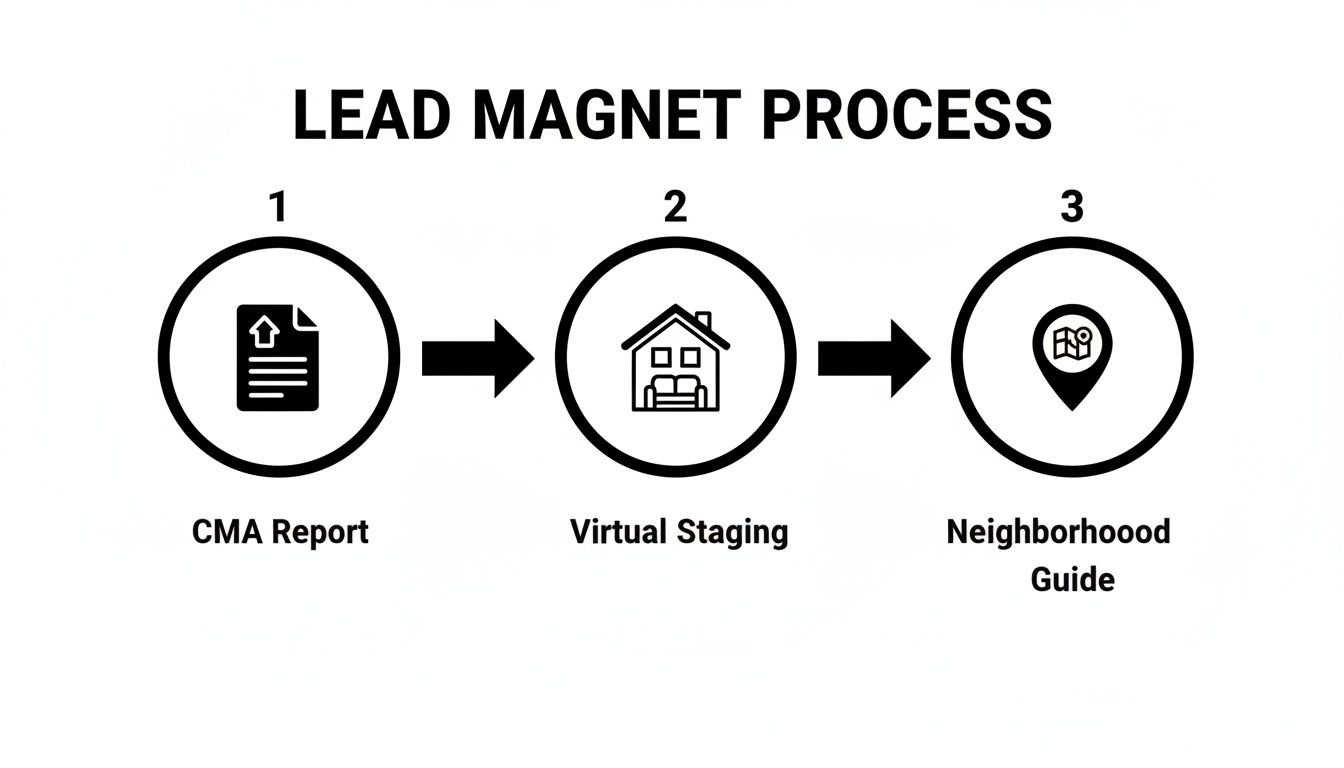
Whether your lead magnet is a CMA, a virtual staging preview, or a detailed neighborhood guide, it’s the spark that ignites this critical follow-up sequence.
Writing Scripts That Actually Start Conversations
Your opening lines, whether on a call or in a text, need to be about them, not you. The goal is to open a dialogue, not corner them into a meeting. The tone should be relaxed, helpful, and completely focused on their needs. You can even use tools like Saleswise to generate and fine-tune scripts based on what top producers are actually saying, so you know your messaging is on point.
Here's a low-pressure phone script opener that works: "Hi [Lead Name], this is [Your Name]. I saw you just requested a home value report on my website, and I wanted to personally make sure you got it. Sometimes those automated emails get lost. Did it come through okay?"
See how easy that is? It immediately puts the lead at ease and opens the door for a real conversation about their property and their plans. If you're looking for more ideas, our complete guide on how to follow up with leads is packed with them.
Nurturing Leads for the Long Game
Let's be real: not every lead is ready to list their house tomorrow. And that's okay. The real money in this business is made in the long-term follow-up. A simple, automated nurturing sequence set up in your CRM is an absolute game-changer here. The mission is to stay top-of-mind by consistently sending them things they’ll actually find useful.
A simple but powerful nurturing plan could look like this:
- Week 1: Send an email with a client testimonial from a home you sold in their neighborhood.
- Week 2: Follow up with a short, data-driven market update for their specific zip code.
- Week 4: Share a quick article you wrote, like "3 Mistakes Most Sellers Make in Today's Market."
- Week 6: Check in with a personal, "just thinking of you" email to see if their plans have changed.
This steady drip of value-packed content builds trust and establishes you as the go-to expert. So when they’re finally ready to make a move, you’re the only agent they’ll even think about calling. Whether you're handling leads from an in-house team or a third-party service, the process of scoring and qualifying new leads is what makes this kind of targeted nurturing possible.
I can't stress the importance of speed enough. The data doesn't lie: leads contacted within 5 minutes are 9 times more likely to convert. Top agents live and breathe by this "speed-to-contact" mantra, blending automated texts with personal calls and multi-channel follow-ups. While referrals are great, paid lead channels absolutely demand this rapid response to be profitable. This is where automation platforms like Saleswise become your secret weapon, turning your speed into a predictable pipeline of closed deals.
How to Measure and Optimize Your Lead Funnel
Running a lead generation system without tracking your numbers is like trying to navigate a new city without a map. Sure, you're moving, but you have no clue if you're actually getting closer to your destination. To build a predictable, profitable real estate business, you have to put on your marketer hat and let the data tell you what’s working and what’s a waste of time.
There’s an old saying: what gets measured gets improved. It might sound like a business cliché, but it’s the absolute foundation for scaling your real estate agent lead generation. By keeping an eye on a few key metrics, you can stop guessing and start making smart decisions that directly grow your income.
Identifying Your Core KPIs
You don't need a data science degree or a complicated analytics dashboard to get started. Just focus on a handful of Key Performance Indicators (KPIs) that paint a clear picture of your lead funnel's health. These numbers tell the real story of where your money and time are paying off.
For every lead channel you're using, start tracking these three essentials:
- Cost Per Lead (CPL): This is your total monthly spend on a channel (like your Facebook ads) divided by the number of leads it brought in. It tells you exactly what you're paying for a single person to show interest.
- Lead-to-Appointment Ratio: This tracks how many of those leads you actually get to meet with, whether it’s for a coffee, a Zoom call, or a listing presentation. It’s the percentage of leads that become a real conversation.
- Appointment-to-Client Ratio: The final step. This shows how many of those meetings result in a signed representation agreement. This metric is crucial because it reveals the quality of the leads each channel is sending your way.
Watching these numbers helps you get past the noise of "likes" or "website visits" and zero in on what actually puts commission checks in your bank account.
Your goal isn't just to get more leads; it's to lower the cost of acquiring a client. Data is the only thing that shows you how to do that consistently over time.
For example, you might realize your blog posts generate leads with a fantastic appointment-to-client ratio, even if the CPL is a bit higher than your social media ads. That insight is pure gold—it tells you exactly where to double down.
Creating a Monthly Review Framework
Collecting data is pointless if you don't use it. The key is to build a simple routine. Block out a couple of hours at the end of each month to sit down, review your numbers, and ask yourself some tough questions. This ritual creates a powerful feedback loop that makes your marketing smarter and more efficient every single month.
During your review, you need to find answers to these questions:
- Which channel gave me the lowest Cost Per Lead? This shows you the most efficient way to get new people into your pipeline.
- Which channel produced the highest-quality leads (meaning, the best conversion ratios)? Remember, the cheapest leads aren't always the best. Look for the source that turns into the most signed clients.
- Where's the biggest leak in my funnel? Are you getting tons of leads but can’t seem to book appointments? That’s a huge red flag that you might need to fix your follow-up speed or tweak your scripts.
Let’s walk through a real-world scenario. Your review shows your Facebook ads are generating leads for $15 a pop, while your Google Ads are costing you $45 per lead. At first glance, Facebook looks like the hands-down winner.
But then you dig into the conversion data. You find that 1 in 10 Facebook leads actually becomes a client, but 1 in 3 Google leads signs with you. Do the math: your cost to acquire a client from either source is the same ($150). The difference is that the Google leads take way less time and effort to convert.
Armed with this information, you can make intelligent adjustments. Maybe you shift some of your Facebook budget over to Google. Or perhaps you test a stronger call-to-action on your landing page to improve the quality of your leads. This cycle of measuring, analyzing, and optimizing is the secret to building a lead generation machine that consistently fuels your business growth.
Your Top Lead Generation Questions, Answered
Even with the best plan in hand, you're bound to have questions as you start putting the pieces together. That's completely normal. Building a lead generation machine takes time, so let's walk through some of the most common things agents ask when they're just getting started.
How Long Before I Actually See Results?
This is the big one, isn't it? Everyone wants to know when the hard work will start paying off. The honest answer is: it depends entirely on where you're focusing your energy.
Think of it in two buckets: short-term wins and long-term growth.
Quick Wins (1-3 Months): If you need leads now, paid advertising on platforms like Facebook or Google is your fastest path. A well-crafted ad and a solid landing page can start bringing in contacts within a week. The same goes for old-school prospecting—picking up the phone and calling expired listings or FSBOs can get you into conversations today.
The Long Game (6-12+ Months): This is where you build a real, sustainable business. Things like creating neighborhood guides, blogging, and climbing the local SEO rankings don't happen overnight. It can easily take six months to a year before you see a steady stream of organic traffic. But when you do? These leads are often fantastic quality, and they found you.
The key is to balance both. Use paid ads and direct outreach to fill your pipeline now while you plant the seeds for your long-term organic growth. Don't get discouraged if your blog isn't a lead magnet in month two.
What's the Best CRM for a New Agent?
Your CRM is your command center. It’s the one tool you absolutely cannot skip. But you don't need to overcomplicate things right out of the gate.
Forget the massive, enterprise-level systems with a million features you'll never use. The best CRM for a new agent is simple, easy to learn, and won't break the bank. You're looking for something that lets you track conversations, set reminders so no one falls through the cracks, and maybe automate a few simple email follow-ups.
The goal is organization. As your database and your business grow, you can always upgrade to a more powerful platform later. For now, just get your contacts out of a spreadsheet and into a system.
How Much Should I Actually Budget for This?
There's no single right answer here, but a solid industry benchmark is to reinvest 10-15% of your gross commission income (GCI) back into your marketing and lead generation efforts.
If you're just starting and don't have a consistent GCI to pull from, that's okay. Start with a fixed monthly amount you can comfortably afford. Even $300-$500 a month can make a real impact if you spend it smartly.
This is where you have to be strategic. Instead of spreading your budget thin, focus on tools that give you the biggest bang for your buck. A platform like Saleswise, for example, bundles essential lead magnets like instant CMAs and virtual staging for a single monthly fee. That's a much smarter way to maximize a small budget than paying for three or four separate services.
Ready to stop wondering and start doing? Saleswise is built to give you the tools—from lightning-fast CMAs to AI-powered virtual staging—that turn browsers into leads. It's time to build your pipeline with confidence.