Winning Real Estate Listing Presentations That Actually Convert
A modern real estate listing presentation isn't just a sales pitch; it's a data-rich consultation. You're combining a deep-dive market analysis, a strategic marketing plan, and compelling visuals all geared toward one thing: winning the seller's trust and their business. It has moved far beyond a simple pitch into a full-blown advisory session designed to show your undeniable value from the minute you walk in the door.
What a Winning Listing Presentation Looks Like Today
Let's be honest, the days of the three-ring binder and a firm handshake are long gone. Today’s sellers are savvy. They’ve done their homework online, and they expect to partner with a sophisticated strategist, not just a salesperson. The winning formula isn't about flooding them with generic flyers; it's about delivering a custom consultation that speaks directly to their goals and calms their anxieties with hard evidence.
A truly high-impact presentation weaves together robust data and a compelling story, showing sellers a clear, believable path to a successful sale. You’re not just showing up with some printouts; you’re arriving with a presentation that answers their questions before they even think to ask them.
Before we get into the slide-by-slide breakdown, it's helpful to see the core components that every top-tier presentation should contain. Think of this as your high-level checklist to ensure you're hitting all the critical points that matter most to a seller.
| Core Components of a High-Converting Listing Presentation | ||
|---|---|---|
| Component | Objective | Key Seller Question It Answers |
| Personal Introduction & Value Prop | Establish credibility and differentiate yourself. | "Why should I trust you with my biggest asset?" |
| Market Analysis (CMA) | Educate the seller on current market realities. | "What is my home actually worth right now?" |
| Strategic Pricing Strategy | Justify your recommended list price with data. | "How did you arrive at that price?" |
| Custom Marketing Plan | Showcase how you'll attract the right buyers. | "What will you do to sell my home that others won't?" |
| Net Sheet & Commission | Provide total transparency on costs and proceeds. | "How much money will I walk away with?" |
This table serves as a great mental map. If your presentation confidently addresses each of these questions, you’re already miles ahead of the competition.
The Shift From Pitching to Advising
The biggest change is a mental one: you're a market advisor, not just an agent hunting for a signature. Your presentation has to reflect that. It should be focused on education and strategy. Sellers don't just want to know what you'll do; they need to understand the why behind your recommended approach.
This advisory role is built on a foundation of trust, and you earn that trust through deep market intelligence and complete transparency.
Here’s how that plays out in practice:
- The Pre-Listing Package: Send key info ahead of your meeting. Your bio, testimonials, and a preliminary market snapshot show you're proactive and sets the stage for a much more productive conversation.
- A Data-Driven Pricing Strategy: Don't just show comps; explain the story the numbers are telling. Talk about absorption rates, the average days on market for homes just like theirs, and list-to-sale price ratios. This is how you justify your pricing recommendation and build confidence.
- A Visual Marketing Blueprint: This is crucial. Show them examples of your professional photography, targeted social media campaigns, and immersive virtual tours. You’re not just telling them you have a plan; you’re showing them the quality of your work.
A successful listing presentation is less about you and more about the seller's journey. It should answer their unasked questions and calm their unspoken fears by demonstrating a clear, expert-led path to their desired outcome.
Essential Tools for the Modern Agent
Technology is no longer optional—it's a critical part of convincing sellers you're the best agent for the job. Using the right tools isn't just for show; it demonstrates your commitment to getting them the best possible outcome. Many leading agents now use AI-powered CMA tools from platforms like Cloud CMA that can deliver incredible accuracy in seconds, which is a lifesaver for making real-time adjustments during a meeting.
And visuals? They're everything. Tools for virtual staging and digital remodel mockups are no longer a luxury. Imagine showing a seller an image of their vacant living room beautifully staged or a mockup of how their dated kitchen could look with a few modern updates. Suddenly, the potential value of their home becomes tangible. It transforms an abstract idea into an exciting reality, proving your value in a way words alone never could.
Weaving a Story That Wins the Listing
Let's be honest, a listing presentation isn't just about data and slides. It’s your one shot to build trust and show a seller you’re the guide who can navigate them to a successful sale. Think of it less as a presentation and more as a story. You're crafting a narrative that takes the seller from where they are now—uncertain and a little stressed—to where they want to be: closing day.
This story needs a beginning, a middle, and an end. You start by showing you understand their unique situation, then you walk them through your exact plan, and finally, you paint a clear picture of the fantastic result you'll achieve together. This is where mastering the art of storytelling in marketing really pays off, helping you connect with sellers on a much deeper level.
Every part of your presentation should build on the last, creating momentum that leads them to say "yes." This simple flowchart breaks down the entire process.
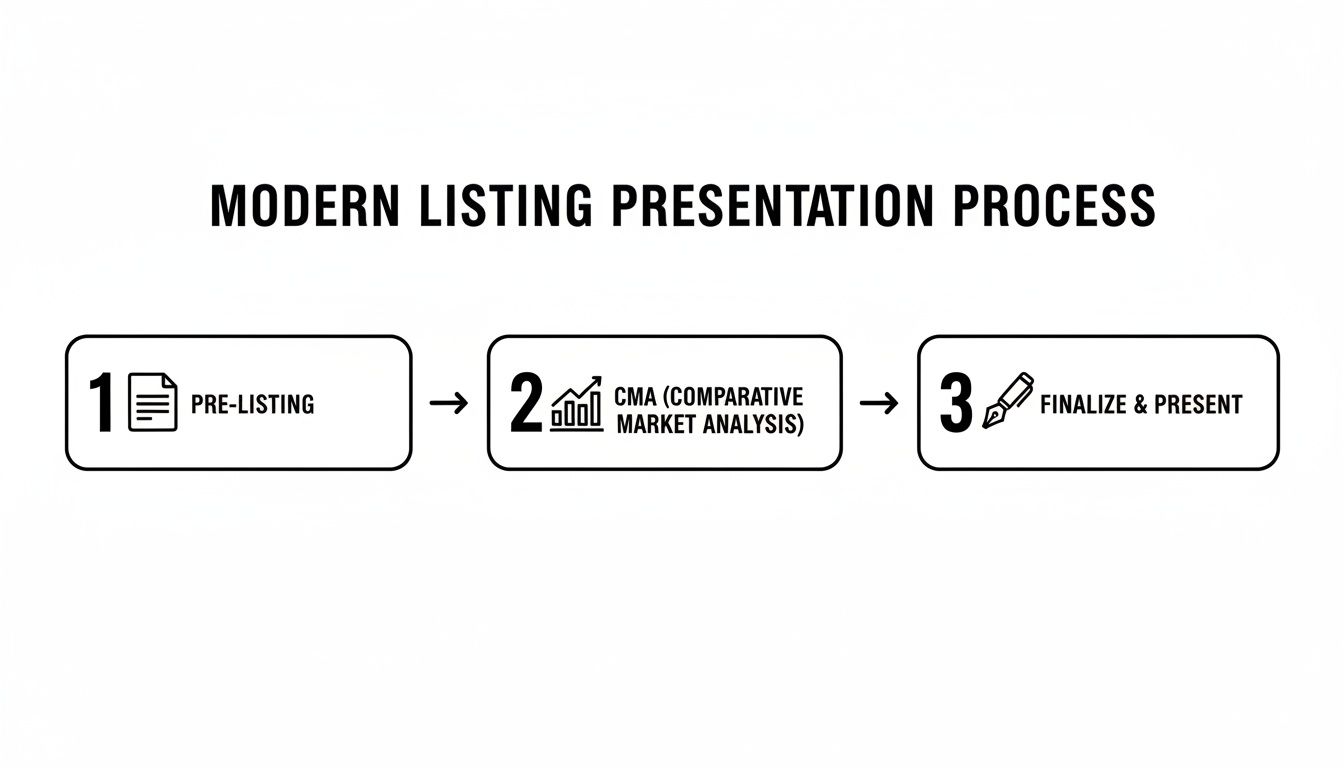
As you can see, a winning presentation starts well before you ever walk in the door. It’s grounded in solid prep work, anchored by a killer CMA, and delivered as a polished, persuasive final pitch.
Setting the Stage: Your Introduction and Value Proposition
The first few minutes are everything. This is your chance to pivot from being "an agent" to becoming their agent. Kick things off by showing you've done your homework. Mention something specific about their home, their potential reasons for moving, or the neighborhood. It shows you see them as people, not just a transaction.
Next, you have to nail your unique value proposition (UVP). This is your clear, concise answer to the question every seller is thinking: "So what? Why are you the best person for the job?" Ditch the generic resume points and frame your skills as direct benefits for them.
- Don't say: "I have ten years of experience."
- Instead, try: "My decade of experience right here in this neighborhood means I have a 'black book' of agents who are actively looking for homes just like yours for their pre-approved buyers."
See the difference? One is about you; the other is a solution to their problem. That’s how you make an impact.
Firing Up Your Marketing Machine
Once you've built that initial rapport, it’s time to show them the engine that will get their home sold. This isn't about making vague promises; it's about providing tangible proof. Anyone can say, "I'll market your home online." You need to show them what that actually looks like.
Pull up a case study from a recent, similar home you sold. Show them the actual ad campaigns you ran on Facebook and Instagram. Point out the specific demographics you targeted to zero in on the right local buyers. Showcase the professional photos and drone video, and explain how stunning visuals generate more clicks, more showings, and ultimately, a faster sale.
This section needs to be a visual feast, packed with concrete examples.
Your marketing plan shouldn't be a simple checklist. It needs to be a portfolio of your greatest hits. When you show sellers real-world examples of your work, your expertise becomes undeniable.
Backing It Up: Your Track Record in Black and White
While stories and testimonials connect emotionally, cold, hard data builds undeniable credibility. This is where you prove you’re not just all talk. By putting your performance stats side-by-side with the market average, you make the choice obvious.
Use clean, easy-to-read charts to highlight the metrics that matter most to a seller.
- Average Days on Market: A simple bar graph showing your average versus the MLS average for their area can be incredibly powerful.
- List-to-Sale Price Ratio: Show them how consistently you sell homes for at or above the asking price compared to the competition.
- Sale Price per Square Foot: This is a great way to demonstrate that your marketing and negotiation skills literally put more money in their pockets.
You can tie it all together with a simple script. For example: "As you can see here, my listings in this area typically go under contract in just 14 days, while the average home sits for 32. That's a direct result of the targeted digital ad strategy I just showed you, which gets a flood of qualified buyers in the door that first week."
Suddenly, your track record isn't just a bunch of numbers—it's the final, convincing chapter of your story, proving you can deliver the results they're hoping for.
Mastering the CMA as Your Secret Weapon
The Comparative Market Analysis (CMA) is the absolute heart and soul of a listing presentation that actually works. Far too many agents treat it like a data dump—they print out a stack of comps, plop it on the coffee table, and hope the numbers speak for themselves. That’s a huge missed opportunity.
A well-crafted CMA isn’t just a report; it's your most powerful tool for building instant trust. It’s how you justify your pricing strategy with cold, hard facts. When you get this right, you stop being a salesperson and become a trusted market advisor. You’re no longer just showing them numbers; you’re telling the story of their home’s place in the market right now. This is the key to gently guiding sellers away from an emotional price and toward a strategic one that actually gets the home sold.

This isn't just theory; it has a real impact on your bottom line. An industry survey recently showed that as agents used CMAs more effectively, their success rates jumped. Listing presentations that ended with a signed contract climbed by nearly 10 percentage points, from 45.90% to 55.65%. It's proof that a killer CMA directly translates to more business.
Choosing Comps That Tell the Right Story
Your analysis is only as good as the properties you choose. Just grabbing the three most recent sales in a half-mile radius won't cut it. To really paint an accurate picture of the market, you need a balanced mix of properties in different stages.
A truly strategic CMA should include these three types of comps:
- Active Listings: These are your seller's direct competition. This is what buyers are looking at today. It’s a reality check on current inventory and pricing.
- Pending Sales: This is your golden ticket. Pending sales show what buyers in the current market are actually willing to pay for a home like your seller's. It's the most up-to-the-minute data you can get.
- Sold Properties: This is the foundation of your valuation. Solds provide the historical proof of what similar homes have actually closed for. For the best results, stick to sales from the last 3-6 months.
When you present all three, you build a powerful narrative. It goes something like this: "Here's what we're up against (active), here's what the market is paying right now (pending), and here's what has successfully sold in the very recent past (sold)." This approach makes your final price recommendation feel like the logical conclusion, not just your opinion.
Making Justifiable Adjustments
No two homes are ever exactly the same, and this is where you can either build or break trust. Don't just pull a price out of thin air. You have to walk them through your thought process and show them how you accounted for the differences between their property and the comps.
I find a simple grid is the best way to make this crystal clear.
| Feature | Subject Property | Comp 1 | Adjustment |
|---|---|---|---|
| Square Footage | 2,200 sq. ft. | 2,000 sq. ft. | +$10,000 |
| Kitchen | Recently Remodeled | Original (1990s) | +$15,000 |
| Garage | 2-Car | 1-Car | +$7,500 |
| Lot Size | 0.25 Acre | 0.20 Acre | +$5,000 |
Actually talking through the math is critical. You might say, "So, Comp 1 sold for $450,000, but it was smaller and had an original kitchen from the 90s. Once we adjust for the value of your extra space and that beautiful new kitchen, its comparable value is actually closer to $487,500. See how we got there?" That kind of transparency is what builds massive trust. For a more detailed breakdown, our guide on building a comparative market analysis goes even deeper.
Explaining Complex Concepts Simply
Your real value shines when you can take a complex market concept and make it dead simple. Things like "absorption rate" can make a seller's eyes glaze over, but it's a powerful way to explain market conditions if you frame it correctly.
Forget the jargon. Use an analogy.
"Think of the absorption rate like this: if no new homes came on the market starting today, it would take us 2.1 months to sell every single available house in your neighborhood. A healthy, balanced market is typically around 5-6 months. At just over two months, we're in a strong seller's market, which means we have more leverage on price and terms."
Suddenly, a confusing statistic becomes a clear strategic advantage for them. It empowers the seller and solidifies your role as the local expert.
Scripting Your Pricing Conversation
That moment when you reveal the price can be the most tense part of the meeting. This is where your confidence and preparation really matter. My advice? Never just state a single number. Instead, present a tight price range and then give your professional recommendation for a starting point within it.
Here's a script I've used time and time again:
"Based on everything we've looked at—the active competition, what's under contract right now, and the adjusted values of the recent sales—all the data points to a fair market value somewhere between $510,000 and $525,000. In this market, to get the most eyeballs on the property right away and potentially attract multiple offers, my professional recommendation is to list at $519,900. This makes us look very competitive while still leaving us room to negotiate toward our goal."
This approach does a few things perfectly. It anchors the price in the data you just presented, it gives them a logical range, and it provides a clear, strategic reason for your recommended list price. You're not just giving them a number; you're collaborating with them on a winning game plan.
Using Visuals to Make Your Value Unforgettable
The numbers in your CMA build the logical case for why a seller should hire you, but it’s the visuals that really stick with them. This is where you create the emotional connection. You’re moving beyond abstract marketing plans and pricing strategies and giving them a tangible sneak peek of their home's future success.
You aren’t just telling them what you’ll do; you’re showing them the premium experience their property is about to receive. It's the difference between promising a great outcome and proving you can deliver one.
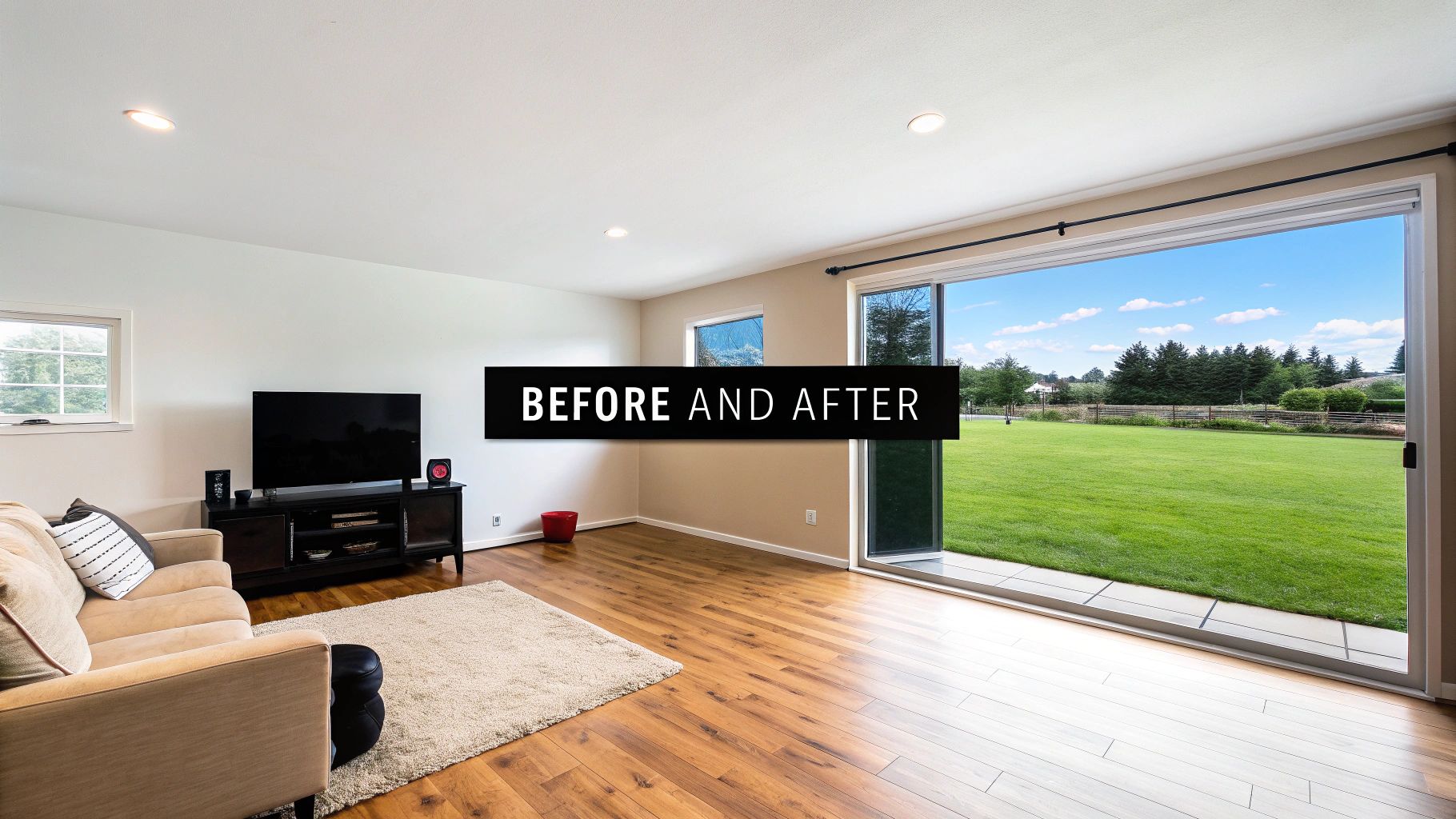
This is your chance to make your value proposition truly memorable. Sellers need to see, with their own eyes, the caliber of marketing that puts you head and shoulders above any other agent they might be considering.
Professional Photography Is Non-Negotiable
Let's get one thing straight: professional photography isn't just another line item in your marketing budget. It’s the single most important visual you’ll create. The quality of those photos directly shapes buyer perception, drives showing traffic, and ultimately impacts the final sale price.
In your presentation, don't just say you hire a pro. Show them the results.
- The "Before & After" Clincher: Find a past listing where the seller gave you some phone snaps. Create a slide showing their photo next to the stunning professional shot you commissioned. The impact is immediate and undeniable.
- A Gallery of Your Best Work: Put together a collage of your greatest hits. Show off those perfect twilight shots, dramatic drone aerials, and beautifully lit interiors. This demonstrates the premium quality you bring to every single listing.
This approach proves that you get it—marketing excellence starts with incredible images.
Never underestimate the power of showing, not just telling. When a seller sees examples of your professional photos, drone videos, and 3D tours, your marketing plan instantly becomes more credible and compelling.
The Power of Virtual Staging and Remodels
Here's where you can truly separate yourself from the pack. Modern tech lets you show sellers the hidden potential in their home, turning "what if" objections into exciting opportunities. An empty room feels cold and small; a virtually staged one feels like home.
Picture this: you're with sellers in their completely vacant property. Instead of just talking about potential, you show them a slide with two images. One is their empty living room. The other is a beautifully furnished, AI-powered virtual rendering of that exact same space.
Suddenly, you’re not just another agent. You’re a visionary who helps them see their home through a buyer's eyes. You can find more deep-dive strategies in our guide on virtual staging for real estate.
This visual-first approach is backed by some serious data. Listings with pro photos can get 61% more views and a staggering 1,200% more social media shares. Zillow reports that homes with professional photos sell 32% faster in the U.S. And when you use tools for instant AI virtual staging or remodels, you can help sellers visualize updates that could boost a home's value by 5-20%. It’s a fact: staged homes sell for more.
Turning Data into a Clear Visual Story
Your presentation is going to have a lot of important numbers, from market absorption rates to your own performance stats. If you just throw a list of figures on a slide, you’re going to see their eyes glaze over. The trick is to transform that data into simple, clean, and persuasive visuals.
Ditch the dense spreadsheets and complicated graphs. Your goal is to tell a story at a glance.
Simple Ways to Visualize Your Data:
- Bar Charts: Perfect for comparing your average days on market to the MLS average.
- Pie Charts: A great way to show how you'll allocate the marketing budget for their home.
- Line Graphs: Ideal for illustrating local home price trends over the last year.
- Icon-Based Stats: Use a simple house icon next to a number to highlight your list-to-sale price ratio (e.g., "My listings sell for 99.7% of asking price").
For instance, when you're talking about your track record, a bar chart showing your 18-day average on market right next to the 45-day MLS average is instantly understood. It visually proves your strategy gets results faster—a powerful motivator for any seller. By making your data easy to digest, you ensure your biggest strengths land with maximum impact.
Navigating Seller Objections with Confidence
Even after you've laid out a brilliant, data-driven presentation, you're going to get hit with tough questions. It's just part of the job. But don't mistake seller objections for a sign of failure. They're actually a good thing—it means your potential client is engaged and thinking seriously.
Think of it this way: an objection is just a request for more information. It’s your golden opportunity to lean in, listen, and really solidify your position as the expert in the room. Whether it's about your commission or their pricing expectations, every question is a chance to prove you’re the right partner to get their home sold.
Responding to the Commission Objection
This is the big one, the classic pushback every agent gets: “Will you cut your commission?” How you handle this single question can define your entire relationship with the seller and, frankly, the value of your work. A weak answer here can instantly undermine everything you’ve just presented.
The trick is to avoid a simple "no" and immediately shift the focus to what they really care about: their net profit. You need to draw a straight line from your fee to the superior results you're going to get them.
Seller: “Your commission seems a little high. The other agent we talked to offered to do it for less.”
Your Response: “I totally understand wanting to get the most out of your sale—that’s my goal, too. What I've seen over the years is that agents who are quick to discount their own fee are often just as quick to recommend a price cut on your home later on. My commission funds a powerful marketing strategy and allows me to negotiate aggressively to protect your equity. We’re aiming for the highest possible sale price, which will ultimately put far more money in your pocket than a 1% commission savings ever could.”
This response does two things perfectly. It validates their concern, showing you're on their team. Then, it pivots directly back to their bottom line, framing your commission as a smart investment, not just a cost.
Overcoming the Overpricing Objection
Homeowners are emotionally invested. It’s only natural for them to feel their home is worth more than the market data suggests. So, when you hear, “We want to list our home for more,” it’s not time to dig in your heels and argue. It’s time to be their trusted advisor and gently guide them back to the facts.
Your CMA is your best tool for this conversation. You need to walk them back through the most compelling comparable sales, especially the ones that are pending. Those pending sales are gold—they show you exactly what today's buyers are willing to pay, right now.
Here’s a simple framework I’ve used countless times:
- Acknowledge and Validate: Always start by finding common ground. "I love your home, and you're right, these custom updates really make it special." This disarms them and shows you're on the same side.
- Reintroduce the Market's Perspective: Gently bring the focus back to the buyers. "The trick is to price it so we get those qualified buyers in the door from day one. Let’s take another look at this home just down the street that went under contract last week. It’s a great comparison and tells us precisely what the market is willing to bear at this moment."
- Explain the Danger of Overpricing: Clearly lay out the risks without being an alarmist. "My only worry with starting too high is that the best buyers might skip over our listing. Homes that sit on the market for too long get a stigma, and that often leads to bigger price drops down the line, sometimes even below where we would have started."
If you’re working with a property that's already gone down that road, having the right scripts for expired listings can give you a solid game plan for that specific conversation.
By following this approach, you transform a potential argument into a collaborative strategy session. You're not telling them they're wrong; you're partnering with them to navigate the market and achieve the best possible outcome. This is what great agents do.
Your Top Listing Presentation Questions, Answered
Even the most seasoned agents have questions when it comes to refining their pitch. Let's tackle some of the most common ones I hear from agents who are trying to perfect their listing presentation.
What's the Ideal Length for a Listing Presentation?
Aim for a sweet spot of 20 to 30 minutes for the core presentation. This gives you enough time to cover the essentials without losing the seller's attention. Anything shorter can feel rushed, while dragging it out longer risks them tuning you out.
Remember, this isn't a lecture. It’s a conversation. The goal is to be concise but thorough, focusing on delivering real value and building a connection. I always pace my delivery to leave room for natural pauses, which actively encourages the seller to jump in with their own thoughts and questions.
Should I Send My Presentation Before the Meeting?
Yes, but with a strategy. Sending a "pre-listing package" is a brilliant move to warm up a seller and showcase your professionalism before you even walk through their door. It shows you’re prepared and that you respect their time.
Here's what I recommend including in a pre-listing package:
- Your Bio: A quick snapshot of who you are and what you bring to the table.
- Client Testimonials: Nothing sells you better than the words of happy clients.
- A High-Level Market Snapshot: Just enough data to set the stage for your in-person discussion.
A word of caution: Never send your full CMA or your detailed pricing strategy in advance. You absolutely need to be there in person to interpret the data, explain your adjustments, and guide the conversation around the home's value.
What's the Single Biggest Mistake to Avoid?
The most common trap agents fall into is making the presentation all about themselves. I've seen countless agents spend the first ten minutes rattling off their resume, awards, and brokerage stats. Frankly, sellers don't care about your accolades; they care about how you're going to solve their problem.
Every single point you make, from the first slide to the last, should be framed as a direct benefit to them. So, instead of saying, "I sold 50 homes last year," reframe it: "My experience selling 50 homes last year means I have a proven system for navigating any challenge that might pop up, which ensures we get to a smooth and successful closing for you."
It’s a subtle shift, but moving from features to benefits makes your entire presentation more compelling. Your job is to be their solution, not just another agent talking about how great you are.
Ready to build data-driven CMAs and stunning visual presentations in minutes? Saleswise provides the AI tools you need to win more listings. You can generate lightning-fast CMAs, create instant virtual staging, and get proven scripts to handle any objection that comes your way. See the difference for yourself with a $1 trial at Saleswise.