What is a cma report? A Practical Guide for Real Estate Listings
A Comparative Market Analysis, or CMA, is an agent's go-to tool for figuring out what a home is really worth in today's market. Think of it as a data-driven reality check. We take the home in question—what we call the "subject property"—and put it side-by-side with similar homes that have recently sold nearby. This comparison is the foundation for setting a smart listing price or making a competitive offer.
Unpacking Your Most Powerful Pricing Tool

A CMA report isn't just a stack of papers filled with numbers. It's the strategic compass that points you toward the right price. Its main job is to tell a clear, factual story about a property's value, which is crucial for protecting sellers from leaving money on the table and buyers from overpaying. It's what separates a professional, calculated price from a wild guess.
When you nail the CMA, you build immediate trust with your clients. By walking them through a clear, evidence-based analysis, you're not just telling them a price; you're showing them how you got there. This report is your chance to prove you have a deep understanding of what’s happening in the local market right now.
The Anatomy of a CMA
At its core, a CMA is all about the "comps"—the comparable properties. A strong analysis will almost always include at least three to five similar properties that have sold within the last three to six months. We look for homes that are as close as possible in location, size, age, and condition.
But it’s not just about finding addresses. The real skill lies in making adjustments. If a comp has a brand-new kitchen and your client's doesn't, you have to account for that difference. The goal is to create a compelling story that answers the big question: "What is this home worth today?" You can find more practical tips on building a great comparative market analysis over at Saleswise.ai.
A great CMA does more than justify a price—it builds confidence. It transforms an agent from a salesperson into a trusted market advisor, providing the clarity clients need to move forward with conviction.
Here’s a quick look at the core elements and their purpose.
CMA Report at a Glance
| Component | Purpose |
|---|---|
| Subject Property Details | Establishes the baseline for comparison (size, beds, baths, features). |
| Comparable Sold Properties | Provides real-world, closed sales data to anchor the valuation. |
| Active & Pending Listings | Shows the current competition and market direction. |
| Market Adjustments | Accounts for differences between the subject and comparable properties. |
| Suggested Price Range | Offers a final, data-backed valuation to guide the client's decision. |
Ultimately, getting good at CMAs is a non-negotiable skill for any successful agent. It's how we:
- Educate Clients: Break down the mystery of home values and show clients the "why" behind the price.
- Guide Strategy: Use hard data to inform everything from the initial listing price to how we handle negotiations.
- Showcase Professionalism: A well-researched CMA instantly sets you apart as an expert who has done their homework.
The Key Ingredients of a Winning CMA Report
A great CMA isn't just a dump of addresses and prices; it's a story about the market. To tell that story convincingly, you need to bring together a few key pieces of information. Think of yourself as a detective building a case for a property's true value—each piece of evidence makes your final price recommendation stronger.
It all starts with the subject property. This is your ground zero. You need every detail nailed down: square footage, bed/bath count, lot size, any recent upgrades, or unique features. A crystal-clear picture of this home is non-negotiable because every other property will be held up against it.
Understanding the Competitive Landscape
With your subject property in focus, it's time to scope out the competition. You'll start with the active listings—the homes currently for sale in the same neighborhood. These listings give you a real-time snapshot of what other sellers are asking and what today's buyers are seeing. It’s a direct look into seller expectations and current market positioning.
But asking prices are only half the picture. The real-time pulse of the market is in the pending sales. These are homes under contract that haven't closed yet. Pending sales are gold because they show you what prices buyers have just agreed to pay, offering the most current read on buyer demand and where the market is headed.
A winning CMA doesn't just look backward at what has sold; it looks sideways at the competition and forward at what's about to close. This multi-dimensional view is what separates a good guess from a great pricing strategy.
The Proof Is in the Past Sales
The most solid evidence in any CMA report comes from sold comparables. These are the closed sales that offer undeniable proof of what buyers were actually willing to pay for a similar home in the recent past. This historical data is the foundation of your valuation, anchoring your pricing strategy in hard facts.
A solid CMA organizes this data clearly. You'll typically see columns detailing each comp's sale price, closing date (ideally within the last 3 months), square footage, and price per square foot. This data, combined with adjustments, leads to a logical and defensible price range for the subject property. If you want to dig deeper into market trends, resources like Realtor.com offer great insights.
Finally, you can’t ignore the expired or withdrawn listings. These are the homes that didn't sell. They’re cautionary tales that clearly mark the price ceiling and show you what the market has already rejected. Learning from these missteps helps you avoid making the same pricing mistakes.
Making Defensible Adjustments
Gathering the data is one thing; interpreting it is another. This is where the real skill comes in—making fair value adjustments.
Let’s say a sold comp has a brand-new $25,000 kitchen, but your subject property’s kitchen is dated. You can't compare them apples-to-apples. You have to subtract value from the comparable property to level the playing field. Using a well-designed comparative market analysis template is a huge help here, as it organizes these adjustments and makes your final recommendation easy for clients to follow. When all these components work together, they tell a complete and convincing story of a home's value.
CMA vs Appraisal vs BPO: Knowing the Difference
In the world of real estate, you'll hear a lot of terms thrown around for property valuation. Clients often lump CMAs, appraisals, and BPOs together, but they’re fundamentally different tools for different jobs.
Think of it this way: a CMA is like a chef crafting a new dish, an appraisal is a food critic’s official review, and a BPO is a quick taste test. Each has a unique purpose, method, and level of authority. Understanding these distinctions is crucial for positioning yourself as the expert.
A Comparative Market Analysis (CMA) is your strategic guide. As an agent, you create it to help sellers find the perfect listing price or to empower buyers to make a smart offer. It's your expert opinion on a property's value, built to compete and win in the current market.
A formal appraisal, on the other hand, isn't for you or your client—it's for the lender. A licensed appraiser performs this legally binding valuation to protect the bank's investment, ensuring the property is worth the money being borrowed. The process is far more rigid and regulated than a CMA.
What About a Broker Price Opinion?
Then there’s the Broker Price Opinion (BPO). Think of a BPO as a "CMA-lite." It's a quick, less formal valuation that banks and lenders often request for situations like foreclosures or home equity lines of credit. It's faster and cheaper than a full appraisal but doesn't offer the strategic depth of a CMA.
If you want to dive deeper, you can learn more in our complete guide on what is a Broker Price Opinion.
Knowing how to explain the differences between these reports is a huge part of building trust. When a client asks, “Isn’t this just like an appraisal?” you can confidently explain that your CMA is a dynamic pricing strategy, not just a static number.
This diagram shows how the key data points in your CMA come together. Active listings reveal the competition, pending sales show what buyers are flocking to right now, and sold comps offer hard proof of what homes are actually worth.
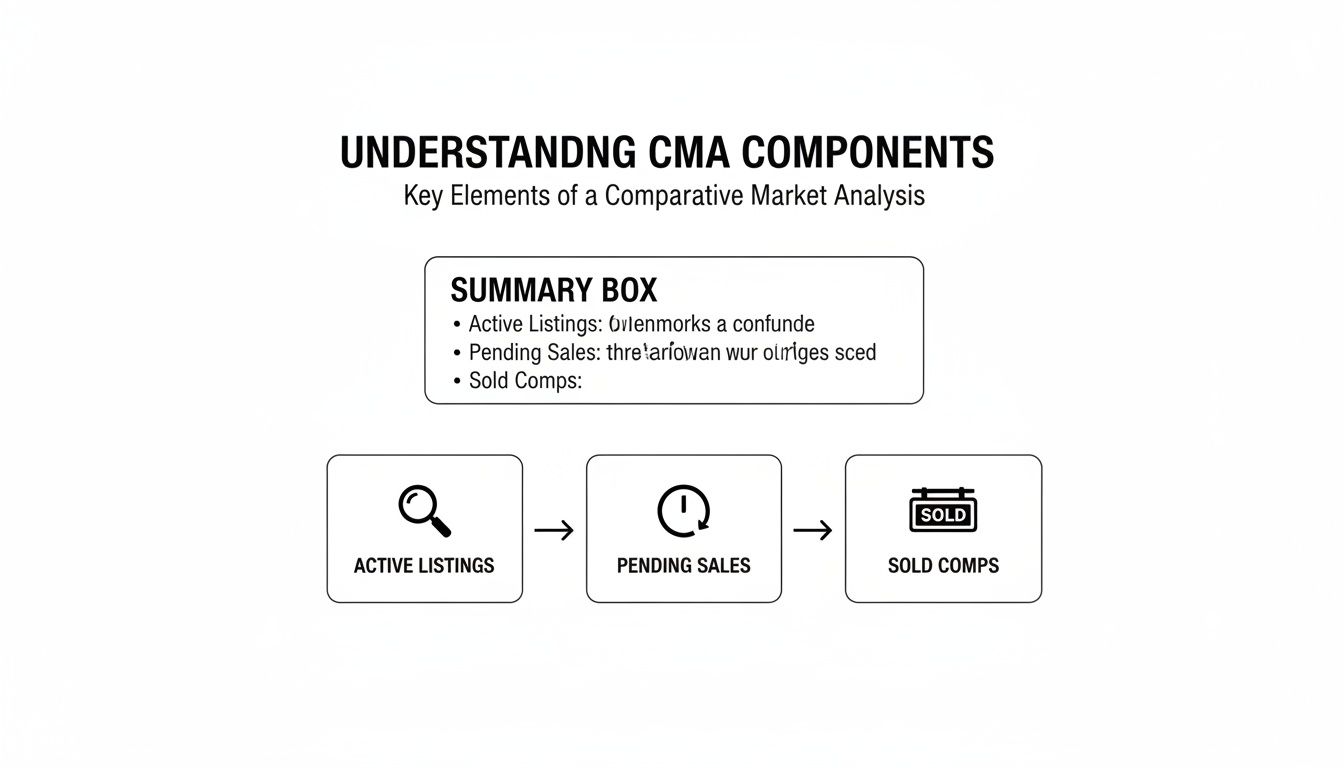
This 360-degree view gives your pricing strategy an edge that a more narrowly focused appraisal or BPO might miss.
To really nail down the differences, let's look at them side-by-side.
CMA vs Appraisal vs BPO
Here’s a direct comparison of the three most common property valuation reports, highlighting exactly what sets them apart.
| Feature | CMA (Comparative Market Analysis) | Appraisal | BPO (Broker Price Opinion) |
|---|---|---|---|
| Purpose | To set a listing price or make an offer | To determine value for mortgage lending | A quick valuation for banks (e.g., foreclosures) |
| Primary User | Real estate agents and their clients | Lenders and financial institutions | Banks, mortgage servicers, and investors |
| Methodology | Analysis of comps and market trends | Formal, regulated process with specific guidelines | Abbreviated version of a CMA, often exterior-only |
| Cost | Usually free from your agent | $400 - $700+ | $50 - $150 |
| Legal Weight | An informed opinion, not legally binding | A legally recognized valuation | An estimate, not legally binding for loans |
While they all aim to determine a property's value, their purpose, process, and final authority are worlds apart. Each one plays a critical role in the real estate ecosystem, but the CMA is the agent's indispensable tool for navigating the market with clients.
How Top Agents Use CMAs to Win More Business
For the best real estate agents, a Comparative Market Analysis isn't just a document for setting a price. It's their secret weapon for winning business. They take what could be a dry stack of data and turn it into a compelling story that builds trust, highlights their expertise, and ultimately, convinces a client to sign on the dotted line.
The game has changed. What used to be a clunky process with spreadsheets has become a sophisticated, data-driven necessity. A modern CMA pulls in "comps"—nearby homes that are similar in size, condition, and features—and makes smart adjustments to pinpoint a property's true market value.
The results speak for themselves. According to NAR research, homes priced with a CMA sell for 6% more than the market average. It’s no wonder that 73% of top agents call it their single most important tool for securing a new listing. You can dig deeper into these numbers at Synder.com.
Using a CMA this way immediately reframes your role. You're not just a salesperson; you're a market advisor they can trust from the very first handshake.

Winning Over Sellers with Data-Driven Confidence
When you sit down with a potential seller, the CMA is your proof. A sharp, well-explained report doesn't just suggest a price—it validates your entire plan for getting their home sold.
Instead of just dropping a number on them, top agents walk clients through the why. They use the CMA to:
- Build Instant Credibility: You're not guessing. By showing sellers the hard data behind your price, you prove your approach is methodical and professional.
- Manage Expectations: The report gives them a realistic snapshot of the current market, grounding them in reality and helping them avoid the classic mistake of overpricing.
- Justify Your Strategy: If a seller pushes back on the price, you have all the ammo you need. You can point directly to recently sold homes, active competitors, and even expired listings to show them why your number is the right one.
A great CMA presentation answers a seller's biggest questions before they even ask them. It sends a clear message: "I've done my homework, I know this market inside and out, and here’s the proof that our strategy will work."
Of course, a CMA is just one piece of the puzzle. The most successful agents also amplify their reach with smart social media marketing strategies for real estate agents, turning these market insights into content that attracts new clients.
Empowering Buyers to Make Winning Offers
Don't forget buyers! The CMA is just as crucial on the purchasing side, giving your clients the confidence to make a strong offer and backing it up during negotiations.
When you hand a buyer a CMA, you’re giving them leverage. Here’s how it helps:
- Validate an Offer Price: Buyers are often terrified of overpaying. Showing them that their offer is right in line with recent sales gives them the confidence to pull the trigger.
- Strengthen Negotiations: Is a property listed too high? A CMA provides the objective, undeniable evidence you need to justify a lower offer. It turns the conversation from emotion to facts.
- Build Long-Term Trust: By using data to protect your buyer’s investment, you do more than close a deal. You earn their loyalty and a steady stream of future referrals.
At the end of the day, whether you're working with a seller or a buyer, the CMA is your chance to prove your value and lock in their business for good.
Creating Accurate CMAs in Seconds with Modern Tools

Let's be honest—the old-school way of building a CMA is a grind. It involves hours spent digging through the MLS, cross-referencing county records, and painstakingly copying property details into a spreadsheet. This kind of data entry isn't just tedious; it's a huge time-drain that pulls you away from what you do best: working with clients.
That manual process can become a real bottleneck. When you're competing for a hot listing, the agent who shows up first with a professional, data-backed analysis often gets the signature. If your workflow is slow and clunky, you’re already behind.
The Shift to Automated Efficiency
This is where today's AI-powered platforms have completely changed the game. These tools tap directly into live market data from millions of properties, automating all the heavy lifting of building a CMA report. Instead of you hunting for comps, the system finds them for you.
What used to burn up an entire afternoon can now be done in less than a minute. This incredible speed means you can respond to a new lead almost instantly, showing up with a polished, data-rich report ready to go.
This isn't about replacing an agent's expertise; it's about amplifying it. By automating the data grunt work, you free yourself up to focus on strategy, negotiation, and building the client relationships that truly matter.
This efficiency is a massive competitive advantage. Imagine being able to deliver a comprehensive analysis during the initial phone call. You immediately establish yourself as a prepared, responsive professional from the very first conversation. Exploring different options for real estate CMA software is the first step toward finding a tool that fits your workflow.
By embracing these modern tools, you can:
- Generate Instant Reports: Turn a task that takes hours into one that takes seconds.
- Access Live Data: Pull the most up-to-date comps from a massive, constantly refreshing database.
- Create Polished Presentations: Instantly produce client-ready reports that look sharp and are easy to digest.
This combination of speed and accuracy helps you win more listings and serve your clients better, all without getting lost in the weeds of administrative work.
Your Top CMA Questions, Answered
Even after you get the hang of CMAs, certain questions pop up again and again. Getting these details right is what separates the pros from the rookies, and it’s how you build rock-solid trust with your clients. Let’s tackle the most common questions agents and homeowners ask.
How Recent Should Comparable Sales Be?
Think fresh. For a CMA to hold any weight, your comps should ideally be from the last 3 to 6 months. If you're in a hot market where prices are shifting week by week, you’ll want to tighten that up to the last 90 days.
Why? Because a sale from a year ago is ancient history in real estate terms. It doesn't reflect today's buyer demand, current inventory, or any economic shifts that have happened since. Stale data leads to a stale pricing strategy.
Can You Create a CMA for a Unique Property?
Absolutely, but this is where your expertise really comes into play. It’s more art than science when you’re dealing with a one-of-a-kind property, like a historic gem in a new subdivision or a home with an unusual layout.
You'll have to get a little more creative. This might mean:
- Widening your search radius to find similar homes in nearby towns.
- Going back a bit further in time if there are no recent sales to pull from.
- Making larger, more substantial adjustments for the features that make the property stand out.
The secret is to justify every single adjustment you make. Walk your client through your logic. This is your chance to demonstrate your deep market knowledge and prove you’re the right agent for the job.
Is a Higher Price Per Square Foot Always Better?
Nope, and this is a common trap. While price per square foot is a useful metric, it's rarely the whole story. In fact, looking at it in a vacuum can be incredibly misleading. For instance, smaller homes almost always have a higher price per square foot than larger ones.
Think about it: a gourmet kitchen or a stunning backyard view adds immense value that doesn't get captured in that single number. The quality of the finishes, the condition of the home, and curb appeal often matter far more. It's just one tool in your toolbox, not the master key.
How Often Should You Update a CMA?
If a home has been sitting on the market for more than 30 days, it’s time to run the numbers again. The market is constantly breathing—new listings come up, pending sales close, and prices on competing homes get adjusted.
A fresh CMA gives you the hard data you need to have a productive, strategy-focused conversation with your seller. It’s how you determine if a price adjustment or a new marketing angle is needed to get the property sold.
Stop wasting hours pulling comps and wrestling with spreadsheets. With Saleswise, you can create a stunning, accurate, and persuasive CMA report in less than 30 seconds. See why top agents are using it to win more listings—visit Saleswise.ai to start your trial.