How to Build Rapport With Clients in Real Estate
Building rapport is all about making a real connection with people, one built on trust and a solid understanding of what they need. For a real estate agent, this isn't just some nice-to-have "soft skill." It's the absolute bedrock of a successful career, turning single deals into a steady stream of repeat business and glowing referrals.
Why Client Rapport Is Your Greatest Asset
Let’s be honest: in real estate, deals come and go, but relationships are what stick. Closing the sale is the goal, of course, but the trust you build along the way is what truly sets you apart and gives you staying power in this business.
Your clients are making one of the biggest financial—and emotional—decisions of their lives. They’re not just looking for someone to open doors and file paperwork. They need a guide, an advisor they can count on who gets their hopes, fears, and goals.
This is exactly why mastering rapport is your biggest competitive advantage. It's what separates the agents who are just transactional from the ones who become trusted consultants for life. A strong connection makes clients feel heard and valued, not like just another lead in your CRM.

It’s More Than Just Being Friendly
Real rapport is much deeper than just pleasantries and small talk. It’s a powerful combination of demonstrating your expertise and showing genuine empathy. The whole idea behind relationship selling is centered on creating that deep, lasting trust, which is why it's so vital to get this right. When clients trust your knowledge and also feel you’re personally invested in their success, the entire process just flows better.
This foundation of trust has a direct, tangible impact on your business growth:
- It Fuels Your Referral Pipeline: Happy clients become your biggest fans. They can’t wait to tell friends, family, and coworkers about their great experience with you.
- It Drives Repeat Business: When it’s time to move again, you’ll be the first and only person they call.
- It Smooths Out Negotiations: Having a high-trust relationship makes those tough conversations about pricing, offers, and market conditions so much easier to navigate.
- It Creates Unshakeable Client Satisfaction: When clients feel you genuinely have their back, they’re far more likely to be thrilled with the outcome, even if the market throws a few curveballs.
Look at it this way: building rapport isn't just about closing this deal. It's about opening the door to every deal that comes after it by turning clients into true partners.
Making That First Call Count
You never get a second chance to make a first impression. In real estate, that first conversation—whether it's on the phone, over email, or face-to-face—sets the tone for the entire relationship. It's your moment to signal competence, confidence, and, most importantly, genuine interest.
Forget the generic, "How can I help you?" Your goal is to create an immediate connection. One of the subtle but powerful ways to do this is by focusing on your communication style. By mastering different tones of voice, you can make sure your message lands just right, shifting the dynamic from a sales pitch to a collaborative partnership from the get-go.
Ditch the Transactional Questions
Anyone can ask about bed and bath counts. The best agents dig deeper. You need to uncover the why behind their move with open-ended questions that show you care about their story, not just the commission check.
Try a few of these next time you're on a call:
- "So, what's prompting this move for you and your family right now?"
- "Tell me a bit about your current neighborhood. What do you love about it, and what are you hoping to find in a new one?"
- "If you could wave a magic wand, what would your perfect home look and feel like?"
Questions like these open the door to real conversation. They turn a sterile fact-finding mission into a meaningful dialogue, which is the fastest way to build rapport with someone you've just met.
Remember, clients aren't just buying a property; they're investing in a future. Your job is to understand that future and show them how you can help them get there.
Prove Your Value from the First Minute
A great conversation is a must, but talk is cheap if it isn't backed by real expertise. The single best way to establish your credibility instantly is to come prepared with data. Before you even pick up the phone, running a quick Comparative Market Analysis (CMA) gives you a massive head start.
Picture this: a potential seller calls you out of the blue. Instead of just booking an appointment, you take two minutes to run a CMA with a tool like Saleswise.
Now, you can say something like, "That's a fantastic area. I just pulled some quick numbers, and it looks like homes similar to yours have sold for an average of $X in the last 90 days. I'd love to stop by and put together a more detailed report for you."
This simple move accomplishes three things at once:
- It shows you're proactive: You didn't wait to be asked; you took the initiative.
- It grounds the conversation in facts: You immediately frame yourself as a data-driven expert.
- It delivers instant value: You've given them a tangible piece of information they can use right away.
This approach transforms that first call from a simple introduction into a powerful demonstration of what you bring to the table. You've already started working for them, proving you're the agent who delivers results, not just promises. This is how you build a foundation of trust that will last through the entire transaction.
Building Unshakeable Trust with Data
A great personality gets your foot in the door, but genuine, lasting trust? That’s built on expertise backed by cold, hard facts. This is the moment you transition from a friendly agent to an indispensable advisor for your clients.
When it comes to building real rapport, your most powerful tool isn't charisma—it's a well-crafted Comparative Market Analysis (CMA). Grounding your conversations in solid data is how you build confidence and show you’re the right person for the job.
This data-driven approach lets you tackle tough pricing questions head-on and, more importantly, calm a client’s nerves. When you can point to specific, recent sales and clear market trends, your pricing strategy isn't just your opinion; it’s a conclusion rooted in evidence. That kind of transparency is the bedrock of trust.
This diagram breaks down the core pillars that support that trust—it’s about moving beyond just being likable and proving your value with data, expertise, and clear communication.
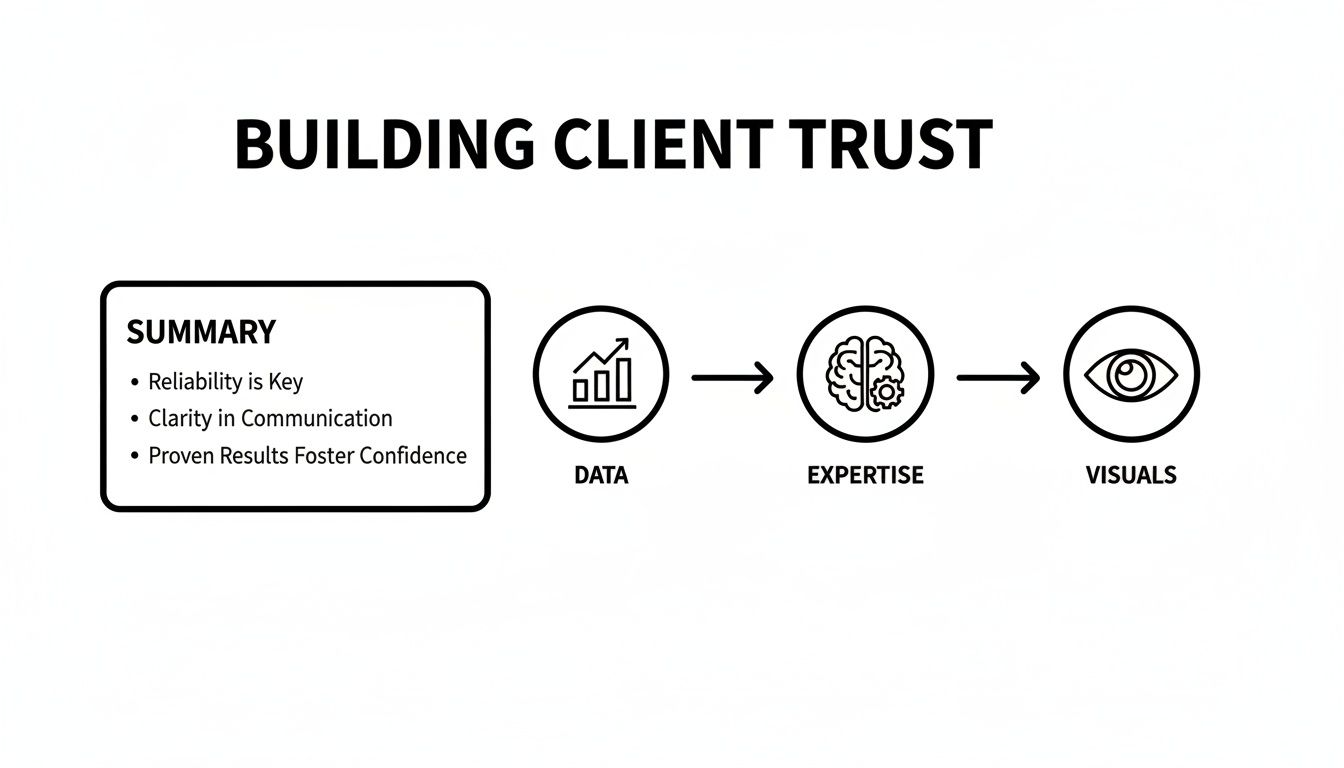
The takeaway here is simple: while your personality makes the introduction, tangible proof of your expertise is what truly solidifies a client's confidence that you can get them the best possible outcome.
From Small Talk to Smart Talk
Instead of just telling a client what their home is worth, you need to show them. Walk them through the "why" behind the numbers.
When you use a fast, accurate CMA from a tool like Saleswise, you can pivot the conversation from subjective feelings ("I feel my home is worth...") to objective market realities. This shows you respect their intelligence and understand how much is at stake for them.
Here are a few ways to frame that conversation:
- For Sellers: "Let's look at these three comparable homes that sold in the last 60 days, all within a half-mile of us. Based on their final prices, the market is pointing to a strong value right around $X. Now, let's compare their features directly to yours."
- For Buyers: "This property is listed at $Y, but my research shows that similar homes in this neighborhood have been closing at about 5% below asking. This data gives us a solid, defensible starting point for our offer."
This simple shift changes everything. You're no longer just a salesperson; you’re their market analyst and strategic partner.
To help you get there, we've put together a guide on how to do a comparative market analysis that dives deeper into these techniques.
The table below contrasts the old way of thinking with a modern, data-driven approach to building trust during a CMA presentation.
Rapport-Building Tactics Using a CMA
| Tactic | Traditional Approach (Less Effective) | Data-Driven Saleswise Approach (More Effective) |
|---|---|---|
| Pricing Discussion | "Based on my experience, I think we should list around..." | "The data from these 5 recent comps suggests a price range of..." |
| Handling Objections | "You have to trust me on this." | "That's a valid concern. Let's look at this sale on Elm Street..." |
| Showing Value | Talking about past successes and marketing plans. | Presenting a clear, visual CMA and a data-backed pricing strategy. |
| Buyer Strategy | "Let's put in an offer and see what happens." | "Homes here are selling for 98% of list. Let's craft our offer based on that." |
As you can see, leading with objective data elevates the conversation and positions you as a credible, strategic advisor from the very beginning.
Setting Realistic Expectations From Day One
One of the biggest sources of friction in any agent-client relationship is a mismatch in expectations, especially around price. A data-first strategy helps you get out in front of this by establishing a realistic baseline from your very first meeting.
It’s about taking the emotion out of it by grounding the entire process in logic.
By leading with data, you’re not just managing expectations; you’re co-creating a strategy with your client. They feel empowered and included, which is essential for building a strong, collaborative partnership that can weather any market shifts.
This level of expertise is exactly why referrals and repeat business are the lifeblood of a successful real estate career. According to the 2023 Profile of Home Buyers and Sellers, a staggering 66% of sellers either found their agent through a referral or used an agent they had worked with before. It’s proof that building trust and demonstrating undeniable value is what fuels your future business.
Using Visuals to Cement Your Expertise
Data isn't just about spreadsheets and numbers on a page. It's about helping clients see the potential.
This is where a tool like AI-powered virtual staging becomes a game-changer for building rapport. Let’s say a seller is worried their home’s outdated decor will drag down its value. Numbers alone might not be enough to reassure them.
Imagine being able to say, "I completely understand your concern about the dated kitchen." Then, right there on your tablet, you show them a virtually staged image of their exact kitchen but with modern cabinets, new countertops, and updated fixtures.
That visual proof does more than just sell a feature; it sells your vision and your proactive problem-solving skills. It cements your role as a trusted, resourceful advisor who has the tools and foresight to get them top dollar.
Keep the Momentum Going with Strategic Follow-Ups
Building genuine rapport doesn't happen in a single meeting. It’s a marathon, not a sprint, and the real work begins after you’ve had that first great conversation. Those quiet moments between calls and emails are where deals are won or lost. A thoughtful follow-up strategy is what separates the agents who get the listing from the ones who get ghosted.
The absolute key is to banish the dreaded "just checking in" email from your vocabulary forever. That phrase offers zero value. Instead, treat every single touchpoint as a chance to reinforce your expertise and show you’re already working for them. This simple shift turns your follow-up from an annoying reminder into a welcome update.
Move Beyond the Generic Check-In
Let's be real: your clients are busy people with overflowing inboxes. To cut through the noise, every follow-up needs a clear purpose that directly benefits them. This approach not only respects their time but also keeps the conversation moving forward in a meaningful way.
Think of each interaction as laying another brick in the foundation of trust. Don't ask them if they've made a decision yet. Give them new information that helps them make a better one.
Here are a few value-packed reasons to get back in touch:
- A Fresh Comp: "Hi [Client Name], a property just sold down the street that I thought you’d want to see. It closed at $X, which is a fantastic new data point for our pricing strategy."
- A Quick Market Pulse: "Morning [Client Name], I just dug into this week's market numbers. Inventory dipped another 3%, which could create some urgency for buyers. I can walk you through what that means for your sale when you have a minute."
- A Helpful Visual: "I was thinking about our chat and used an AI tool to mock up a virtual renovation of that kitchen you were on the fence about. Check it out—it really changes the feel of the space!"
See the difference? Each of these examples delivers something tangible. You're not just pestering them; you're actively providing insights and solutions, cementing your role as their go-to expert.
Crafting the Perfect Follow-Up
The way you say something is just as critical as what you say. Your tone should be professional but warm, brief but packed with information. The goal is to sound like a helpful, seasoned pro, not a robot spitting out CRM tasks. If you're looking for more ways to structure these messages, our guide on how to follow up with leads effectively has some great ideas.
Here’s a simple, effective email template you can tweak. Notice how it leads with value and ends with a clear, no-pressure call to action.
Subject: A quick update for [Client's Address/Target Neighborhood]
Hi [Client Name],
Hope you're having a great week.
I was just digging into the latest sales data and a new comp for your home just hit the records. It's the property at [Comp Address], and it sold for [Price] after just [Days on Market] days.
I've attached a one-page summary from my Saleswise report so you can see the details. This is another strong signal for the value we've been discussing.
Just wanted to keep you in the loop with the latest info. No need to act on this right away.
Best,
[Your Name]
This kind of proactive, data-backed communication is how you build unshakable trust. You're proving, time and again, that you're on top of the market and always have their best interests at heart. This patient, value-first approach ensures that when they're finally ready to pull the trigger, you're the only agent they'll even think about calling.
Using Visuals to Connect in a Digital World
In real estate, we build relationships everywhere—at open houses, over coffee, and definitely online. To really build rapport with clients these days, you have to meet them where they are. More often than not, that’s on social media, scrolling through their feeds. This isn’t just about posting another new listing; it's about telling a story that makes someone stop and imagine a future they want.
Your social media isn't just a digital billboard. Think of it as a way to show off your expertise and personality to hundreds of people at once. When you move past the standard, static photos of empty rooms, you can create content that actually stops the scroll and starts a real conversation. And honestly, the tools we have now give us a massive advantage.
Showcasing Potential Instantly
Picture this: a client is on the fence about a property because the living room feels a little dark and dated. Instead of just trying to tell them what it could be, you can show them. With AI-powered tools, you can virtually stage a room or even do a quick remodel in minutes.

This kind of visual storytelling is absolute gold for social media. You can create killer "before and after" posts or carousels that don't just sell a house—they sell a vision. This immediately frames you as a creative problem-solver who sees a property's true potential. If you want to go deeper on this, it's worth exploring the benefits of using real estate virtual staging software to really make your listings pop.
The goal is to make your social feed a source of inspiration and expertise. When followers see you consistently showcasing potential, they begin to trust your vision and see you as the go-to expert for what's possible in the market.
Crafting a Connection Through Content
Your content needs to be a solid mix of market smarts and your own personal brand. This is your chance to let your personality shine through, which is what makes you relatable and, more importantly, memorable.
Here are a few ideas that work:
- Highlight a "Fixer-Upper" Transformation: Post a picture of a dated kitchen. In the next slide, show an AI-generated remodel with sleek new cabinets and countertops. Ask your audience, "What would you do with this space?" to get the conversation going.
- Share a Quick Market Tip: Grab a key statistic about your local market and pair it with a clean graphic or a quick video of you explaining what it actually means for buyers or sellers right now.
- Tell a Client Story (with their permission, of course): Post a photo of a happy client at their new home and share a quick story about how you helped them overcome a hurdle, like seeing the amazing potential in a home that just needed a few cosmetic touches.
This strategy isn't just fluff; it flat-out works. Research shows that listings with videos can pull in 403% more leads. Agents who are really active on social media are generating 38% of their new clients from it.
Considering 89% of Realtors are already on Facebook and 59% are on Instagram, using dynamic visual tools is how you cut through the noise. It’s how you build the kind of rapport that turns a passive follower into a real, engaged lead.
Navigating Tricky Conversations: Your Rapport-Building FAQ
Let's be real. Even the best agents run into situations where building a connection feels like an uphill battle. It's one thing to have a strategy, but it's another to handle those specific, sometimes awkward moments with confidence.
Here are some of the most common questions I hear from agents about building real, lasting rapport and how to navigate them.
How Fast Is "Fast Enough" When Following Up with a New Lead?
In this business, speed is the name of the game. You should be reaching out within 5-10 minutes of a new lead hitting your inbox. No exceptions.
A quick response immediately tells a potential client that you're on top of your game, professional, and you value their time. This is how you start building trust from the very first second.
It doesn’t need to be an hour-long phone call, either. A simple, personalized text or a quick email can work wonders.
My Go-To Move: I often use an AI-generated script to fire off a well-crafted message right away. This lets me respond instantly without sounding rushed, which sets a fantastic tone for the entire relationship.
What Do I Do When a Client Pushes Back on My CMA?
First, don't panic. This isn't a confrontation; it's a golden opportunity to prove your value and deepen the relationship. When a client challenges your pricing, your job is to get curious, not defensive. The goal here is to understand where they're coming from and then gently guide them with the facts.
I find that opening the door to a real conversation works best. Try asking a few open-ended questions:
- "That's a really interesting point. Can you tell me what you've seen that's leading you to that number?"
- "I'd love to hear more about the features you believe add the most value to your home."
Once you understand their perspective, you can calmly walk them through your CMA. Explain why you chose specific comps and how they stack up. This is also where visuals can save the day. Showing them an AI-powered virtual staging of their home with a few minor updates can help them see a clear path to closing that value gap.
This approach shifts the dynamic from a disagreement to a partnership, where you're both working toward the same outcome.
How Can I Connect with a Client Who Barely Says Two Words?
We've all been there. For the quiet, analytical, or just plain busy client, rapport isn't built on small talk—it's built on competence and efficiency. Trying to force casual chatter will only make things uncomfortable for both of you.
The key is to mirror their style. Be direct, be concise, and let the data do the talking.
Instead of chit-chat, send them exactly what they need, without the fluff. Deliver a hyper-fast CMA from Saleswise, text them a relevant market stat, or email a new listing that's a perfect match. For this type of person, your ability to deliver concrete results without wasting their time is the most powerful way to build trust.
Ready to build unshakeable client trust with lightning-fast data and stunning visuals? Saleswise gives you the tools to create expert CMAs in 30 seconds, generate instant virtual staging, and craft perfect follow-up scripts. Start your $1 trial and see the difference at https://www.saleswise.ai.