How to Get Listings in Real Estate A Modern Agent's Playbook

In real estate, getting listings consistently comes down to a potent mix of proactive prospecting, precision pricing, and a persuasive presentation. The winning formula is simple on the surface: find motivated sellers, prove you're the market expert with solid data, and show them exactly how you'll highlight their home's best features to get it sold.
A Modern Blueprint for Winning More Listings
The bedrock of a lasting real estate career isn’t just about showing beautiful homes—it's about securing the inventory in the first place. Old-school methods like working your network or sending mailers still have their place, but today’s market moves too fast to rely on them alone. The agents who are really crushing it are the ones who blend timeless relationship skills with smart, efficient technology.
This guide isn't about high-level theory. It's a practical, step-by-step blueprint designed to help you build and scale your listing business, starting right now.
Why a Tech-Forward Strategy Isn't Optional Anymore
Sellers today have access to more information than ever before. They don't just want a friendly agent; they expect a data-savvy expert who can cut through the noise. This is where leaning into technology gives you a serious competitive edge.
Instead of burning hours manually pulling comps or fumbling with design software to create marketing flyers, you can use specialized tools to get it all done in minutes. This is a game-changer. It frees you up to spend your time on what actually makes you money: connecting with people and closing deals.
The point of technology isn't to replace your expertise—it's to amplify it. When you automate the tedious, repetitive tasks, you get back your time and mental energy for the high-impact, client-facing work that leads directly to signed listing agreements.
The Four Pillars of a Winning Listing Strategy
When you boil it all down, consistently securing listings means mastering four key areas. Get these right, and you'll build a repeatable system that keeps your pipeline full of seller clients.
Here’s a look at the core components of a modern, effective strategy.
| Pillar | Core Activity | Key Objective |
|---|---|---|
| Proactive Prospecting | Consistently engaging with potential sellers through multiple channels (sphere, FSBOs, expireds, farming). | To build a reliable pipeline of qualified seller leads and stay top-of-mind. |
| Precision Pricing | Creating fast, accurate, and data-backed Comparative Market Analyses (CMAs) to establish trust. | To justify your recommended list price and position yourself as the undeniable market expert. |
| Persuasive Presentations | Using high-quality visuals and marketing materials to showcase a property's potential and your value. | To help sellers envision a successful sale and confidently choose you as their agent. |
| Persistent Follow-up | Implementing structured outreach cadences to nurture leads over time without letting anyone fall through the cracks. | To convert long-term prospects into active clients by providing consistent value. |
Each pillar supports the others, creating a powerful flywheel for your business.
Getting the CMA right is especially crucial. With the National Association of Realtors forecasting a potential surge in home sales of up to 14% nationwide by 2026, the agents who can deliver sharp, immediate pricing data will be the ones sellers call first. Top producers know that a fast, accurate CMA builds more trust than a gut feeling ever could.
For a deeper look into finding motivated sellers, check out our complete guide on lead generation strategies for real estate agents.
If you want a steady stream of listings, you can't just wait for the phone to ring. Building a predictable business comes down to one thing: a smart, consistent prospecting plan. It's not about luck; it's about proactively connecting with potential sellers across different channels.
Relying solely on inbound leads is a recipe for a rollercoaster income. The real pros know that mastering the art of getting listings means having a repeatable workflow for the four goldmines of seller leads: your Sphere of Influence (SOI), For Sale By Owners (FSBOs), Expired Listings, and your Geographic Farm. Each one needs a slightly different touch, but the core idea is the same—show up, provide value, and be the agent they think of first.
This isn't about making a hundred cold calls a day and hoping something sticks. It's a journey, and prospecting is just the first, most critical step.
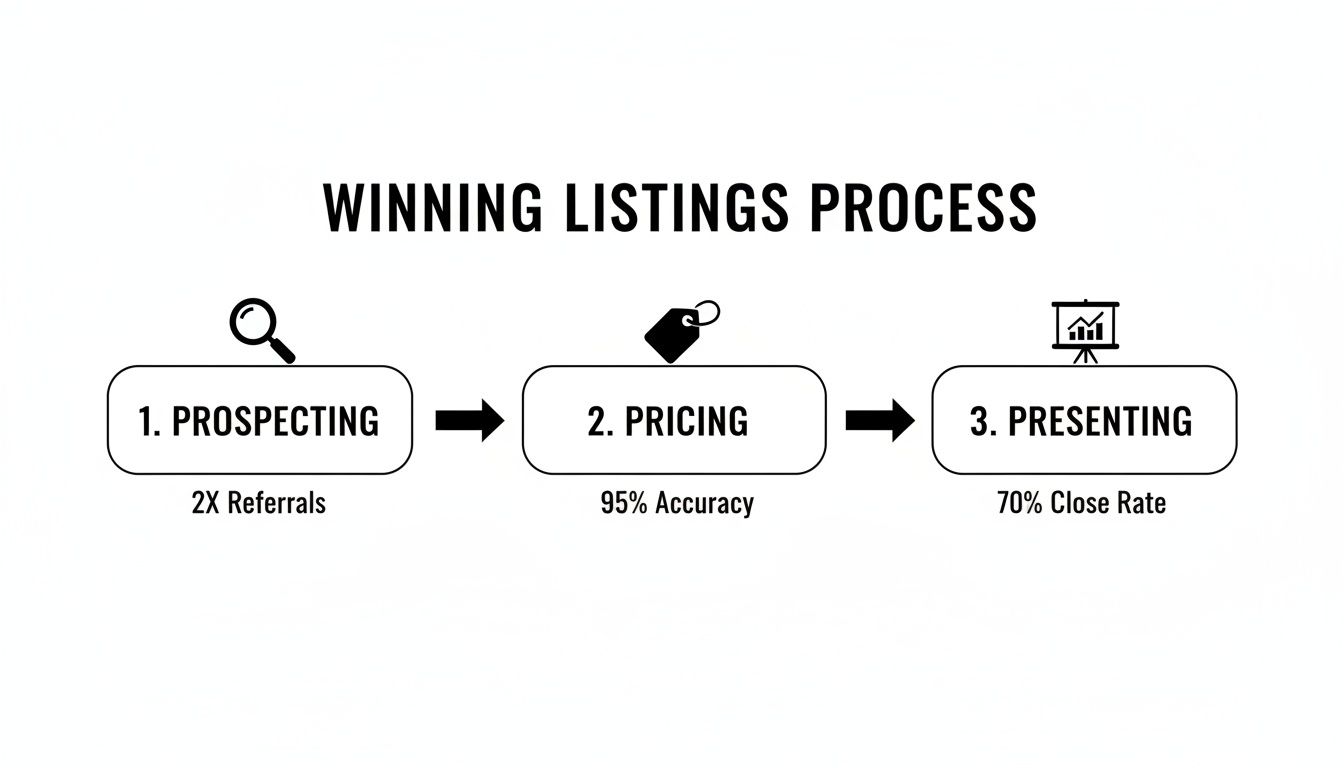
As you can see, everything flows from that initial outreach. When your prospecting is on point, you get the appointments you need to nail the pricing and deliver a presentation that closes the deal.
Tapping Into Your Sphere of Influence
Your most valuable asset isn't a fancy website; it's the people who already know, like, and trust you. Your Sphere of Influence (SOI)—think family, friends, past clients, your favorite barista—is a referral engine waiting to be activated. The goal here is simple: stay top-of-mind without being salesy.
It’s all about consistent, authentic connection. A simple cadence can work wonders:
- Quarterly Check-in: A real phone call or a personal text to see how they're doing. Don't start with real estate. Ask about their new puppy or that vacation they were planning.
- Monthly Market Update: Shoot them a quick, valuable email with local market stats. An AI content tool can help you draft a compelling summary that doesn't sound like a boring robot wrote it.
- Social Media Engagement: Interact with their posts. A genuine "Congrats on the promotion!" on LinkedIn goes a surprisingly long way.
This kind of low-pressure contact builds a protective moat around your relationships. When someone they know mentions buying or selling, your name will be the first one that comes to mind.
Winning Over For Sale By Owners
FSBOs have already raised their hand and said, "I want to sell!" The challenge? They're often wary of agents and are getting bombarded with calls. To cut through that noise, you have to lead with undeniable value, not a sales pitch.
Picture this: A FSBO has been on Zillow for three weeks, their phone is blowing up with lowball offers, and they're starting to feel overwhelmed. You don't call asking for the listing. You call with a solution.
A FSBO script that actually works: "Hi [Seller Name], I'm not calling to try and list your home. I saw it online and honestly, I respect you for selling it yourself. I know from talking to other homeowners that the hardest part is often figuring out the right price to attract serious buyers. I have a tool that runs a really detailed market analysis in about 30 seconds. Would you be open to me sending that over, no strings attached? It might give you a solid data point to work with."
This approach instantly changes the dynamic. You're not another salesperson; you're an expert offering to solve their biggest headache—pricing uncertainty.
Reviving Expired Listings
When a listing expires, the homeowner is usually frustrated, demoralized, and ticked off at their last agent. The last thing they want is another agent making the same old promises. Your first contact needs to be full of empathy while clearly showing you have a different, better plan.
Here’s a multi-touch cadence that gets results with expireds:
- Day 1 (Morning): Pick up the phone. Start by acknowledging their frustration. Then, immediately pivot to offering a fresh take on why their home didn't sell, backed by some data you’ve already pulled.
- Day 2 (Afternoon): Send a personalized email. A tool like Saleswise's AI content generator can help you draft a compelling message that outlines the specific, modern marketing strategies you’d use, like AI-powered virtual staging to make their empty rooms pop online.
- Day 5: Follow up with a simple text. Offer a quick, 15-minute virtual coffee to walk them through a marketing plan that’s built for today’s market.
This structured approach shows you're a professional who has a real strategy, not just someone hoping to get lucky.
Dominating a Geographic Farm
Geographic farming is the long game. It's about planting seeds in a specific neighborhood and becoming the go-to expert there. You win by being relentlessly consistent and providing hyper-local value that the big portals can't touch.
Your farm strategy needs to hit from multiple angles, blending digital and old-school methods to build that critical name recognition.
- Monthly Newsletter: A high-quality print or digital piece with recent sales, neighborhood trends, and maybe a spotlight on a local business.
- Just Listed/Just Sold Postcards: Never, ever skip this. Seeing your face on a "SOLD" sign in their neighbor's yard is incredibly powerful social proof.
- Community Involvement: Sponsor the local little league team. Host a "dumpster day" or a pumpkin patch in the fall. Be a visible, helpful part of the community fabric.
Pulling all of this off requires organization. To manage these different channels and make sure no lead ever gets lost, you need a solid system. Finding the best CRM for real estate agents is crucial for turning these scattered efforts into a well-oiled machine that consistently churns out listings. A good CRM will help you track every conversation, automate follow-ups, and keep your prospecting on track.
Justify Your Price with a Lightning-Fast CMA
The pricing conversation is the make-or-break moment of any listing appointment. This is where you either cement your role as the trusted market expert or plant a seed of doubt that costs you the entire deal. For agents looking to consistently secure new listings, absolutely nailing this part of the process is non-negotiable.

Let's be honest, the old way of building a Comparative Market Analysis (CMA) is a total grind. It means hours spent glued to the MLS, trying to find decent comps, manually adjusting for every little feature, and then fumbling with spreadsheets to make it all look presentable. By the time it's done, you’ve burned half a day you could have spent talking to actual clients.
Thankfully, technology has finally caught up. Instead of taking all afternoon, you can now pull a comprehensive, hyper-accurate CMA in about 30 seconds. This isn’t just about speed; it's about walking into every seller meeting armed with undeniable data that immediately positions you as the go-to authority.
Turn Data Points into a Clear Pricing Story
A powerful CMA is so much more than a list of addresses and sale prices. It tells a compelling story about where the market is today and how the seller's home fits perfectly into that picture. Your job is to be the storyteller, translating those numbers into a clear, logical argument for your recommended price.
When you present your findings, break the comparables down into three simple categories:
- Active Listings: This is your direct competition. These homes show the seller exactly what buyers are looking at right now and the price tags they're up against.
- Pending Sales: These are gold. Pending sales represent the most current prices that real buyers were willing to pay for similar homes in today's market.
- Sold Properties: This is the foundation. These sales from the last 3 to 6 months provide the historical proof of value that an appraiser is going to rely on.
One of the biggest mistakes agents make is getting bogged down in the raw data. Don't just read the numbers—explain what they mean. Walk the seller through why one comp is a better match than another based on its condition, location, or recent updates. This educational approach builds incredible trust and makes your pricing recommendation feel like a collaborative conclusion, not a command.
Field Common Seller Objections with Data
Every seasoned agent has been there. "But the Zestimate said my house is worth more!" or "My neighbor got $50,000 more for their place down the street!" These objections are a natural part of the process, and they're easy to navigate when you have the right data at your fingertips.
Instead of getting defensive, treat these moments as an opportunity to shine and reinforce your expertise. A calm, data-backed response is always your best bet.
Your Expert Response: "That's a great point, and I'm glad you brought it up. Let's pull up that property in the report together. It looks like it sold four months ago when the market was a bit hotter, and it also had a brand-new kitchen. On the other hand, your home has a much larger backyard, which is a huge draw for buyers, and I've factored that advantage in right here."
This kind of response works wonders. It validates their concern, uses specific data points (market timing, property features) to explain the discrepancy, and smoothly pivots back to the unique strengths of their own home. You aren't telling them they're wrong; you're showing them the why behind the numbers.
Explain Market Dynamics in Simple Terms
Throwing around jargon like "market absorption rate" can make a seller's eyes glaze over. Your ability to simplify these complex ideas is what truly demonstrates mastery. Forget the economics lecture; a simple analogy works far better.
Think of it like supply and demand at a farmer's market.
- Low Absorption Rate (Buyer's Market): "Right now, there are more homes for sale than there are active buyers. It's like having too many apples at the market—sellers might have to lower their prices a bit to stand out and attract a buyer."
- High Absorption Rate (Seller's Market): "We're seeing very few homes for sale and a ton of buyers looking. That scarcity creates competition and naturally drives prices up."
When you frame it this way, you demystify the market and empower the seller to make a confident decision with you as their guide. They start to see you not just as a salesperson, but as a trusted advisor who can navigate any market condition. For agents ready to perfect this part of their process, exploring the best CMA software for realtors is a great next step to see what modern tools can really do.
Crafting Irresistible Listing Presentations That Convert
You’ve landed the appointment. Now comes the moment of truth: the listing presentation. This isn't just a casual chat over coffee; it's your audition. You're there to prove you have the marketing chops, the local expertise, and the right strategy to get their home sold for top dollar. A great presentation isn't about dumping data on them—it's about painting a clear, compelling picture of a successful sale with you at the helm.

The secret is walking in the door completely prepared with materials that don't just inform, but inspire confidence. I’m talking about having a stunning, story-driven listing description already drafted and a pre-launch social media plan ready to create buzz from day one.
The Power of Storytelling in Your Marketing
Every single home has a story. Your job is to uncover it and tell it in a way that makes buyers feel an immediate connection. A boring list of features—"3 bed, 2 bath, granite counters"—is forgettable. You have to go deeper and help buyers imagine the life they could build within those walls.
This is where you can get a serious leg up. Instead of wrestling with a blank page, an AI content generator can instantly spin up beautiful, evocative listing descriptions that truly sell a lifestyle.
Let's look at the difference. A standard description might say:
- "Spacious backyard with a large deck, perfect for entertaining."
An AI-enhanced description tells a story:
- "Step outside to your private backyard oasis. The expansive deck is ready for summer barbecues and evening conversations under the stars, offering the perfect backdrop for making memories with family and friends."
That subtle shift from a feature to an experience is what grabs a buyer's attention and, more importantly, impresses the heck out of a potential seller.
Show, Don’t Just Tell, with Powerful Visuals
I can't stress this enough: visualization is the most powerful tool in your listing presentation. Homeowners are often blind to their home's potential because they're so used to their own furniture, clutter, or dated decor. If you can show them what their home could look like, you’re not just an agent anymore—you’re a visionary.
This is where AI-powered virtual staging and room remodels become your secret weapon. Don't just suggest they paint the kitchen cabinets; show them exactly what it would look like.
Picture this: You're sitting with sellers in their dated 1990s kitchen, complete with honey oak cabinets. They're convinced no buyer will want it. You pull out your tablet and, in seconds, present an AI-generated image of their exact kitchen transformed with crisp white cabinets, sleek quartz countertops, and a modern backsplash.
That single action obliterates their biggest objection, builds massive excitement, and proves you have the tools to make their home shine in a crowded market.
The Undeniable Impact of Virtual Enhancements
Virtual staging and remodel visuals aren't just flashy tricks; they are powerhouse tactics for winning listings. As the market continues to shift, standing out is everything. In fact, properties that feature virtual staging sell 73% faster on average. This technology is quickly becoming an expectation, not a bonus.
Platforms like Saleswise can generate these AI-powered room remodels instantly, even suggesting popular styles based on live market data. To get a better sense of where the market is headed, check out CBRE's 2026 outlook. Agents who've made these visual tools a standard part of their presentation often see a huge jump in signed agreements because sellers can finally see their home's full potential.
Building a Complete Pre-Launch Marketing Kit
Walk into your presentation with a complete marketing plan that's ready to launch the second they sign. Having tangible examples of your work shows you're a prepared professional, not someone who's going to figure it out as they go.
Your pre-launch kit should include samples of:
- Professional Property Flyers: Clean, modern designs that you can generate in seconds.
- "Coming Soon" Social Media Posts: Eye-catching images and compelling captions designed to build anticipation on Instagram and Facebook.
- Targeted Email Blasts: A well-crafted email ready to go out to your database of potential buyers.
When a seller sees you have a full suite of high-quality marketing materials ready to deploy, it erases any doubt about your ability to execute. It demonstrates that you have a proven system for getting listings in real estate sold. This level of preparation is what separates the good agents from the great ones.
Automating Your Outreach to Nurture and Convert Seller Leads
Let's be honest: getting a "yes" on the first call is a unicorn. The real money in this business is made in the follow-up—that consistent, valuable contact that keeps your name at the top of a potential seller's list.
But who has the time to personally track and email every single lead you generate? This is where a smart outreach system becomes your secret weapon.
By setting up automated nurture sequences, you can stay in front of potential sellers for weeks or even months. You're essentially building a relationship on autopilot, making sure no opportunity ever slips through the cracks. It’s all about working smarter, not harder, to turn those "maybe later" conversations into signed listing agreements.
Building Your Automated Nurture Engine
The point of automation isn't to sound robotic; it's to deliver the right message at the right time, consistently and at scale. This means creating different email campaigns tailored to specific lead types. For example, a homeowner who's just starting to think about selling needs a much different message than a prospect you've already met with who is still on the fence.
AI-powered content is also a huge advantage here. With commercial real estate investment in the U.S. projected to climb 16% to $562 billion, you can bet the residential market will feel that momentum. You can get ahead of it by creating compelling emails, scripts, and social posts that truly connect.
Tools like Saleswise, which are trained on the communication styles of top-producing agents, can help you build an entire library of content that resonates with homeowners. In fact, agents using these AI tools often see 25-40% higher response rates because the material just feels more authentic and helpful.
Once you have a solid library of high-quality content, you can plug it into automated campaigns that send valuable information on a set schedule. This frees you up to do what you do best: meet with clients. To learn more about setting up these systems, check out our guide to real estate marketing automation.
A Simple 30-Day Nurture Campaign for a "Maybe Seller"
Imagine you meet a homeowner at an open house who says, "We're thinking of selling, but probably not for another six months." Instead of just a single follow-up call, you can add them to a simple, automated 30-day campaign.
Here’s a practical example of what that could look like:
- Day 1 (Immediate Follow-up): An email thanking them for the chat and including a no-pressure resource, like a guide to "5 Simple Updates That Boost Home Value."
- Day 7 (Market Snapshot): An automated email with a quick, hyper-local market update. "Hi [Name], just wanted to share that a home similar to yours on Maple Street just went under contract in 6 days. The market is moving fast!"
- Day 15 (Value-Add Content): An email that solves a common seller problem. Think something like, "The Ultimate Decluttering Checklist for a Stress-Free Sale."
- Day 30 (Soft Call to Action): A friendly check-in email to reopen the conversation. "Hi [Name], hope you're doing well. Have you had any more thoughts about your moving timeline? I'd be happy to run an updated home value report for you anytime."
This multi-touch approach ensures you’re consistently providing value, not just asking for their business. By the time they're ready to make a move, you’re the only agent they’ll think of calling.
If you’re managing a high volume of leads, even one missed call can be a lost listing. To make your automated system even more powerful, see how a dedicated real estate answering service can handle incoming calls and book appointments for you, ensuring you never miss an opportunity.
A Few Common Questions About Getting Listings
If you're an agent focused on building your listing inventory, you've probably run into some of these common roadblocks. Let's tackle the questions I hear most often and give you some straight-up, actionable advice to get ahead of the competition.
What's the Absolute Fastest Way to Land a Listing?
Look, there's no silver bullet, but if you want speed, you need to go where the motivation is. That means targeting For Sale By Owners (FSBOs) and Expired Listings. These sellers have already raised their hands and said, "I want to sell my house."
The trick is how you approach them. Don't be the tenth agent to call with the same old script. You need to lead with immediate, undeniable value. Offer them a free, no-strings-attached, incredibly fast CMA. When you use an AI tool to do this, you're not just offering an opinion; you're giving them hard data they need, right now. This simple shift changes the entire dynamic—you're no longer a salesperson, you're a helpful expert. It's the best way I know to cut through the noise from that very first conversation.
How Can I Possibly Compete with Top Producers and Vets in My Market?
You compete by being smarter, faster, and better prepared. Many veteran agents are comfortable, often relying on old-school methods that just can't keep up anymore. This is your opening. Your advantage is using modern tools to outmaneuver them.
Here's how you can stand out:
- Speed: While they're pulling comps and crunching numbers for an hour, you can create a more accurate and visually stunning CMA in about 30 seconds.
- Visuals: You can instantly generate professional marketing materials, including AI-powered virtual staging that makes a property pop.
- Confidence: Ever feel nervous on a call? Use AI-generated scripts and emails that have been trained on what top producers actually say. You'll sound like a pro from day one.
When you show up with a data-driven, efficient, and visually compelling presentation, you're not just competing—you're often outclassing the agent who's just leaning on their years in the business.
The new agent's edge isn't a huge database of contacts; it's the hustle to adopt technology that makes the whole process smoother, delivers marketing that wows sellers, and creates a better client experience from the get-go.
How Many People Do I Really Need to Talk to Every Day?
The number can feel all over the place, but a solid benchmark that’s stood the test of time is the "20-5-1" rule. The idea is to have 20 meaningful conversations a day. Out of those, you should be able to identify 5 qualified leads, which ultimately leads to booking 1 solid appointment.
The most important part of that rule is "meaningful conversations." This isn't about speed-dialing until your fingers go numb. It's about quality. When your systems are tight—you've got your scripts, email templates, and value-adds like an instant CMA ready—your 20 calls can be more effective than another agent's 50 generic ones. Focus on making every interaction count.
Ready to create lightning-fast CMAs and win more listings? Saleswise gives you the AI-powered tools you need, from instant market analysis to virtual staging and compelling marketing content. Start your $1 trial and see the difference.